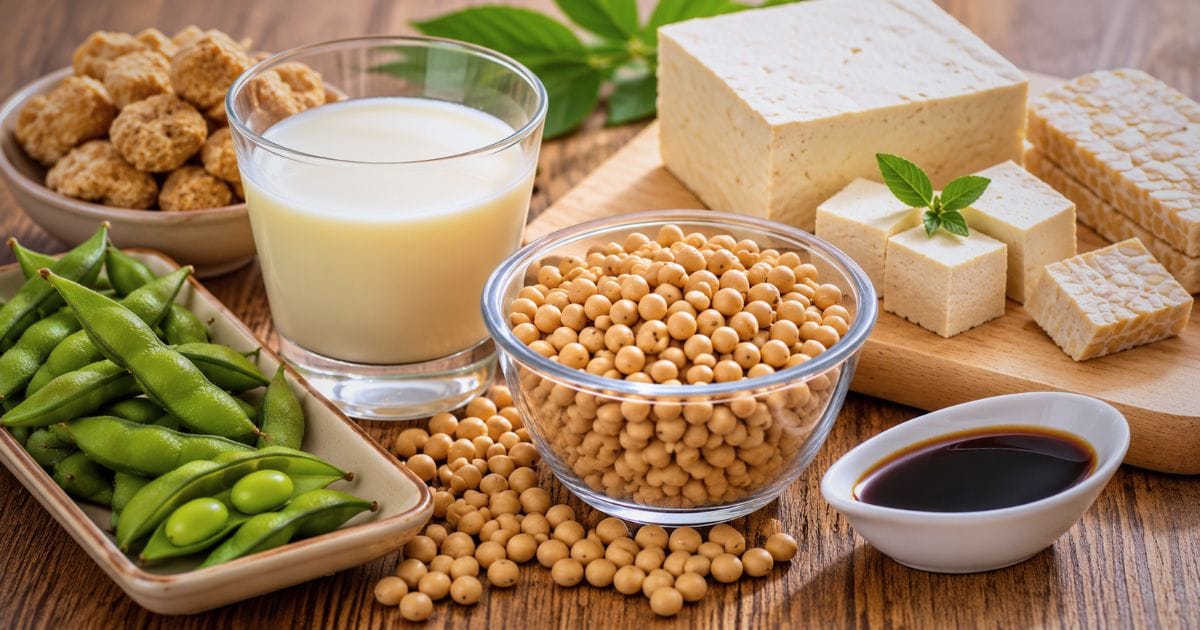
English named the soybean after a sauce. The word "soy" arrived in the 1670s through the Dutch soja, from the way Japanese speakers in Satsuma said shōyu, soy sauce. The Chinese characters behind it mean bean paste and oil. So the bean took its name from something made out of it, and that turns out to be much of the story of soy. Most of it never reaches a plate looking like a bean, and the first place to look for it is a chicken.
Most articles on soy weigh its health risks against its benefits. Those questions matter, and this article gives the short verdict on them, with links to the full answers. What gets less attention is where the bean goes, who pays to study it, and its environmental impact on the land. That's where the soy dilemma sits.
Three-quarters goes to animals
About three-quarters of the world's soybeans are fed to livestock. A dry soybean is about 36% protein and 20% fat, and the usual route is to crush it. The beans are cracked, heated, rolled into flakes and washed with hexane, a solvent that pulls the oil out, and what's left is soybean meal, a cheap, protein-rich feed. That meal is commonly fed to pigs, broiler chickens and laying hens, and cattle in feedlots get soy along with grain.
Brazil and the United States grow two-thirds of the world's crop between them, and China alone buys more than 60% of the beans sold abroad. The growth since the 1980s has come largely from the demand for meat. If you eat meat, as this site recommends, that's worth knowing. A great deal of the world's soy ends up in a chicken in a shed.
The oil and the rest
Crushing gives oil as well as meal, and the oil then goes through refining, whose deodorising step can add a little trans fat. Soybean oil is the second most consumed vegetable oil in the world, and about half of it is linoleic acid, the omega-6 fat at the centre of the seed-oil question. Where Seed Oils Hide, Even in the Foods Sold Without Them found soybean oil in bottles labelled "pure" olive oil. For frying, the job soybean oil gets sold for, an animal fat such as does the job.
The oil gives up one more product on the way. Lecithin, an emulsifier that takes its name from the Greek lekithos, egg yolk, smooths textures in packaged food and, in cooking sprays, keeps food from sticking to the pan, and soybean oil is now a major source of it. The protein, meanwhile, is concentrated into soy protein isolate, used in protein shakes, meat-free burgers and soy formula for babies. Read enough labels and soy turns up as oil, lecithin, isolate or "vegetable protein" in places that never mention a bean. For a crop grown by the hundreds of millions of tonnes, soy is remarkably good at hiding.
The car made of beans
Before soy disappeared into packaged food, Detroit tried to build a car out of it. In August 1941, Henry Ford showed off the "soybean car", with a body made of plastic from soybeans and other crops. With the help of the inventor George Washington Carver, his engineers got the weight down from about 1,130 kg for a typical car to 860 kg. Ford talked of growing cars from the soil and planted over 4,900 hectares of soybeans to experiment with. The war stopped car production, the prototype was later destroyed, and its exact recipe is still argued over.
The car never went anywhere, but the idea did. Ford saw the soybean the way the industry still sees it: a raw material to be split into parts. Some of the oil now ends up in the fuel tank instead, as biodiesel, and Brazil makes most of its biodiesel from soybean oil.
From feed to food
Outside East Asia, the soybean was long a farm feed. It only crossed over into human food after the chemists Lafayette Mendel and Thomas Osborne showed that cooking, moisture and heat raised its food value. Raw soybeans contain trypsin inhibitors, compounds that stop the enzymes that break protein down. It also carries phytate, which latches on to calcium, iron and zinc and keeps them from being absorbed, and soaking, sprouting and fermenting are the ways to bring it down. How much boiling removes, and why the fermented forms digest more easily, is in Is Plant Protein as Good as Meat?.
East Asia worked that out long ago. Soy was domesticated in north-central China between 6,000 and 9,000 years ago, and soy sauce in something like its present form dates back about 2,200 years, to the Western Han dynasty. It began as a way to stretch salt, which was expensive. In the 7th century, Buddhists coming from China brought soy foods to Japan, among them the sauce that later gave soy its English name. The old forms, the sauce and the bean pastes, were fermented. Tofu is the exception. Legend credits a Han prince, Liu An, with curdling soy milk and pressing the curds, much as cheese is made, though tofu only became an everyday food in China about a thousand years later, under the Song dynasty. Which Fermented Foods Are Still Alive When You Eat Them? tells natto's own story.
What the usual claims get wrong
Two claims that turn up in articles on soy don't survive a check. The first is that soy isn't a complete protein. It is. Whole soybean scores near the top of the scale used to rate protein quality, as shown in Is Plant Protein as Good as Meat?, even if it builds muscle less well than several animal proteins. Its weak spot is the sulphur pair, methionine and cysteine, which beans run short of. In rat tests, soy protein only matched casein, a milk protein, once methionine was added, though young rats need more of these than people do. The second, that soy strips the soil, gets it backwards. Like other legumes, it carries bacteria in its roots that pull nitrogen out of the air and put it into the ground.
Other worries stand. Soy's isoflavones are plant compounds that latch on to oestrogen receptors in the body, and the isolate holds the most. Babies on soy formula take them in every day, and in Canada, New Zealand and elsewhere there is public concern over the high levels of plant oestrogens in soy formula and what they may do to a baby's thyroid. Soy can also interfere with levothyroxine, the thyroid hormone tablet. Plant Toxins: Why Vegetables Fight Back When You Eat Them explains both, along with soy's lectins.
Who pays for the research
US soybeans carry a compulsory levy set by Congress, the soybean checkoff. The money goes to the United Soybean Board, run by farmer-directors under the Department of Agriculture, to fund soy research and promotion. In 2014 it came to $109.1 million.
That doesn't make every soy study suspect. It does mean reading the funding line before the conclusion, and a 2021 pooled analysis on soy and men's hormones shows why. It gathered 41 sets of results and found that soy made no difference to testosterone, and the one grant listed for the work came from the United Soybean Board. The finding may still be right, but a study paid for by the industry it judges can't settle the question.
The land
Most soy is now genetically modified, and in 2023, 95% of US soybeans came from strains bred to tolerate several weedkillers. In the mid-1990s Monsanto brought out soybeans engineered to survive its glyphosate weedkiller, so the herbicide could be sprayed over the growing crop rather than only before planting. Glyphosate is systemic, which means it moves inside the plant, and when it's applied wrongly the residues can stay high enough to make a crop unfit for sale. The weeds caught up. No glyphosate-resistant weeds were known in the 1990s, and by 2014 they dominated the research on herbicide resistance, and the newer strains tolerate dicamba and glufosinate as well as glyphosate. In the United States, soy certified as organic can't be grown from genetically modified seed.
Then there's the ground it grows on. Rising demand for meat has pushed soy into the Amazon, and the Amazon Soy Moratorium was meant to stop that, until Brazil's competition regulator suspended it from January 2026. Soy still drives clearing indirectly, by taking over pasture that then moves into forest, and by spreading across the Cerrado, Brazil's vast savannah, which the moratorium doesn't cover. The men who turned the Cerrado into soy fields received the World Food Prize in 2006 for doing it.
The meat that doesn't need it
On a carnivore diet, soy never reaches the plate, but it can still reach you through the animals. If meat drives soy, the answer for anyone who eats meat first is to ask which meat. A pig in a barn and a broiler chicken in a shed live on grain and soybean meal, and so do feedlot cattle at the end. Pigs and chickens lay down the fat they eat, which is why chicken fat and lard carry the linoleic acid from their feed, as From Soap Factory to Frying Pan: How Seed Oils Got Here sets out. Grass-fed beef and lamb, raised on pasture, don't need soy at all. A cow on grass has never once asked for a protein shake. makes the case for that kind of meat, and for what grazing animals can do for the land. Grass isn't a free pass, though. Cattle ranching has driven Amazon clearing in its own right, so where the animal grazed matters as well as what it ate.
Eggs are the hard one, because laying hens are commonly fed soybean meal. Soy-free feed exists, so look for it on the box.
Should you avoid soy?
For an adult who eats a little tofu, soy milk or miso, nothing above gives cause for alarm. Cooking deals with most of the trypsin inhibitors. The concerns sit with the concentrated forms, the isolate and the formula.
Nobody needs it. Soy can be made safe to eat, as the sections above show, but meat, fish and eggs give you complete protein with nothing to cook out of them first, and without the isoflavones or the lectins.
Read the label for its other names. Soybean oil, soy lecithin and soy protein isolate are the usual ones. If you're allergic to soy, lecithin rarely carries enough soy protein to matter, though in the United States most lecithin products still have to declare it. The seed-oil article above has where the oil hides.
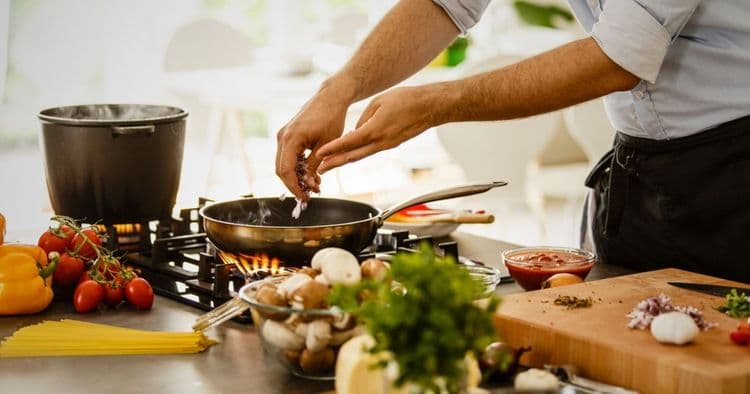
Cook with animal fat at home. That's this site's choice for the kitchen. Butter, ghee, lard and tallow take the place of the bottle of soybean oil, and of the "vegetable oil" that is often soybean oil under a general name.
If you eat it, keep it small, and favour the fermented forms. A little at a time, as soy sauce, miso or natto, rather than as shakes and burgers built from isolate. is a cookbook built on those old methods of soaking and fermenting.
Be careful with formula and thyroid tablets. If you're choosing a formula or take levothyroxine, let a qualified health professional weigh in on soy before you decide.
A splash of sauce
The word came from the sauce, and the sauce may be the best use the bean was ever put to. A few drops of something fermented, first made to stretch salt, is far from a field of herbicide-tolerant beans crushed for oil and feed. So the soy dilemma is less about the bean on your plate than about the ones you never see. Next time you shop, turn over three packets you buy every week, and the egg box, and look for soy by any of its names, and for what the hens were fed.
Wondering how soy compares with meat? Is Plant Protein as Good as Meat? — protein scores, trypsin inhibitors, and the fermented forms that digest better.
Curious what else plants carry? Plant Toxins: Why Vegetables Fight Back When You Eat Them — soy's oestrogens, the thyroid tablet, and the lectins in beans.
Know someone who thinks soy is a health food? Send them "The oil and the rest".
Tried something here, or got a question it didn't answer? Write to us at contact@allforlife.club. Your questions shape the next articles.
Disclaimer: This article is general information, not medical advice. If you take thyroid medicine, are choosing an infant formula, or have a soy allergy, talk to a qualified health professional.
Affiliate Disclosure: This article contains affiliate links. As an Amazon Associate, All For Life earns from qualifying purchases, at no extra cost to you. We only link to products we would recommend without the commission.
Sources
Wiktionary. soy. en.wiktionary.org
Wikipedia. Soybean. en.wikipedia.org
Wikipedia. Soybean meal. en.wikipedia.org
Wikipedia. Grass-fed beef. en.wikipedia.org
Wikipedia. Soybean oil. en.wikipedia.org
Wikipedia. Lecithin. en.wikipedia.org
Wikipedia. Soybean car. en.wikipedia.org
Wikipedia. Biodiesel. en.wikipedia.org
Wikipedia. Phytic acid. en.wikipedia.org
Wikipedia. Soy sauce. en.wikipedia.org
Wikipedia. Tofu. en.wikipedia.org
Wikipedia. Soy protein. en.wikipedia.org
Wikipedia. Infant formula. en.wikipedia.org
Wikipedia. United Soybean Board. en.wikipedia.org
Reed KE, Camargo J, Hamilton-Reeves J, et al. (2021). Neither soy nor isoflavone intake affects male reproductive hormones: An expanded and updated meta-analysis of clinical studies. Reproductive Toxicology 100:60–67. doi.org/10.1016/j.reprotox.2020.12.019
Wikipedia. Glyphosate. en.wikipedia.org
Wikipedia. Organic food. en.wikipedia.org
Wikipedia. Amazon Soy Moratorium. en.wikipedia.org
Wikipedia. Deforestation in Brazil. en.wikipedia.org