
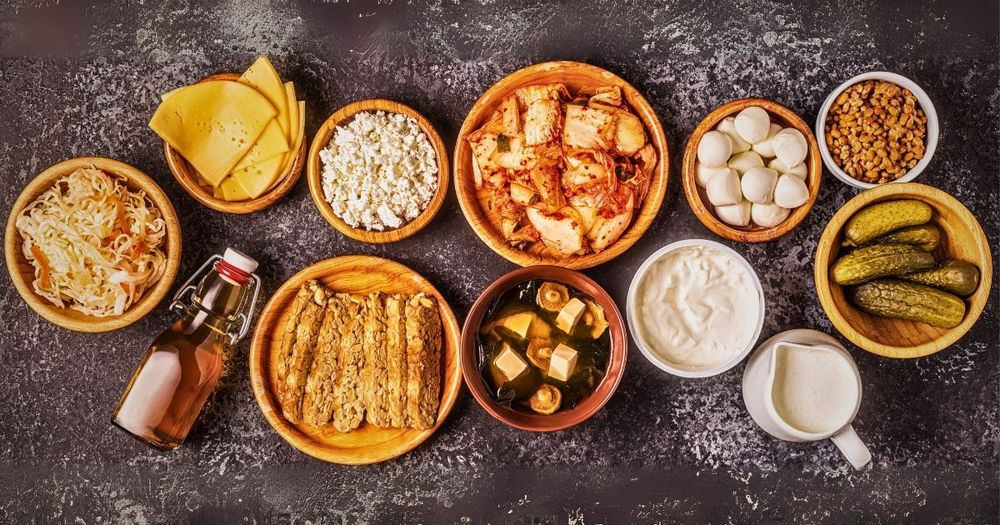
Captain Cook carried sauerkraut on his long Pacific voyages to keep scurvy off his ships. More than a century later, the Nobel Prize winner Élie Metchnikoff decided that Bulgarian peasants lived long because of their sour milk, and drank it every day for the rest of his life. His idea outlived him: it's the reason "probiotic" is printed on yoghurt pots today. The word itself is half Latin, half Greek, pro, for, and biōtikos, fit for life.
So do fermented foods help your gut? Some are, in a few specific ways, and a few carry risks the labels never mention. Yoghurt helps you digest milk only while its bacteria are alive, the jar of sauerkraut on an ordinary shelf has often been heated until nothing in it is alive, and the trendiest fermented drink has almost nothing behind it. Knowing which is which is worth more than any superfood list.
What fermentation does to food
Fermentation is food partly eaten by microbes before you get to it. Bacteria and yeasts feed on the sugars and turn them into acids, gases or alcohol. The acid keeps other microbes out, which is why sauerkraut lasted a whole winter, or a voyage, without a fridge.
Some of the oldest ferments are animal. Rome ran on garum, a sauce of fish guts left in salt until they turned to liquid. It was made in coastal factories from Spain to Tunisia, and jars of it turned up in the ruins of Pompeii, some of them a kosher version. Its descendants are the fish sauce in a Thai kitchen, made from fish and salt, and the original Worcestershire sauce, fermented with anchovies inside.
Salami is fermented too, soured by lactic acid bacteria before it dries. It's also processed meat, and The Everyday Food Scare That Turned Out to Be a Myth sizes that risk. Sour cream is cream soured by the same kind of bacteria.
Fermentation's head start changes the food. Milk is about 4.8 percent lactose. Cheddar, after months of ageing, is about 0.07 percent, because the bacteria have eaten nearly all of it. Fermentation also breaks down phytate, the compound in grains and beans that locks up zinc and iron, and some bacteria make vitamins along the way. Vitamin B12 is the exception people hope for. Tempeh and other fermented plant foods are an unreliable source, and the US Academy of Nutrition and Dietetics tells vegans to use fortified foods or supplements instead.
Natto, the sticky Japanese fermented soybean, is so rich in vitamin K2 that people who eat it often carry far more K2 in their blood, and the Japanese regions that eat the most natto have fewer hip fractures in women.
One story says natto began around 1086, when a samurai's troops were attacked while boiling soybeans for their horses, packed the beans into straw bags in a hurry, and opened them days later to find them fermented. They ate them anyway, liked them, and passed some to their commander.
None of that needs the bacteria to stay alive. The work is already done by the time the food reaches you.
Live or not: what's in the jar
A jar of fermented vegetables that keeps for months on an unchilled shelf has usually earned that shelf life with heat. Fermented foods are often heated after fermenting, which kills the bacteria to make the jar last longer, and this is where labels mislead.
Shelf-stable sauerkraut and kimchi are usually pasteurised. The live kind sits in the chilled section and says "raw", "unpasteurised" or "live cultures".
Pickles made with vinegar were never fermented at all. They are sour from the vinegar. Fermented pickles are made in salt water and sold chilled.
Sourdough bread is fermented, but baking kills the microbes. The fermentation still helps by breaking down phytate.
Yoghurt and kefir carry live cultures unless they've been heat-treated after fermenting, so check the label for "live" or "active" cultures. In the US, yoghurt heated after fermenting has to say "does not contain live and active cultures" on the pot.
Heat treatment matters. When yoghurt was pasteurised after fermenting, its live bacteria fell a hundredfold, and its help with digesting lactose disappeared.
Your own stove does the same job. Milk is pasteurised at about 72°C for 15 seconds, so a simmering soup or a hot pan finishes off live cultures too. Stir sauerkraut, kimchi or yoghurt in once the food is off the heat.
Do the bacteria survive your stomach?
Many die on the way. With nothing else in the stomach, the acid is strong, and in lab tests at that strength several common strains were nearly wiped out within 15 minutes. Food changes the picture. A meal buffers the acid for a while, and bacteria inside yoghurt or kefir, eaten with food, arrive better protected than a capsule swallowed with water. When healthy people ate ordinary yoghurt, its bacteria turned up alive in their stool.
Most of these bacteria are passing through. They do their work on the way, and the effect lasts as long as you keep eating them.
Capsules are a weaker bet than food. After a course of antibiotics, people who took probiotic capsules took longer to get their own gut bacteria back than people who took nothing. The exception is the course itself. Across 63 tests with nearly 12,000 people, a probiotic taken alongside antibiotics cut the chance of antibiotic diarrhoea by about two-fifths. Foods That Upset Your Gut: What's Real and What's Personal, linked below, has what else capsules miss.
What the evidence shows
The strongest result so far comes from 36 healthy adults split into two groups for ten weeks. One group raised its fermented food from almost none to about six servings a day, and the variety of its gut bacteria grew steadily while inflammation markers dropped. The other group added fibre instead, and on average its variety stayed where it was.
Dairy shows the most practical effect. For adults who struggle with lactose, yoghurt and kefir cut the gas from undigested lactose by about two-thirds compared with the same lactose in milk, and flatulence by more than half. The live bacteria bring their own lactase and keep it working in the gut. That's why the heat-treated yoghurt lost its help.
The mood claims run ahead of all this. The gut produces about 90 percent of the body's serotonin, a fact used to sell fermented foods as mood food, but the brain makes its own, and serotonin from the gut stays outside it.
Yoghurt has one official nod. In 2024 the FDA, the US food regulator, allowed yoghurt labels to claim that eating it regularly may lower type 2 diabetes risk, adding that the evidence is limited. The request came from Danone, the yoghurt maker.
The fermented foods worth eating
Kefir. A fermented milk made with kefir grains, a mix of bacteria and yeasts, so it carries a wider range of microbes than yoghurt. It's tart, drinkable and easy on lactose. People were buried with it 3,600 years ago, in Bronze Age graves at the Xiaohe Cemetery. A spoonful of live turns ordinary milk into kefir at home, batch after batch.
Plain full-fat yoghurt. The classic, as long as the label says live cultures. Flavoured versions are a different food. Fruit yoghurt carries about 19 grams of sugar per 100 grams, four times the 4.7 grams in plain whole-milk yoghurt, and strawberry kefir has twice the sugar of plain.
Sauerkraut and kimchi. Cabbage, good unrefined salt and time. Buy them raw from the chilled section or make them at home. They're low in carbohydrate, which makes them the vegetable ferment that fits a keto plate, as the side, not the foundation.
The cheapest live sauerkraut is the one you make, and How to Make Fermented Foods at Home has it step by step. A adds airlock lids and glass weights that keep the cabbage under its brine. For the craft behind it, Sandor Katz's covers vegetables, dairy and drinks.
A keto or carnivore plate already has room for most of these. Kefir, yoghurt and sauerkraut all fit, and so does the sour cream on your steak. Plain whole-milk yoghurt and plain kefir carry under 5 grams of carbohydrate per 100 grams, all of it the milk's own sugar, some of it already eaten by the bacteria.
When fermented foods cause trouble
Histamine. Fermentation produces histamine, and fermented foods are high in it. For people who break histamine down slowly, they can bring on headaches, flushing or a stuffy nose. Every low-histamine diet cuts fermented foods. Unexpected Causes of Your Headaches and How to Find Yours, linked below, has histamine among the clues.
Tyramine and some antidepressants. Aged cheese, cured meats and other fermented foods are rich in tyramine. On the older antidepressants called MAO inhibitors, tyramine can push blood pressure up dangerously. Check before mixing the two.
Natto and blood thinners. Natto is so rich in vitamin K that it can work against warfarin, the blood thinner, and a sudden change in how much vitamin K you eat can shift the drug's effect. Check before adding natto while you take it.
Cheese and casein. Ageing makes cheese nearly lactose-free, but it concentrates something else: casein. Casein makes up about 80 percent of the protein in cow's milk, it forms the curd while the whey drains away, and cheddar ends up about a quarter protein. With a milk-protein allergy, cheese is no safer than milk.
Cow's milk carries two forms of one casein, called A1 and A2. When 45 people in China drank both kinds in turn, in a test paid for by an A2 milk company, milk containing A1 caused more gut symptoms than milk with only A2, while Europe's food safety authority found no link between A1 milk and disease. Sheep's and goat's cheeses carry mostly the A2 kind. As cheese ages, its casein breaks down, and bacteria turn the freed building blocks into tyramine and histamine, which is why strong, old cheese tops both lists.
Pregnancy and listeria. Listeria is a bacterium that can cause miscarriage or stillbirth, and pregnancy makes catching it more likely. In dairy, the risk sits in anything made from unpasteurised milk, soft cheeses with a white rind such as brie and camembert, and soft blue cheeses, unless they're cooked until steaming hot. Pasteurised milk and yoghurt are on the NHS list of foods that are safe in pregnancy. Kefir is also slightly alcoholic, which is worth knowing while pregnant.
A weakened immune system. Live bacteria are a risk for a few groups: people with weakened immunity, premature babies, people with heart-valve disease or a long-term intravenous line, and the critically ill. In them, probiotic bacteria or yeasts can rarely reach the blood and cause a serious infection.
Salt. Salted, pickled vegetables went with 28 percent more stomach cancer in Japan and Korea, where they're eaten in large amounts. That risk comes from eating salty pickles in large amounts every day, a long way from a forkful of sauerkraut beside dinner.
Fermented fish and meat at home. These carry the most serious risk of all, botulism. In Canada, 85 percent of the 91 confirmed food-borne cases between 1985 and 2005 were in Inuit communities, after traditionally prepared fish and marine-mammal foods. Enough salt and acid are what keep it away.
Kombucha. The fizzy fermented tea has a health halo and little behind it. Human evidence of a benefit is thin to non-existent, and there are case reports of liver damage, dangerous acid build-up in the blood and one death. Bottled kombucha can also carry more alcohol than the label suggests. In 2010, some shops pulled it from the shelves over just that.
A spoonful at a time
Cook's sauerkraut had a real job, carrying some vitamin C through months at sea. Metchnikoff's sour milk promised more than any food can deliver. Fermented foods sit between the two: old foods that do a few useful things well. They predigest lactose, add vitamins, widen the range of bacteria in your gut while you eat them, and calm a few markers of inflammation. The live ones help most, and the label decides which ones you're buying.
Start with one. Have a glass of kefir between meals or a forkful of raw sauerkraut beside dinner, buy it from the chilled section, and keep it going for a few weeks. A jar that keeps for months on a warm shelf brings the flavour, and the chilled one brings the bacteria.
Wondering what else your gut bacteria live on? Foods That Upset Your Gut: What's Real and What's Personal — fibre, fermentable carbohydrates, and what probiotic capsules miss.
Get headaches after aged cheese or wine? Unexpected Causes of Your Headaches and How to Find Yours — histamine, timing and the other clues that point to a cause.
Know someone who buys kombucha for their gut? Send them this. A glass of live kefir has far more behind it.
Tried something here, or got a question it didn't answer? Write to us at contact@allforlife.club. Your questions shape the next articles.
Disclaimer: This article is general information. For advice about your own health, talk to a qualified health professional, especially if you are pregnant, have a weakened immune system or take antidepressants.
Affiliate Disclosure: This article contains affiliate links. As an Amazon Associate, All For Life earns from qualifying purchases, at no extra cost to you. We only link to products we would recommend without the commission.
Sources
Wikipedia. Sauerkraut. en.wikipedia.org
Wikipedia. Élie Metchnikoff. en.wikipedia.org
Wikipedia. Probiotic. en.wikipedia.org
Savaiano D, AbouElAnouar A, Smith D, Levitt M (1984). Lactose malabsorption from yogurt, pasteurized yogurt, sweet acidophilus milk, and cultured milk in lactase-deficient individuals. The American Journal of Clinical Nutrition 40(6):1219–1223. doi.org/10.1093/ajcn/40.6.1219
Lerebours E, N’Djitoyap Ndam C, Lavoine A, et al. (1989). Yogurt and fermented-then-pasteurized milk: effects of short-term and long-term ingestion on lactose absorption and mucosal lactase activity in lactase-deficient subjects. The American Journal of Clinical Nutrition 49(5):823–827. doi.org/10.1093/ajcn/49.5.823
Ernst E (2003). Kombucha: A Systematic Review of the Clinical Evidence. Complementary Medicine Research 10(2):85–87. doi.org/10.1159/000071667
Wikipedia. Garum. en.wikipedia.org
Wikipedia. Fish sauce. en.wikipedia.org
Wikipedia. Salami. en.wikipedia.org
Wikipedia. Sour cream. en.wikipedia.org
Wikipedia. Lactose intolerance. en.wikipedia.org
Wikipedia. Phytic acid. en.wikipedia.org
Wikipedia. Vitamin B12. en.wikipedia.org
Kaneki M, Hedges SJ, Hosoi T, et al. (2001). Japanese fermented soybean food as the major determinant of the large geographic difference in circulating levels of vitamin K2. Nutrition 17(4):315–321. doi.org/10.1016/s0899-9007(00)00554-2
Wikipedia. Natto. en.wikipedia.org
US Electronic Code of Federal Regulations. 21 CFR 131.200 Yogurt. ecfr.gov
Wikipedia. Pasteurization. en.wikipedia.org
Mainville I, Arcand Y, Farnworth ER (2005). A dynamic model that simulates the human upper gastrointestinal tract for the study of probiotics. International Journal of Food Microbiology 99(3):287–296. doi.org/10.1016/j.ijfoodmicro.2004.08.020
Elli M, Callegari ML, Ferrari S, et al. (2006). Survival of Yogurt Bacteria in the Human Gut. Applied and Environmental Microbiology 72(7):5113–5117. doi.org/10.1128/AEM.02950-05
Suez J, Zmora N, Zilberman-Schapira G, et al. (2018). Post-Antibiotic Gut Mucosal Microbiome Reconstitution Is Impaired by Probiotics and Improved by Autologous FMT. Cell 174(6):1406–1423.e16. doi.org/10.1016/j.cell.2018.08.047
Hempel S, Newberry SJ, Maher AR, et al. (2012). Probiotics for the prevention and treatment of antibiotic-associated diarrhea: a systematic review and meta-analysis. JAMA 307(18):1959–1969. doi.org/10.1001/jama.2012.3507
Wastyk HC, Fragiadakis GK, Perelman D, et al. (2021). Gut-microbiota-targeted diets modulate human immune status. Cell 184(16):4137–4153.e14. doi.org/10.1016/j.cell.2021.06.019
Hertzler SR, Clancy SM (2003). Kefir improves lactose digestion and tolerance in adults with lactose maldigestion. Journal of the American Dietetic Association 103(5):582–587. doi.org/10.1053/jada.2003.50111
Wikipedia. Serotonin. en.wikipedia.org
US Food and Drug Administration (2024). FDA Announces Qualified Health Claim for Yogurt and Reduced Risk of Type 2 Diabetes. fda.gov
Wikipedia. Kefir. en.wikipedia.org
US Department of Agriculture. FoodData Central. fdc.nal.usda.gov
Sánchez-Pérez S, Comas-Basté O, Veciana-Nogués MT, et al. (2021). Low-Histamine Diets: Is the Exclusion of Foods Justified by Their Histamine Content? Nutrients 13(5):1395. doi.org/10.3390/nu13051395
Wikipedia. Tyramine. en.wikipedia.org
Wikipedia. Casein. en.wikipedia.org
Wikipedia. Milk allergy. en.wikipedia.org
Jianqin S, Leiming X, Lu X, et al. (2016). Effects of milk containing only A2 beta casein versus milk containing both A1 and A2 beta casein proteins on gastrointestinal physiology, symptoms of discomfort, and cognitive behavior of people with self-reported intolerance to traditional cows’ milk. Nutrition Journal 15(1):35. doi.org/10.1186/s12937-016-0147-z
Wikipedia. A2 milk. en.wikipedia.org
Wikipedia. Listeriosis. en.wikipedia.org
NHS. Foods to avoid in pregnancy. nhs.uk
Kim HJ, Lim SY, Lee J, et al. (2010). Fresh and pickled vegetable consumption and gastric cancer in Japanese and Korean populations: A meta‐analysis of observational studies. Cancer Science 101(2):508–516. doi.org/10.1111/j.1349-7006.2009.01374.x
Wikipedia. Botulism. en.wikipedia.org
Wikipedia. Kombucha. en.wikipedia.org