
In 2009, Sense about Science, a British organisation, looked into products sold as "detox". It found the word meant something different to each company that used it. Most offered no evidence for what they claimed. And in most cases, "detox" turned out to be a new name for "mundane things, like cleaning or brushing". Brushing your teeth, it turns out, was a detox all along.
Your body already has a detox system, and it does not come in a box. Your liver and kidneys filter your blood and clear out what should not stay. They work every minute, free of charge, and they do not need a tea to help them.
So when you detox from processed foods, nothing is being flushed out. What changes is what sits in your kitchen, what lands on your plate, and what happens at the table when other people are eating. That is the whole plan, and it beats any cleanse in a bottle.
Why Processed Food Is Hard to Leave, linked below, has what your body goes through in the first weeks: the caffeine, the water, the cravings, and when food starts tasting right again. This is the practical half.
Ahead: what "detox" really means, the menu that added 500 calories a day, the 1948 column that already called it junk, the bowl of snacks that lost its pull at arm's length, the one detox that really does take years, why you should never shop hungry, why dinner with company is bigger than dinner alone, and the national food rule that fits on one line.
What "detox" really means
"Detox" is a clipping of detoxification, which is what your liver and kidneys do all day. The detox industry sells a different idea: that "toxins" build up in you and need a product to get them out. The toxins are rarely named. A villain with no name is easy to sell a cure for.
When detox diets were reviewed, there was very little evidence for them. The few tests that existed were small and badly designed, and no one had run a randomised controlled test of a commercial detox diet in humans at all.
Used honestly, though, the word still fits. Detox also means getting free of something that has a hold on you. Processed food is a habit with a supply chain behind it, built to be easy to eat and hard to stop eating. And it is a big habit. Among 9,317 Americans, ultra-processed food made up 57.9% of their calories and supplied 89.7% of their added sugar. That is not a snack habit. That is the menu. Michael Moss's tells how the food giants built it.
And the menu decides how much you eat. Why People Fail at Weight Loss (And How to Succeed) has the twenty adults who lived in a clinic for a month and ate as much as they liked from two menus, two weeks each. On the ultra-processed menu, matched to the real-food one for calories, sugar, fat, fibre and salt, they ate about 500 calories a day more and gained 0.9 kg. On real food, they lost 0.9 kg without trying.
You are not cleaning your blood. You are changing a habit, and a habit lives in your surroundings.
Clear the kitchen
If it is in your house, you will eat it eventually. Treat that as a law of physics.
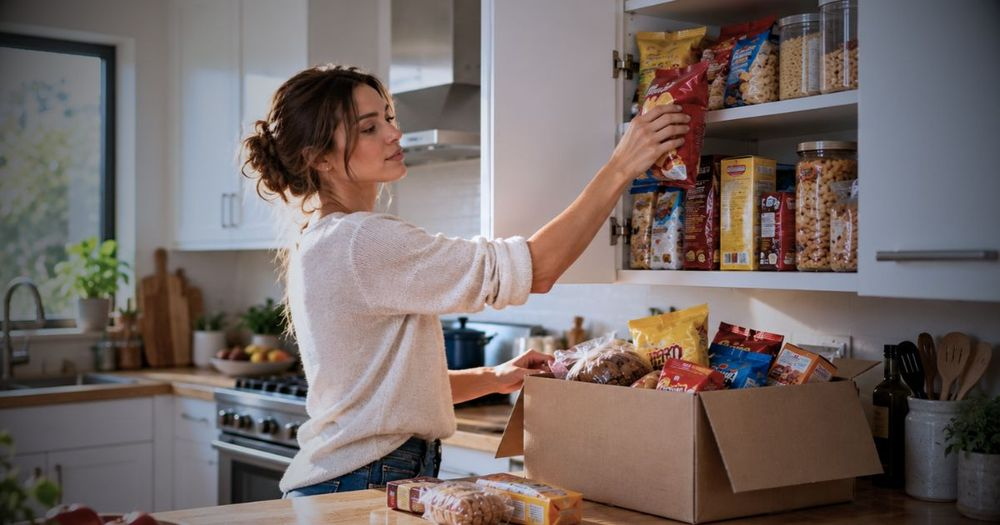
Start with the foods that pull hardest: breakfast cereals and cereal bars, crackers and crisps, sweets, biscuits and desserts, soft drinks, sports drinks and fruit juice, processed meats, and ready meals. Do it in one go. Do not save a box for a special occasion. Special occasions turn up suspiciously often.
None of this is a new warning. "Junk food" is usually credited to Michael Jacobson, of the Center for Science in the Public Interest, in 1972. But a 1952 headline in an Ohio paper already read "'Junk Foods' Cause Serious Malnutrition", over a reprint of a 1948 health column called "More Junk Than Food". Nearly eighty years of warnings, and the snack aisle only got longer.
Then read the labels on what is left. Why People Fail at Weight Loss, linked above, has the quick test: if the ingredients list includes things no home kitchen has, such as high-fructose corn syrup, hydrogenated oils, emulsifiers, flavourings and colours, it is ultra-processed. Check the foods that look healthy too. Salad dressings, "health" bars and "protein" snacks often fail it.
Distance matters as well. In two tests, a bowl of snacks was put 20, 70 or 140 centimetres away from people. Moved further off, fewer people ate any, and those who did ate less. They did not crave more to make up for it. The snacks were just as noticeable. They were more effort. For once, laziness is on your side. So if something has to stay in the house, make it hard to reach: a high cupboard, the back of a shelf, behind something boring. If others in the house still eat it, give it their own cupboard, and make it the high one.
Restock
Fill the space with food that needs little work.
Meat, fish and eggs come first: mince, a whole chicken, steaks, salmon, sardines, a tray of eggs. None of it has an ingredients list worth reading. Butter, ghee or tallow to cook with. Frozen vegetables, which keep for months and need no chopping.
Leave the seed oils behind with the packets. This is the one part of the detox that is real, and it is slow. Why Processed Food Is Hard to Leave, linked below, has the elderly men fed a diet high in seed oils for up to five years: the share of linoleic acid, the main seed-oil fat, in their body fat rose from 11% to 32%, on a curve with a half-time of 680 days. Across the United States, that share in adults' body fat rose by 136% over half a century. Your body fat keeps the record for years, so start the new one now.
For drinks, water is the main one. Sparkling water if you miss the fizz. Loose tea if you want something warm.
Shop fed, with a list. How to Outsmart Cravings, linked below, has the 94 students who shopped in a virtual supermarket: the impulsive ones bought the most calories, most of all from snacks, and only when they were hungry. A hungry shopper is the shop's favourite customer. Shops know where you are weakest, which is why the sweets wait at the till. When six British supermarket chains took sweets, chocolate and crisps away from their checkouts, purchases of those small packets fell by about 17% straight away.
Build the plate
Every meal gets the same frame: protein, fat, and vegetables. Eggs cooked in butter with whatever is in the pan. Beef or salmon with a side of vegetables. Chicken thighs roasted in their own fat.
Protein goes first for a reason. How to Outsmart Cravings, linked below, has the hunger that keeps looking for it. Among 9,042 Americans, the more ultra-processed food people ate, the thinner the protein in their diet became, from 18% of their food down to 13%. Their protein stayed about the same, and their calories climbed. Processed food waters the protein down, and your appetite keeps going until it finds it. A plate built on meat, fish or eggs answers that hunger directly.
Cook once, eat twice
Processed food wins on convenience, so take the convenience back. Cook a big batch once and eat from it for days: a pot of mince, a roast chicken, a dozen boiled eggs. A pressure cooker or a programmable does the work while you do something else. Glass containers make it easy to portion and freeze.
It pays. The Hidden Ingredient That Changes Every Meal You Cook has the national sample of more than 9,500 American adults, where people in homes that cooked dinner six or seven nights a week ate fewer calories, less sugar and less fat than people in homes where someone cooked once a week or less.
Fermented food
Processed food is made to last on a shelf. Fermented food is alive.
Are Fermented Foods Good for Your Gut? has the healthy adults who went from barely any fermented food to several servings a day over ten weeks. The range of bacteria in their gut widened steadily, and markers of inflammation in their blood fell. A high-fibre diet over the same ten weeks left the range unchanged on average.
Sauerkraut and kefir are easy places to start. Choose the jars sold from the fridge and labelled raw or unpasteurised, so the cultures are still alive. Boiled sauerkraut is just wet cabbage. Or make your own: a turns a cabbage and some salt into sauerkraut on the kitchen counter.
When a craving hits
A craving feels like an order. Treat it as a request you can think about.
Wait before you decide. Drink a glass of water, walk around the block, or call someone. Then decide.
Notice when cravings come: in front of the TV, at the desk, at the end of a hard day, when you are bored or stressed. Each one is a cue, and a cue can be planned for. Why Motivation Fails — and What Keeps Habits Going After It Does has the sentence that does it: "When I sit down on the sofa after dinner, I make a pot of peppermint tea." Plans of that kind took away the old habit's head start, and gave people a real choice in the moment.
Turn the screen off while you eat, too. The Hidden Ingredient That Changes Every Meal You Cook, linked above, has the young women who ate the same lunch on two days, once in front of the TV and once without it. After the TV lunch, they ate more biscuits that afternoon, and they remembered the lunch less clearly.
Then there is sleep. Why People Fail at Weight Loss, linked above, has the adults on the same reduced diet who were hungrier and lost much less fat when they slept 5.5 hours a night than when they slept 8.5, and the short sleepers who were coached to sleep longer and ate about 270 calories a day fewer. A craving after a short night is the night talking.
Other people
Food is social, and company changes how much you eat. In one set of food diaries, 63 adults wrote down everything they ate for a week and who was with them. Meals eaten with others were bigger, and the more people at the table, the bigger the meal. The drink adds its share. Why People Fail at Weight Loss, linked above, has the 12 tests where people who had an alcoholic drink ate about 80 calories more food on top of it.
So plan for the table. Eat before you go to a party where the food will be processed. Offer to bring a dish you know you can eat. In a restaurant, ask for grilled meat or fish with vegetables, leave off the sauce, and drink water. A kitchen that can grill a steak can serve it plain. When you travel, pack boiled eggs, cold meat and nuts.
If someone asks, keep it simple and calm: "I'm eating food that makes me feel better." It is true, and it is hard to argue with.
After a slip
You will eat something off the plan. Go back to it at the next meal, not "next week". Next week is where plans go to wait.
Why Motivation Fails, linked above, has what does the real damage: the dieters who ate more biscuits once they believed a rule was already broken, and the kindness toward themselves that stopped it. One meal is a meal. Deciding the week is ruined is what costs you.
Then ask what led to it. Stress, a party, an empty fridge, a long day. Each answer shows you where the plan needs another support.
What to watch
Track what you feel, not only what you weigh: your energy through the day, how you sleep, how strong the cravings are, your mood, how your clothes fit. These change before the scale has much to say.
Watch your taste too, because it changes. The Hidden Science of Sugar Cravings has the people who cut their sugar by 40% for three months and came to rate the same pudding about 40% sweeter than a comparison group did. Sweet things started to taste sweeter, so less was enough. Give your taste time to catch up, and the food you eat now will start tasting like enough.
Why Processed Food Is Hard to Leave, linked below, has what to expect, and when.
Take care if
If you take medicine for blood sugar or blood pressure, a big change in what you eat can change how much of it you need, so tell whoever prescribes it before you start. If you have had an eating disorder, or you are pregnant or breastfeeding, make the change with support, not alone.
The rule that fits on one line
In 2014, Brazil based its new national food guidelines partly on the Nova system, which sorts food by how processed it is and grew out of Carlos Monteiro's work at the University of São Paulo. The guidelines give one "golden rule": "Always prefer natural or minimally processed foods and freshly made dishes and meals to ultra-processed foods."
No tea, no pills, no flush. No purchase necessary. Your liver and kidneys have the daily detox covered. The slow one, in your body fat, is up to you. Your job is the kitchen, the plate and the table, and it starts with the next meal you choose.
Today, clear one shelf of anything whose ingredients list includes something no home kitchen has.
Want to know what the first weeks will feel like? Why Processed Food Is Hard to Leave — and When It Gets Easier — what caffeine and sugar do in the first days, when the cravings soften, and when food starts tasting right again.
Fighting the cravings on willpower alone? How to Outsmart Cravings and Make Healthier Choices Without Relying on Willpower — what a craving is asking for, why protein quiets it, and how to stop without a willpower battle.
Know someone halfway through a detox tea? Send them this before they buy the next box.
Disclaimer: This article is general information. For advice about your own health, talk to a qualified health professional. If you take medication for blood sugar or blood pressure, a big change in what you eat can change what you need, so get advice before you start.
Affiliate Disclosure: This article contains affiliate links. As an Amazon Associate, All For Life earns from qualifying purchases, at no extra cost to you. We only link to products we would recommend without the commission.
Sources
Wikipedia. Detoxification (alternative medicine). en.wikipedia.org
Wiktionary. detox. en.wiktionary.org
Klein AV, Kiat H (2015). Detox diets for toxin elimination and weight management: a critical review of the evidence. Journal of Human Nutrition and Dietetics 28(6):675–686. doi.org/10.1111/jhn.12286
Martínez Steele E, Baraldi LG, Louzada MLdC, Moubarac JC, Mozaffarian D, Monteiro CA (2016). Ultra-processed foods and added sugars in the US diet: evidence from a nationally representative cross-sectional study. BMJ Open 6(3):e009892. doi.org/10.1136/bmjopen-2015-009892
Hall KD, Ayuketah A, Brychta R, et al. (2019). Ultra-processed diets cause excess calorie intake and weight gain: an inpatient randomized controlled trial of ad libitum food intake. Cell Metabolism 30(1):67–77. doi.org/10.1016/j.cmet.2019.05.008
Wikipedia. Junk food. en.wikipedia.org
Maas J, de Ridder DTD, de Vet E, de Wit JBF (2012). Do distant foods decrease intake? The effect of food accessibility on consumption. Psychology & Health 27(sup2):59–73. doi.org/10.1080/08870446.2011.565341
Dayton S, Hashimoto S, Dixon W, Pearce ML (1966). Composition of lipids in human serum and adipose tissue during prolonged feeding of a diet high in unsaturated fat. Journal of Lipid Research 7(1):103–111. doi.org/10.1016/S0022-2275(20)39591-2
Guyenet SJ, Carlson SE (2015). Increase in Adipose Tissue Linoleic Acid of US Adults in the Last Half Century. Advances in Nutrition 6(6):660–664. doi.org/10.3945/an.115.009944
Nederkoorn C, Guerrieri R, Havermans RC, Roefs A, Jansen A (2009). The interactive effect of hunger and impulsivity on food intake and purchase in a virtual supermarket. International Journal of Obesity 33(8):905–912. doi.org/10.1038/ijo.2009.98
Ejlerskov KT, Sharp SJ, Stead M, et al. (2018). Supermarket policies on less-healthy food at checkouts: Natural experimental evaluation using interrupted time series analyses of purchases. PLOS Medicine 15(12):e1002712. doi.org/10.1371/journal.pmed.1002712
Martínez Steele E, Raubenheimer D, Simpson SJ, Baraldi LG, Monteiro CA (2018). Ultra-processed foods, protein leverage and energy intake in the USA. Public Health Nutrition 21(1):114–124. doi.org/10.1017/S1368980017001574
Wolfson JA, Bleich SN (2015). Is cooking at home associated with better diet quality or weight-loss intention? Public Health Nutrition 18(8):1397–1406. doi.org/10.1017/S1368980014001943
Wastyk HC, Fragiadakis GK, Perelman D, et al. (2021). Gut-microbiota-targeted diets modulate human immune status. Cell 184(16):4137–4153.e14. doi.org/10.1016/j.cell.2021.06.019
Adriaanse MA, Gollwitzer PM, De Ridder DTD, de Wit JBF, Kroese FM (2011). Breaking Habits With Implementation Intentions: A Test of Underlying Processes. Personality and Social Psychology Bulletin 37(4):502–513. doi.org/10.1177/0146167211399102
Higgs S, Woodward M (2009). Television watching during lunch increases afternoon snack intake of young women. Appetite 52(1):39–43. doi.org/10.1016/j.appet.2008.07.007
Nedeltcheva AV, Kilkus JM, Imperial J, Schoeller DA, Penev PD (2010). Insufficient sleep undermines dietary efforts to reduce adiposity. Annals of Internal Medicine 153(7):435–441. doi.org/10.7326/0003-4819-153-7-201010050-00006
Tasali E, Wroblewski K, Kahn E, Kilkus J, Schoeller DA (2022). Effect of sleep extension on objectively assessed energy intake among adults with overweight in real-life settings: a randomized clinical trial. JAMA Internal Medicine 182(4):365–374. doi.org/10.1001/jamainternmed.2021.8098
de Castro JM, de Castro ES (1989). Spontaneous meal patterns of humans: influence of the presence of other people. The American Journal of Clinical Nutrition 50(2):237–247. doi.org/10.1093/ajcn/50.2.237
Kwok A, Dordevic AL, Paton G, Page MJ, Truby H (2019). Effect of alcohol consumption on food energy intake: a systematic review and meta-analysis. British Journal of Nutrition 121(5):481–495. doi.org/10.1017/S0007114518003677
Polivy J, Herman CP, Deo R (2010). Getting a bigger slice of the pie. Effects on eating and emotion in restrained and unrestrained eaters. Appetite 55(3):426–430. doi.org/10.1016/j.appet.2010.07.015
Adams CE, Leary MR (2007). Promoting Self–Compassionate Attitudes Toward Eating Among Restrictive and Guilty Eaters. Journal of Social and Clinical Psychology 26(10):1120–1144. doi.org/10.1521/jscp.2007.26.10.1120
Wise PM, Nattress L, Flammer LJ, Beauchamp GK (2016). Reduced dietary intake of simple sugars alters perceived sweet taste intensity but not perceived pleasantness. American Journal of Clinical Nutrition 103(1):50–60. doi.org/10.3945/ajcn.115.112300
Wikipedia. Nova classification. en.wikipedia.org