
In a small experiment, people tasted a sweet that came with a note. For some, the note said it had been picked out especially for them. For others, it had been chosen at random. Same sweet. The people who believed someone had chosen it for them said it tasted better, and sweeter.
A hidden ingredient was at work in that sweet, and it's real. It makes food taste better to the person who cooks it and to the people who eat it. It works through the people at the table, which makes it something you can add tonight. By the end, you'll know what it is.
Cooking at home changes what you eat
Cooking shaped us long before it shaped dinner. A primate our size would be expected to spend nearly half its waking day eating. Humans spend under 5%, and the team behind that comparison credits cooking and other ways of preparing food, which soften it and free up the hours. Our back teeth shrank to match.
Its first effect on you is simple. In a national sample of more than 9,500 American adults, people in homes where dinner was cooked six or seven nights a week ate fewer calories, less sugar and less fat than people in homes where someone cooked once a week or less.
When you cook, you choose what goes in. Real meat, fish and eggs, vegetables, a proper fat to cook them in, and none of the extras a factory adds to keep things on the shelf. A jar of covers the fat.
Time is the usual objection, and it pays back. Adults who spent less than an hour a day on food preparation ate vegetables, salads and fruit less often, and spent more on eating out. A one-pan dinner keeps the time short.
Pick two evenings this week to cook from scratch. Keep it simple: one piece of meat or fish, one vegetable, one pan. A will see you through years of one-pan dinners.
Make it yourself
People value what they build. Assemble a flat-pack box yourself, and you'll rate it higher than the same box built by someone else. It has a name: the IKEA effect.
It works in the kitchen too. Women who prepared a healthy dish themselves liked it more than women served the same dish made by someone else. The effect showed up for the healthy food, and it was strongest in people who usually held back from eating.
So getting someone to help cook is one of the kindest tricks you can play. Children aged six to ten who cooked lunch with a parent ate 76% more salad and 27% more chicken than children whose parent cooked alone, and they came away feeling more positive and more in control.
With a picky eater, repetition beats pressure. Children offered a taste of sweet red pepper every day for eight days came to like it and ate more of it, while a sticker reward did less. Offer it again, without a fuss.
Give everyone at your table one job in the next meal, from peeling to stirring to laying the table.
What cooking does for the cook
Cooking feeds the cook too. Young adults who kept a diary for 13 days felt more upbeat, and more like they were flourishing, on the days after they'd done something creative, such as trying a new recipe. The lift ran from making things to feeling good. Jean Anthelme Brillat-Savarin wrote in 1825: "The discovery of a new dish does more for the happiness of mankind, than the discovery of a new planet."
Try one new recipe this week, just for the pleasure of making it.
Cook it for someone
Food made for you carries a message, and you can taste it. In the sweet experiment, a short note saying "picked for you" was enough to make the same sweet taste better.
People sense something extra in handmade things too. Across four experiments, shoppers found handmade products more attractive than machine-made ones, largely because they felt the handmade ones carried something of their maker's care. The pull was strongest when the gift was for someone close to them.
Effort you only hear about still changes how good something looks. People shown the same abstract painting liked it more, and valued it higher, when they were told it had taken 26 hours to paint than when they were told 4.
A home-cooked meal is a handmade gift, given every day, and the people eating it know it.
English has carried this idea for a thousand years. Lord comes from the Old English hlāfweard, the guardian of the bread. Lady comes from hlǣfdīġe, the bread-kneader. The heads of the household were named for the loaf they kept and made.
Giving lifts the giver too. People handed some money and told to spend it on someone else ended the day happier than people told to spend it on themselves. A meal cooked for someone is that kind of gift, made by hand.
Cook together, too. Couples who spent seven minutes on a new, slightly challenging task side by side felt better about their relationship afterwards than couples given a routine task. A recipe neither of you has tried could be your seven minutes.
Cook someone's favourite this week, and tell them you made it for them.
What you call it changes how it tastes
In a busy university canteen, the same carrots went out at lunch for weeks. On some days the label said "carrots". On others it said "twisted citrus-glazed carrots". Same recipe, same pan, same cook. When the name sounded like a treat, a quarter more people put the carrots on their plate.
The carrots were part of a pattern. Over 46 days, labels like "twisted", "sizzling" and "zesty" beat basic names and health-focused labels for getting people to choose their vegetables. Words that promise pleasure set people up to enjoy the food.
At home, you can do the same out loud. Talk about the food the way you'd talk about something you're looking forward to: the crackling on the pork, the butter on the beans.
The eye tastes too. The same salad was served three ways: tossed together, set out neatly, or arranged like a Kandinsky painting. The artful plate was rated tastier after eating, and people said they'd pay more for it. A minute spent arranging the plate is care your guests can see.
At the next meal, describe what's on the plate by how it tastes, leave out how healthy it is, and take a minute to arrange it.
Eat with your full attention
How you eat matters as well. When the findings from 24 experiments were pooled, people who ate while distracted ate a little more at the meal and noticeably more later on. People who paid attention to their food, or were reminded of what they'd eaten, ate less afterwards.
One small test shows how it works. Young women ate the same lunch on two days, once in front of the TV and once without it. After the TV lunch, they ate more biscuits that afternoon, and they remembered the lunch less clearly.
Pace matters too. When women ate the same meal slowly, they ate less, drank more water and felt fuller than when they ate it quickly.
Eat one meal a day with the screens off, and notice the first three bites.
Eat together
"Companion" comes from the Latin com, with, and panis, bread: the person you share bread with. A shared table does its own work. Across 17 sets of findings covering more than 180,000 children and teenagers, those who ate family meals three or more times a week were more likely to be a healthy weight, ate more healthily, and were less likely to develop disordered eating than those who ate together less often.
People have gathered to eat for a long time. In a cave in northern Israel, about 12,000 years ago, a community buried one of its own with a feast: at least 71 tortoises and three wild cattle, cooked and shared, enough meat for around 35 people.
Sharing a dish changes how it tastes. People who tasted chocolate at the same moment as another person found it more likeable and more flavourful than when that person was in the room doing something else. With a bitter chocolate, sharing made it taste worse. Shared tastes are stronger tastes.
Eating the same food builds trust. Strangers given the same food to eat trusted each other more in a money game than strangers eating different foods, and in a mock pay negotiation they cooperated more and earned more. Put one dish in the middle of the table.
Food carries company even when you eat alone. When people ate a food that reminded them of being cared for, thoughts of relationships came to mind. For people who felt secure in their relationships, comfort food eased the sting of feeling left out. Chicken soup is good for the soul after all.
Smell carries the strongest memories of all. When older adults were given a word, a picture or a smell and asked for a memory, the smells brought back the oldest ones, mostly from the first ten years of life, with the strongest sense of being taken back in time. Marcel Proust wrote the famous version in 1913: a grown man tastes a madeleine dipped in tea, and his childhood comes flooding back. That's the honest reason a grandmother's kitchen stays with you.
It may start earlier than memory. Flavours from a mother's meals reach her baby before birth, and again through breast milk. Babies whose mothers drank carrot juice in late pregnancy, or while breastfeeding, pulled fewer unhappy faces at carrot-flavoured cereal months later.
Make one meal this week a sit-down meal with the people you live with, or invite someone round.
How it gets into the food
The hidden ingredient travels through the cook's hands and the eater's heart. Claims that a cook's emotions change the structure of water, add "biophotons" or age food faster have no reliable evidence behind them, and the ingredient works without them: through what you choose, how you cook it, and what the people at the table know about who made it.
Your mood does change one thing: what you reach for. Stress before a meal left the total amount people ate the same, but stressed emotional eaters chose more sweet, fatty food and a richer meal overall. A calm kitchen helps the cook more than the pot.
The ingredient you already have
The hidden ingredient is love.
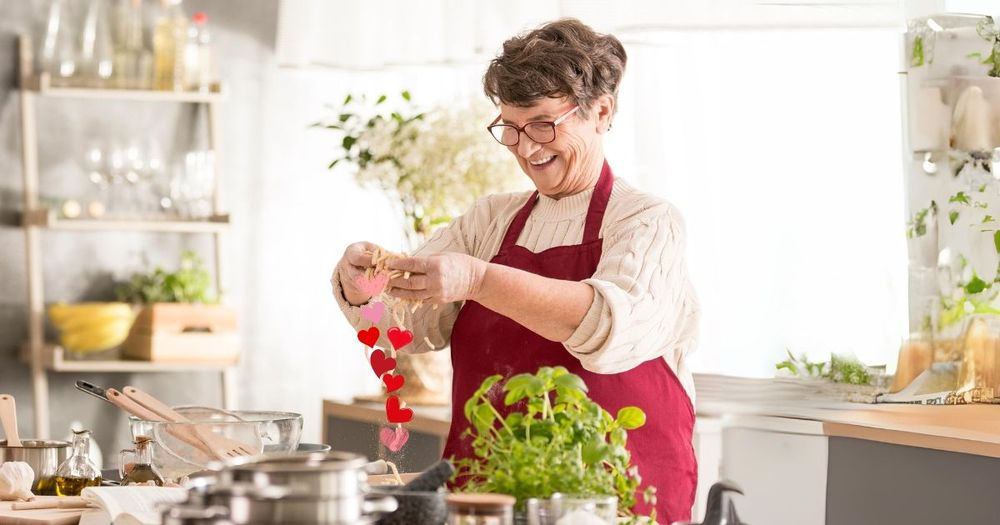
Loving what you cook, and cooking for the people you love. It costs nothing, and it changes every meal you make. You add it by choosing real ingredients, cooking them yourself, naming them with pleasure, eating them slowly and sharing them with someone. The note on that sweet said it in three words: picked for you.
Start tonight. Cook something you love for someone you love, and tell them who it's for.
Ready to cook more at home? The Cooking Skills That Keep Your Family Healthy and Safe — the skills that matter most, in cooking order.
Want more from every plate? Food Pairings That Improve Nutrient Absorption — which foods help each other's nutrients reach you.
Know someone who cooks for everyone but themselves? Send them this, and cook them their favourite.
Disclaimer: This article is general information. For advice about your own health, talk to a qualified health professional.
Affiliate Disclosure: This article contains affiliate links. As an Amazon Associate, All For Life earns from qualifying purchases, at no extra cost to you. We only link to products we would recommend without the commission.
Sources
Gray K (2012). The power of good intentions: perceived benevolence soothes pain, increases pleasure, and improves taste. Social Psychological and Personality Science 3(5):639–645. doi.org/10.1177/1948550611433470
Organ C, Nunn CL, Machanda Z, Wrangham RW (2011). Phylogenetic rate shifts in feeding time during the evolution of Homo. Proceedings of the National Academy of Sciences 108(35):14555–14559. doi.org/10.1073/pnas.1107806108
Wolfson JA, Bleich SN (2015). Is cooking at home associated with better diet quality or weight-loss intention? Public Health Nutrition 18(8):1397–1406. doi.org/10.1017/S1368980014001943
Monsivais P, Aggarwal A, Drewnowski A (2014). Time spent on home food preparation and indicators of healthy eating. American Journal of Preventive Medicine 47(6):796–802. doi.org/10.1016/j.amepre.2014.07.033
Norton MI, Mochon D, Ariely D (2012). The IKEA effect: when labor leads to love. Journal of Consumer Psychology 22(3):453–460. doi.org/10.1016/j.jcps.2011.08.002
Dohle S, Rall S, Siegrist M (2016). Does self-prepared food taste better? Effects of food preparation on liking. Health Psychology 35(5):500–508. doi.org/10.1037/hea0000315
van der Horst K, Ferrage A, Rytz A (2014). Involving children in meal preparation. Effects on food intake. Appetite 79:18–24. doi.org/10.1016/j.appet.2014.03.030
Wardle J, Herrera ML, Cooke L, Gibson EL (2003). Modifying children's food preferences: the effects of exposure and reward on acceptance of an unfamiliar vegetable. European Journal of Clinical Nutrition 57(2):341–348. doi.org/10.1038/sj.ejcn.1601541
Conner TS, DeYoung CG, Silvia PJ (2018). Everyday creative activity as a path to flourishing. Journal of Positive Psychology 13(2):181–189. doi.org/10.1080/17439760.2016.1257049
Wikiquote. Jean Anthelme Brillat-Savarin. en.wikiquote.org
Fuchs C, Schreier M, van Osselaer SMJ (2015). The handmade effect: what's love got to do with it? Journal of Marketing 79(2):98–110. doi.org/10.1509/jm.14.0018
Kruger J, Wirtz D, Van Boven L, Altermatt TW (2004). The effort heuristic. Journal of Experimental Social Psychology 40(1):91–98. doi.org/10.1016/S0022-1031(03)00065-9
Wiktionary. Lord. en.wiktionary.org
Wiktionary. Lady. en.wiktionary.org
Dunn EW, Aknin LB, Norton MI (2008). Spending money on others promotes happiness. Science 319(5870):1687–1688. doi.org/10.1126/science.1150952
Aron A, Norman CC, Aron EN, McKenna C, Heyman RE (2000). Couples' shared participation in novel and arousing activities and experienced relationship quality. Journal of Personality and Social Psychology 78(2):273–284. doi.org/10.1037/0022-3514.78.2.273
Turnwald BP, Boles DZ, Crum AJ (2017). Association between indulgent descriptions and vegetable consumption: twisted carrots and dynamite beets. JAMA Internal Medicine 177(8):1216. doi.org/10.1001/jamainternmed.2017.1637
Michel C, Velasco C, Gatti E, Spence C (2014). A taste of Kandinsky: assessing the influence of the artistic visual presentation of food on the dining experience. Flavour 3:7. doi.org/10.1186/2044-7248-3-7
Robinson E, Aveyard P, Daley A, et al. (2013). Eating attentively: a systematic review and meta-analysis of the effect of food intake memory and awareness on eating. American Journal of Clinical Nutrition 97(4):728–742. doi.org/10.3945/ajcn.112.045245
Higgs S, Woodward M (2009). Television watching during lunch increases afternoon snack intake of young women. Appetite 52(1):39–43. doi.org/10.1016/j.appet.2008.07.007
Andrade AM, Greene GW, Melanson KJ (2008). Eating slowly led to decreases in energy intake within meals in healthy women. Journal of the American Dietetic Association 108(7):1186–1191. doi.org/10.1016/j.jada.2008.04.026
Wiktionary. Companion. en.wiktionary.org
Hammons AJ, Fiese BH (2011). Is frequency of shared family meals related to the nutritional health of children and adolescents? Pediatrics 127(6):e1565–e1574. doi.org/10.1542/peds.2010-1440
Munro ND, Grosman L (2010). Early evidence (ca. 12,000 B.P.) for feasting at a burial cave in Israel. Proceedings of the National Academy of Sciences 107(35):15362–15366. doi.org/10.1073/pnas.1001809107
Boothby EJ, Clark MS, Bargh JA (2014). Shared experiences are amplified. Psychological Science 25(12):2209–2216. doi.org/10.1177/0956797614551162
Woolley K, Fishbach A (2017). A recipe for friendship: similar food consumption promotes trust and cooperation. Journal of Consumer Psychology 27(1):1–10. doi.org/10.1016/j.jcps.2016.06.003
Troisi JD, Gabriel S (2011). Chicken soup really is good for the soul: "comfort food" fulfills the need to belong. Psychological Science 22(6):747–753. doi.org/10.1177/0956797611407931
Willander J, Larsson M (2006). Smell your way back to childhood: autobiographical odor memory. Psychonomic Bulletin & Review 13(2):240–244. doi.org/10.3758/bf03193837
Wikipedia. Involuntary memory. en.wikipedia.org
Mennella JA, Jagnow CP, Beauchamp GK (2001). Prenatal and postnatal flavor learning by human infants. Pediatrics 107(6):e88. doi.org/10.1542/peds.107.6.e88
Oliver G, Wardle J, Gibson EL (2000). Stress and food choice: a laboratory study. Psychosomatic Medicine 62(6):853–865. doi.org/10.1097/00006842-200011000-00016