
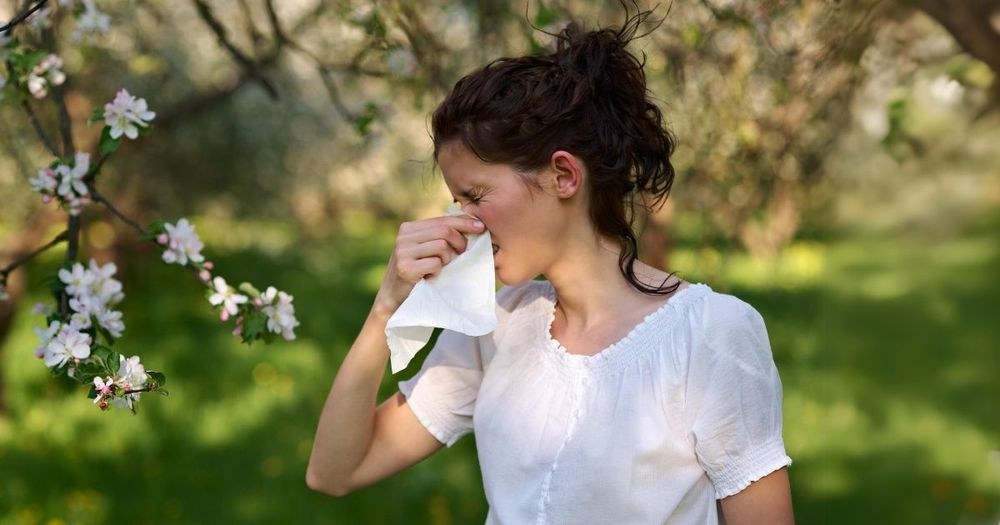
Springtime should be a period of renewal and joy. Then the first warm, windy day arrives, and with it the sneezing, the itchy eyes and the nose that will not stop running.
The usual answer is a remedy for each symptom: a spray for the nose, drops for the eyes, a tea or a tablet for the rest. Some of them help for an afternoon. None of them asks the more useful question. Why does your body treat a speck of pollen like an invasion, and what makes it react harder in some years and on some days than others?
That question has answers, and several of them are things you can change.
A modern illness
Hay fever is younger than it looks. In 1819, an English scientist named John Bostock described it with care, and in his day it was regarded as most unusual. Before then, only a handful of rare descriptions can be found, going back to Islamic texts of the 9th century. By the end of the 1800s it had become commonplace across Europe and North America.
Even the name is a mistake. People once blamed the smell of new hay. The smell was innocent, but the timing fitted: the hay harvest falls right in the peak of the pollen season, and harvest work puts people in the thick of it.
Unconventional Remedies for Chronic Allergies, linked below, has how pollen was finally proven to be the cause, in 1859. Charles Darwin read the 1873 book on that work and wrote to its author, Charles Blackley, to explain that some pollens travel on the wind while others rely on insects.
Once it was common, people began travelling to escape it. From 1867 the railway brought visitors from Boston and New York to Bethlehem, New Hampshire, for the low pollen in its mountain air. The town still calls itself the highest in the state. The National Hay Fever Relief Association was founded there, and a Hebrew Hay Fever Relief Association followed in the 1920s.
The same thing still happens to people who move. Among 91,642 children in the United States, those born abroad were far less likely to have hay fever. The longer they stayed, the more it caught up with them: children who had lived there for more than ten years had about six times the odds of hay fever of those who had arrived within the last two.
An illness that went from rare to ordinary in under a century, and that grows on newcomers within a decade, is unlikely to be about genes alone. Something in the way we live changed, and that is where the causes are worth looking for. Theresa MacPhail follows that question from Bostock's day to ours in .
What the pollen meets
Pollen itself is harmless. With hay fever, your immune system mistakenly identifies it as a threat. Mast cells, which sit in large numbers in the lining of the nose, release histamine, a chemical messenger that makes small blood vessels leaky and drives the itching. The sneezing and streaming are the body trying to wash out an enemy that was never there. It is like calling the fire brigade for a birthday candle.
If you are not sure it is hay fever at all, the clues are no fever, itchy eyes and throat, and symptoms that last as long as the pollen does, often for weeks. A cold usually clears within a week or two. Why You Keep Getting Sick: The Causes of Frequent Colds has the full comparison.
How hard that reaction runs is not fixed. It depends on what arrives with the pollen, what else the body is dealing with at the same time, and how much pollen there is. Those are the causes in the rest of this article.
What comes in with the pollen
Pollen in a town rarely travels alone. On a busy road it shares the air with traffic exhaust, and that changes how the body answers it.
In one test, people already allergic to ragweed had its pollen sprayed into the nose, either alone or together with diesel exhaust particles. With the diesel, their noses made markedly more of the antibodies aimed at ragweed.
The same team then tried something bolder. Fifteen people with allergies breathed diesel particles before being given a protein their bodies had never met, taken from the blood of a sea snail that lives off California. Nine of them became allergic to it. Of ten given the protein without the diesel, none did.
Exhaust does not just irritate. It can teach the immune system new targets. The pollen is the guest. The exhaust is the bad company it keeps.
Pollution works on the pollen as well. Birch trees were sampled across Munich and the country around it. Those growing where there was more ozone, a pollutant that forms in sunlight from the fumes of burning fuel, made pollen with more allergen in it, and skin tests reacted more strongly to their pollen.
The pattern shows up in children too. Across groups of children followed from birth, more traffic pollution early in life went with more asthma and more sensitisation to allergens, with their bodies making allergy antibodies against them. There was some evidence for hay fever as well. Second-hand smoke went with about 10% more hay fever, and among children and teenagers who smoked themselves, the risk was about 40% higher.
This is where lightening the load starts. On days when the pollen count is high, keep away from busy roads where you can, take the quieter street, and keep the car windows closed in traffic. Keep smoke out of the house and out of the car. Indoors, when the windows have to stay shut, a HEPA purifier such as the takes fine particles out of the air. How to Make Your Home Smell Fresh Without Air Fresheners has how much two of them removed in the homes of children with asthma.
What comes in with food and drink
Histamine also comes in ready-made. Some foods carry it: aged cheese, cured and fermented meats, fermented foods, wine, and a few plants, tomatoes among them. One idea, still unproven and not a recognised diagnosis, is that some people have a lower threshold, so that moderate amounts in food are enough to set off symptoms.
A friend of ours reacted to tomatoes for years. After a cleanse, he found he could eat them again. That is one person's experience, and the cleanse is unlikely to have flushed anything out. What it did do was take things away.
A cleanse that cuts out alcohol and heavily processed food also takes away some of the richest sources of histamine: wine, aged cheese and cured meats. With less histamine coming in from everywhere else, a tomato may no longer be enough to tip the balance. Sometimes the best remedy is what you stop putting in.
There is a second link. Tomato is one of the foods whose proteins look enough like grass pollen to set off the same antibodies, a reaction called oral allergy syndrome. It happens only in people who already react to pollen. For some, a tomato reaction is a pollen allergy turning up at the table.
So when the season is rough, look at the plate and the glass as well as the air. Leaving out alcohol and the histamine-rich foods during your worst weeks takes some weight off. Keep meat and fish fresh, too. Histamine Intolerance, linked below, has why freshness matters more than any list of foods.
How much pollen, and where
The season has a shape. Symptoms are usually worse from late March to September, especially when it is warm, humid and windy, because that is when the pollen count is highest. In most temperate regions, grasses are the biggest source.
The daily pollen forecast is worth a look, and one common way of counting is surprisingly hands-on. A trap facing the wind pumps air onto sticky tape wrapped around a drum that turns once a week. The tape is cut into days, stained so the pollen grains show up magenta, and counted under a microscope. The world's first pollen forecasting service started in the UK in 1983. Mild winters push the counts up, while cold ones delay the pollen. 7 Things Local Honey Is Said to Do, and the One It Does has how much longer the pollen season has grown.
Some plants are champions. A single ragweed plant can release about a billion grains of pollen in a season, all of it carried on the wind. Somewhere, one weed is having a very productive summer. Ragweed is behind up to half of pollen hay fever in North America, and it is spreading in Europe.
Cities help it along. In one comparison, the air in a city held about 30% more carbon dioxide than the countryside nearby and was about 2 °C warmer. Ragweed growing there shot up faster, flowered earlier and made more pollen.
City trees may add more. In some tree species, only the male trees make pollen, while the females drop fruit and seeds. Planners have often chosen the tidier males. Neat pavements, itchy eyes.
The horticulturist Tom Ogren calls this botanical sexism and says it fills city air with pollen. Other scientists say it applies to only a few species, and that there is too little data to show how many urban trees are male. What is certain is the simple part. If you are choosing trees for your own garden, a female tree of those species adds no pollen to your air, and a tree pollinated by insects adds little.
Keep the pollen outside
Less pollen in the house means less for your body to answer, and a few simple rules are worth keeping in your worst weeks.
Close the house. Keep windows and doors shut when the count is high, and fit a pollen filter in the car's air vents if it takes one.
Bring less in. In pollen season, dry the washing indoors, because clothes on the line catch pollen. Leave fresh flowers out of the house, and keep pets out where you can, because they carry pollen in on their coats.
Wash the pollen off. A shower and a change of clothes when you come in, and washing your hair before bed, keep the day's pollen off the pillow.
Clean with care. Vacuum with a HEPA filter, and dust with a damp cloth.
Train it and feed it
An allergy is not a weak immune system. It is one that reacts too readily.
Part of that is training. Unconventional Remedies for Chronic Allergies, linked below, has the Amish children raised among farm animals, whose immune cells seem to have learned early to stay calm. It also has the ordinary city homes where the same pattern shows up. That training happens in childhood, so it matters most for the children in your life.
The other part is supply. An immune system is built from protein, zinc and vitamin A, and meat, fish and eggs carry all three. Why You Can't Boost Your Immune System (and Shouldn't) has why the aim is a well-supplied, balanced defence, and why "boosting" one that already overreacts is the wrong idea.
Why it is worth the trouble
Hay fever is easy to shrug off as a nuisance. Nineteen people with hay fever were given an hour-long driving test on a real road, outside the pollen season, after pollen was sprayed into the nose. With symptoms and nothing to calm them, their driving was impaired about as much as at a blood alcohol level of 0.05%, the legal limit in many countries. Adding a simple memory task while they drove made it worse.
Treating the symptoms partly undid that impairment, and pills have their place on a bad day. They block the messenger, though, not the reason it was sent, and the drowsy kind can bring a fog of its own. 7 Things Local Honey Is Said to Do, linked above, has the teenagers who dropped a grade in their summer exams. Whatever you take, the causes are still there afterwards.
A streaming nose takes attention away from everything else, which is one more reason to go after what drives it.
Relief, briefly
Causes come first, but a bad day still has to be got through.
Rinse your nose. A saline rinse flushes out allergens, especially after time outdoors. Natural Sinus Relief: What Works, and What Makes It Worse has how to do it safely.
Shield your eyes. Wraparound sunglasses and a wide-brimmed keep pollen off the eyes and face.
Drink water. Plenty of water, the drink with nothing added, and nothing histamine-rich in the glass.
Know when it is more. Wheezing, a tight chest, or a tongue or throat that starts to swell is not hay fever to ride out. It needs help straight away. Pollen can reach the lungs as well, and Unconventional Remedies for Chronic Allergies, linked below, has the night a thunderstorm over Melbourne filled the city's emergency departments with asthma.
Before the season comes
Start early and give your body time to adjust. The pollen will arrive whatever you do. What you can change is what it meets. That means the fumes and smoke that come in with it, the histamine that comes in with food and drink, the pollen you carry indoors, and an immune system that is well fed rather than pushed.
This week, before the next high-pollen day, plan a walking route that keeps you away from the busiest road.
Allergic all year round? Unconventional Remedies for Chronic Allergies — why the farm protects, how to find your triggers, the bedroom, and what the evidence does not support.
Reacting to food as well as pollen? Histamine Intolerance: The Hidden Trigger Behind Your Mystery Symptoms — where the histamine in food comes from, why freshness beats any list, and the test that works.
Know someone who plans every spring around the pollen forecast? Send them this, and the quieter route to the shops.
Disclaimer: This article is general information. For advice about your own allergies or health, talk to a qualified health professional.
Affiliate Disclosure: This article contains affiliate links. As an Amazon Associate, All For Life earns from qualifying purchases, at no extra cost to you. We only link to products we would recommend without the commission.
Sources
Wikipedia. Charles Harrison Blackley. en.wikipedia.org
Emanuel MB (1988). Hay fever, a post industrial revolution epidemic: a history of its growth during the 19th century. Clinical & Experimental Allergy 18(3):295–304. doi.org/10.1111/j.1365-2222.1988.tb02872.x
Wikipedia. Allergic rhinitis. en.wikipedia.org
Wikipedia. Bethlehem, New Hampshire. en.wikipedia.org
Silverberg JI, Simpson EL, Durkin HG, Joks R (2013). Prevalence of Allergic Disease in Foreign-Born American Children. JAMA Pediatrics 167(6):554–560. doi.org/10.1001/jamapediatrics.2013.1319
Wikipedia. Histamine. en.wikipedia.org
Diaz-Sanchez D, Tsien A, Fleming J, Saxon A (1997). Combined diesel exhaust particulate and ragweed allergen challenge markedly enhances human in vivo nasal ragweed-specific IgE and skews cytokine production to a T helper cell 2-type pattern. The Journal of Immunology 158(5):2406–2413. doi.org/10.4049/jimmunol.158.5.2406
Diaz-Sanchez D, Garcia MP, Wang M, et al. (1999). Nasal challenge with diesel exhaust particles can induce sensitization to a neoallergen in the human mucosa. Journal of Allergy and Clinical Immunology 104(6):1183–1188. doi.org/10.1016/S0091-6749(99)70011-4
Wikipedia. Keyhole limpet hemocyanin. en.wikipedia.org
Beck I, Jochner S, Gilles S, et al. (2013). High Environmental Ozone Levels Lead to Enhanced Allergenicity of Birch Pollen. PLoS ONE 8(11):e80147. doi.org/10.1371/journal.pone.0080147
Wikipedia. Ground-level ozone. en.wikipedia.org
Bowatte G, Lodge C, Lowe AJ, et al. (2015). The influence of childhood traffic-related air pollution exposure on asthma, allergy and sensitization: a systematic review and a meta-analysis of birth cohort studies. Allergy 70(3):245–256. doi.org/10.1111/all.12561
Saulyte J, Regueira C, Montes-Martínez A, et al. (2014). Active or Passive Exposure to Tobacco Smoking and Allergic Rhinitis, Allergic Dermatitis, and Food Allergy in Adults and Children: A Systematic Review and Meta-Analysis. PLoS Medicine 11(3):e1001611. doi.org/10.1371/journal.pmed.1001611
Wikipedia. Histamine intolerance. en.wikipedia.org
Wikipedia. Oral allergy syndrome. en.wikipedia.org
NHS. Hay fever. nhs.uk
Wikipedia. Anemophily. en.wikipedia.org
Wikipedia. Pollen count. en.wikipedia.org
Wikipedia. Ragweed. en.wikipedia.org
Ziska LH, Gebhard DE, Frenz DA, et al. (2003). Cities as harbingers of climate change: Common ragweed, urbanization, and public health. Journal of Allergy and Clinical Immunology 111(2):290–295. doi.org/10.1067/mai.2003.53
Wikipedia. Botanical sexism. en.wikipedia.org
Vuurman EFPM, Vuurman LL, Lutgens I, Kremer B (2014). Allergic rhinitis is a risk factor for traffic safety. Allergy 69(7):906–912. doi.org/10.1111/all.12418
Wikipedia. Antihistamine. en.wikipedia.org