
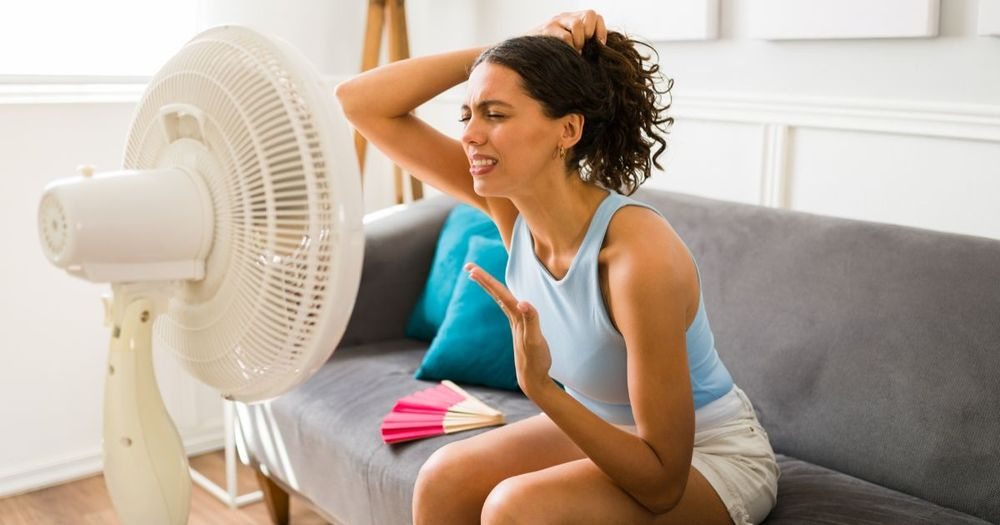
You know the kind of day. The air feels heavy, a trip to the shops feels like an expedition, and you've got a cold drink in one hand, a damp cloth on your neck and a bowl of ice in front of the fan, because somebody online swore by it.
Is any of that doing anything?
Some of it is. Some of it only feels as if it is, which is a different thing and can catch you out. And one of the better-tested tricks goes against every instinct you have: in the right conditions, a hot drink beats a cold one. So here are the heatwave tricks, tested. For the part that keeps you alive, meaning who's most at risk, the hot car and the signs of heatstroke, read Heat Survival Guide, linked below. This one is about what to do with your bowl of ice.
The hot drink
Nine men cycled for 75 minutes while drinking water at one of four temperatures, from 1.5°C up to 50°C. Their bodies stored the least heat on the 50°C water. It seems to work because a hot drink makes you sweat more, and the extra sweat carries away more heat than the drink brought in.
There's a catch, and it's a big one. Sweat has to evaporate to do any cooling, and the air in that test was dry, at about 23% humidity. In a sticky heatwave, with sweat running down your back, the extra sweat just sits there and you've simply had a hot drink. It's a poor reward for all that sweating. These were also men on bikes, so don't assume it scales down to you on the sofa.
The iced drink
The same researchers looked at the other end. After a very cold drink, sweating dropped within minutes, even though core and skin temperatures hadn't changed. When the cold water was swilled in the mouth and spat out, nothing happened. When it went straight to the stomach through a tube, it did. So the sensors seem to sit in the abdomen, and an iced drink sends them a message that things are under control.
None of this makes iced water bad. It's water, it's what the NHS recommends in a heatwave, and on a hot day it's one of life's great pleasures. Just don't confuse the pleasure with the cooling. The cold beer is the classic case, and Heat Survival Guide has why it's a poor plan: alcohol sends water out through the kidneys.
There's one exception, for people who have to work or train in it. Ten men drank either slushed ice or cold water before running in 34°C heat. After the slush, they ran for 50.2 minutes against 40.7, and their core temperature had dropped by 0.66°C before they started, against 0.25°C with the water. They also finished the run hotter, so it's a head start and no kind of shield. If you're heading out to lay a roof, it may be worth it. For sitting in the garden, it's a treat.
The black robe
You've been told to wear light colours, and that's sound for most clothes. But in 1980 a group of researchers asked a question with a lovely title: why do Bedouins wear black robes in hot deserts? They measured the heat gained in black and white robes, and it came out the same. The black cloth took in more heat, and lost it again before it reached the skin.
Accounts of the study credit the air moving under loose cloth, and they suggest it may have used a single volunteer, so don't redesign your wardrobe on the strength of it. A tight black T-shirt is not a Bedouin robe. However good you look in it. But it does put things in the right order: loose first, colour second.
Your head and your skin
Shaving your head for summer sounds clever. Researchers tested it, more or less, with a thermal manikin in a range of wigs and bald, including under simulated sun. Hair significantly cut the solar heat reaching the scalp, and tightly curled hair did it best. A bare scalp can lose more heat through sweat, but it also needs more sweat just to keep up with the sun. It's a manikin and not a person, but the barber can wait.
Sunburn costs you something else. Ten men exercised in 49°C heat before a sunburn, then again a day and a week afterwards. Core temperature and overall sweat rate didn't change significantly, but a day after the burn, sweating fell in the burned skin measured, from 0.60 to 0.37 on the forearm and from 1.08 to 0.74 on the back. It's a modest effect in a small test, and one more reason for shade and a hat. That's about avoiding the burn, not the sun: your skin needs some of it for vitamin D.
Spicy food
The claim is that chilli makes you sweat and sweat cools you, so spicy food cools you down. I found no good test of that in people on a hot day. The sweat part is real enough, and it comes with the same catch as the hot drink.
The usual evidence is that hot countries eat spicier food. They do. When researchers went through 4,578 meat recipes from 36 countries, spice use rose steadily with temperature.
Their explanation had nothing to do with cooling. Many spices kill the bacteria that spoil meat, and meat spoils faster in the heat. Chilli was doing the fridge's job. So the curry may have been keeping the meat safe, and you can put the chilli on your steak purely because you like it.
The light salad
"Eat light in the heat" usually means salad. Digesting does make heat: on average about 10% of a meal's energy, with protein at 20 to 30%, carbohydrate at 5 to 15% and fat next to nothing. Here's another sum of my own. A 500-calorie meal at the average rate adds about 12 watts over five hours. If it were pure protein at the top rate, about 35 watts. Your body gives off about 80 watts at rest, and walking to the shops adds a good deal more.
So a big meal does add some heat, but it won't decide what kind of day you have. The salad feels cool because it came out of the fridge. If the heat kills your appetite, eat less. There's no thermal reason to swap your steak for leaves.
The cold cloth on your neck
This covers the frozen washcloth, the cooling collar and the wet towel. A 2025 review pulled together 63 studies with 618 people, mostly male and mostly exercising. Cooling the head, face and neck cooled the skin in that spot, and people felt cooler and more comfortable. The effects on heart rate and core temperature were negligible.
That's worth having. Feeling better is a perfectly good reason to do something. The only danger is believing that because your neck feels fine, the rest of you does too. Your neck isn't in charge.
Mint
You'll be told to put mint in your water, and you certainly can. Just know what it's doing. Menthol, the cooling compound in mint, triggers your cold sensors without any actual cold. In a small test, six people at 30°C in humid air wore a shirt that was dry, soaked in water, or soaked in menthol and alcohol. The menthol shirt felt coolest of all, and it also left them storing the most heat.
That was a soaked shirt, not a sprig in a glass, so your mint water is innocent. It's just a clear example of how little your feeling of coolness can tell you.
The bowl of ice
This is the trick that sounds cleverest, and I found no test of it, so here's a sum of my own instead. Melting a kilo of ice takes about 334 kilojoules, which is roughly the heat a resting adult gives off in about an hour. So a kilo of ice cancels out one person for one hour, and does nothing about the sun on the walls, the hot roof or the second person on the sofa. Then there's the freezer that made the ice, which has been dumping heat into your kitchen. The ice owes the room more than it will ever pay back.
If you sit right in front of it, the breeze will feel lovely. As a way of cooling a room, it isn't one.
Older houses did this far better. The windcatchers of Yazd in Iran are towers that pull the breeze down through a building, sometimes past water, and they are said to bring the inside 8 to 12°C below the air outside. They go back so far that several countries claim to have invented them. It's the same idea as opening your windows at night, with a few thousand years of practice behind it.
The cold bottle at your feet
The old advice is to fill a hot water bottle with cold water and put it at your feet. It sounds logical, and it may be backwards. Reset Your Body Clock: Sleep Hacks, Tested has why: falling asleep depends on the blood vessels in your hands and feet opening up and letting heat out, and warm feet help them do it. Cold may close the exit.
That evidence comes from ordinary nights in cool rooms, and it doesn't seem to have been tested in a heatwave. So treat it as a reason for doubt rather than a verdict. Heat Survival Guide has what's safer ground for a hot night: a cool shower, a single cotton sheet and the night air let in through the window.
Water against the fan
This is the one result here that should change what you do. Twenty-three people aged 66 to 84 spent three hours at 47°C in dry air, with no help, with a water spray, with a fan, or with both.
Water spray held back the rise in core temperature by 0.24°C and lowered heart rate by 5 beats a minute. The fan pushed the core temperature rise up by 0.60°C and heart rate up by 15 beats a minute. Using both did nothing for temperature either way. At that heat, a fan is a hairdryer.
That's an extreme test, and it fits what Heat Survival Guide says about fans being useful below about 35°C and not above it. The lesson that travels is the water. Wet skin and a wet shirt work whether or not the power is on. That spray test was in dry air, but the plain water shirt from the mint test, at 70% humidity, still boosted evaporative cooling in a small test, so this isn't only for deserts.
As for air conditioning, it does what a fan can't, and Heat Survival Guide has how many lives it saves. It also moves your heat outside. When researchers modelled Paris, the streets came out 0.5°C warmer with today's air conditioning, and 2°C warmer if it doubled, with more of the rise at night than by day. So it won't help the neighbour who hasn't got any.
The cold plunge
This is the one trick in the article that can kill you. A cool shower is fine, and Heat Survival Guide has why. Jumping into open water on a hot day is another matter, because warm air tells you nothing about the water.
Sudden immersion sets off cold shock, with a gasp, fast breathing and a jump in heart rate and blood pressure. If your head is under at that moment, you can drown, however well you swim. The US National Weather Service says that the gasp can be triggered by water as warm as 25°C, and that cold shock can be as severe at 10 to 15°C as it is at 2°C. So get in slowly, and never jump into a lake, a quarry or the sea just because the day is hot.
Your temper
Heat gets into your head as well. Researchers went through 57,293 Major League Baseball games and found that the odds of a pitcher hitting a batter rose sharply at high temperatures, when more of his teammates had been hit earlier in the game. The provocation was the same. The heat made them likelier to act on it.
7 Ways to Make Every Day Work Better — Starting With What Your Body Is Doing has the Boston students who were slower on tests after a heatwave night without air conditioning. So on a hot day you may be slower and shorter-tempered, and you won't necessarily notice either. The big conversation with your partner can wait until it's cooler. You're unlikely to throw anything at ninety miles an hour, but you get the idea.
The people who can't feel it
All through this article, feeling cool and being cool have turned out to be different things. It matters most for older people. In one test, 20 young adults and 39 older adults rested for nine hours at a heat index of 37°C. The older group's bodies held more heat, and they reported no more symptoms than the young, with slightly less disturbance to their mood.
So when your mother says she's fine, that tells you less than it seems to. Thirst fades too. 7 Fun and Tasty Ways to Stay Hydrated Without the Boredom has the men in their late sixties and seventies who were less thirsty after a day without water than younger men, and took in less. Don't ask an older person whether they're hot. Check the room, and put a drink in their hand.
What the old advice got right
Plenty of the standard list holds up, and it's less exciting because it works. Wear loose clothes and a wide-brimmed . Close the curtains and blinds through the hottest hours, and a on the sunny side does more than a thin one. Move anything strenuous to early or late, take your breaks in the shade, and slow down when it's at its hottest.
Shade deserves more credit than it gets, because it does its work on something a thermometer doesn't show. Researchers in Tempe, Arizona, wheeled a cart of sensors around on hot days to measure the radiation hitting a body. Air temperature barely differed between types of shade, while the radiation figures spanned a range of 50°C. Shade from buildings worked best during the day, then trees, then light structures such as umbrellas and sails. And all of them held on to heat after sunset, so a concrete overhang at dusk is no place to cool off.
What to do, in order
Get the safety right first. Know the signs of heatstroke, check on the older people near you, and never leave anyone in a parked car.
Keep the heat out. Curtains closed by day, windows open once the night is cooler than the room.
Use water on the outside. Wet your skin or your shirt, and put your hands and forearms in cool water. do the job nicely, whatever the name says.
Use water on the inside. Drink it cold if you like, watch the colour of your urine, and add a little good unrefined salt if you've been sweating hard.
Wear loose clothes. Then think about the colour.
Enjoy the rest for what it is. The cold cloth, the mint and the breeze off the ice are comfort, and comfort is fine. Just don't let them tell you you're safe.
Leave the argument for the evening.
Your body's cooling system is water leaving your skin. What works helps that along, and most of the rest just makes you feel better about it. Next hot day, leave the ice in the freezer, fill a spray bottle with water and use it.
Want the part that keeps you alive? Heat Survival Guide: How to Stay Cool and Safe in Hot Weather — who's most at risk, how to run the house, the hot car, and what to do when someone goes down.
What should actually go in the glass? What to Drink Instead of Plain Water — and What the Popular Alternatives Do to Your Body — why salt helps water stay in the body, and what the popular alternatives really do.
Know someone with a bowl of ice in front of their fan? Send them this, and hand them a spray bottle.
Disclaimer: This article is general information. For advice about your own health, talk to a qualified health professional. Heatstroke is an emergency: if someone is hot, confused or collapses, call the emergency services and start cooling them straight away.
Affiliate Disclosure: This article contains affiliate links. As an Amazon Associate, All For Life earns from qualifying purchases, at no extra cost to you. We only link to products we would recommend without the commission.
Sources
Bain AR, Lesperance NC, Jay O (2012). Body heat storage during physical activity is lower with hot fluid ingestion under conditions that permit full evaporation. Acta Physiologica 206(2):98–108. doi.org/10.1111/j.1748-1716.2012.02452.x
Morris NB, Bain AR, Cramer MN, Jay O (2014). Evidence that transient changes in sudomotor output with cold and warm fluid ingestion are independently modulated by abdominal, but not oral thermoreceptors. Journal of Applied Physiology 116(8):1088–1095. doi.org/10.1152/japplphysiol.01059.2013
NHS. Heatwave: how to cope in hot weather. nhs.uk
Siegel R, Maté J, Brearley MB, et al. (2010). Ice Slurry Ingestion Increases Core Temperature Capacity and Running Time in the Heat. Medicine & Science in Sports & Exercise 42(4):717–725. doi.org/10.1249/MSS.0b013e3181bf257a
Shkolnik A, Taylor CR, Finch V, Borut A (1980). Why do Bedouins wear black robes in hot deserts? Nature 283(5745):373–375. doi.org/10.1038/283373a0
Lasisi T, Smallcombe JW, Kenney WL, et al. (2023). Human scalp hair as a thermoregulatory adaptation. Proceedings of the National Academy of Sciences 120(24):e2301760120. doi.org/10.1073/pnas.2301760120
Pandolf KB, Gange RW, Latzka WA, et al. (1992). Human thermoregulatory responses during heat exposure after artificially induced sunburn. American Journal of Physiology 262(4 Pt 2):R610–R616. doi.org/10.1152/ajpregu.1992.262.4.R610
Billing J, Sherman PW (1998). Antimicrobial Functions of Spices: Why Some Like it Hot. The Quarterly Review of Biology 73(1):3–49. doi.org/10.1086/420058
Wikipedia. Specific dynamic action. en.wikipedia.org
Stevens CJ, Borg D, Brade C, et al. (2025). Head, Face, and Neck Cooling for Performance: A Systematic Review and Meta-Analysis. International Journal of Sports Physiology and Performance 20(6):743–763. doi.org/10.1123/ijspp.2024-0561
Gillis DJ, Barwood MJ, Newton PS, et al. (2016). The influence of a menthol and ethanol soaked garment on human temperature regulation and perception during exercise and rest in warm, humid conditions. Journal of Thermal Biology 58:99–105. doi.org/10.1016/j.jtherbio.2016.04.009
Wikipedia. Enthalpy of fusion. en.wikipedia.org
Wikipedia. Human power. en.wikipedia.org
Wikipedia. Windcatcher. en.wikipedia.org
McKenna ZJ, Atkins WC, Sarma S, et al. (2025). Evaluating low-energy cooling strategies on thermal and cardiac strain in older adults exposed to very hot and dry heat with accompanying activities of daily living. Journal of Applied Physiology 139(1):206–218. doi.org/10.1152/japplphysiol.00390.2025
de Munck C, Pigeon G, Masson V, et al. (2013). How much can air conditioning increase air temperatures for a city like Paris, France? International Journal of Climatology 33(1):210–227. doi.org/10.1002/joc.3415
National Weather Service. Cold Water Hazards and Safety. weather.gov
Larrick RP, Timmerman TA, Carton AM, Abrevaya J (2011). Temper, temperature, and temptation: heat-related retaliation in baseball. Psychological Science 22(4):423–428. doi.org/10.1177/0956797611399292
McGarr GW, Meade RD, Notley SR, et al. (2024). Physiological responses to 9 hours of heat exposure in young and older adults. Part III: Association with self-reported symptoms and mood state. Journal of Applied Physiology 136(2):408–420. doi.org/10.1152/japplphysiol.00740.2023
Middel A, AlKhaled S, Schneider FA, et al. (2021). 50 Grades of Shade. Bulletin of the American Meteorological Society 102(9):E1805–E1820. doi.org/10.1175/BAMS-D-20-0193.1