
A beautiful spring day can quickly turn miserable when your allergies flare up. At least you know who to blame. But what about a wet day in November, with every window shut, when you're still sneezing on your own sofa?
Pollen can't explain that one. Year-round allergy often means something you live with, and the usual lists of natural remedies skip that part and go straight to what to swallow.
So let's take the natural ways to cope with allergies in the right order. First, five things you may be sharing your home with, and what lightens each. Then the popular remedies, checked. Your Hay Fever May Start on the Road, Not in the Field, linked below, has the outdoor half of the story. Unconventional Remedies for Chronic Allergies, also linked below, has how to work out what you are reacting to.
The president's dog
In April 2009 it was announced that the Obama family would be getting a Portuguese Water Dog, after months of public speculation about the breed. The choice was made in part because their elder daughter's allergies called for a hypoallergenic dog. It was a reasonable thing to want.
Then it was tested. Researchers took hair and coat samples from 196 dogs of the breeds sold as hypoallergenic, among them Poodles, Labradoodles and Airedales, and from 160 other dogs. They also sampled the dust and air in their homes.
The hypoallergenic dogs had more of the main dog allergen on them, about three times as much in the hair and twice as much in the coat. In the air of their homes, there was no difference. Labradoodle homes had less on the floor, and that was the only exception. The gaps between breeds were small next to the gaps between one dog and another of the same breed. The authors' title says "lack of evidence to describe any dog breed as hypoallergenic". The breeders' websites have not been told.
A separate study sorted dogs four different ways, by which breeds the internet calls hypoallergenic, and compared the dust in their homes. None of the four sorting methods found any difference.
The reason is simple enough. The allergen isn't the fur. In dogs it comes from saliva and dander, and a dog that sheds less still makes it.
So if you're choosing a dog, test the dog and not the breed. The gaps were bigger within a breed than between breeds, so spend real time with that animal, on more than one visit, before it comes home.
The allergen that got there first
You may not own a pet and still be living with one's leftovers.
In a national survey of 831 American homes, only 49% had had a dog or cat in the previous six months. Dog allergen turned up in 100% of them, and cat allergen in 99.9%. The levels were far higher with the animal indoors, but almost no house was empty.
It also stays for a long time. When cats were removed from 15 homes, only eight homes had reached the levels of cat-free houses by 20 to 24 weeks. In the other seven it took longer, and in three of them the allergen was still high after 20 weeks or more. The authors called getting rid of it "extremely difficult", even with the source gone. The cat has left. Its estate has not.
It also reaches beyond the front door. Researchers identified 410 children with asthma who were allergic to cats and had no cat at home, and 92 of them reported no contact with furred pets at all. Those in school classes with many cat owners ran 9 times the risk of their asthma getting worse once term began. The researchers put that down to indirect exposure at school.
If the pet stays
A pet is family, and I'm not going to tell you to give yours up. But each choice here has a cost, and you should know what it buys.
Be sure first. Skin-prick and blood tests can tell you whether it is the animal. It would be a sad thing to rehome a dog for the sake of a dust mite. A week away can tell you something too. If your nose clears in a home without your pets or your damp, and the trouble returns within days of coming back, you've learned where to look.
Keep the bedroom yours. You spend a third of your life in there, breathing close to the bedding. A door that stays shut is the cheapest thing on this list.
Wash the dog. A wash with a hand-held shower and ordinary shampoo cut the allergen on the hair by 84%. By day three it was back. The researchers put the catch in the title of their paper: "the dog needs to be washed twice a week". The air in five homes did better, with less allergen for the whole week, but the coat is where it starts. Ask the dog how it feels about this.
Know your cat. Cats make their main allergen in their saliva and skin glands. Kittens make less. Females and neutered males make less than intact males, though still enough to set off someone sensitive.
A newer idea works from the other end. Cats fed a diet containing an egg-based antibody had less active allergen in their saliva: 82% showed a drop of at least a fifth, against 38% of cats on the ordinary food. The authors work for Nestlé Purina, which paid for the study and sells such a food, and they measured cats' saliva, not people's sneezes.
Clean the air and the floor. An in the bedroom does its work while you sleep. Unconventional Remedies for Chronic Allergies has the HEPA purifier and vacuum, and why a machine without that filter blows the dust straight back into the room.
If you can't get away from it. Unconventional Remedies for Chronic Allergies has allergen immunotherapy, which goes back to 1911 and still stands alone in working on the cause of airborne allergies, not just the symptoms.
For the next generation, the picture turns around. Among 1,029 Swedish children aged 7 to 8, allergy at some point in life ran at 49% in those with no cats or dogs as babies, and fell step by step with each animal, reaching zero with five or more. In American children followed to 18, an indoor cat in the first year of life went with about half the risk of a cat allergy later on, and cats at any other age made no difference. These are links, and they apply to babies. They won't help an adult who is already allergic.
Mites
Dust mites eat your dead skin and live in your bed. They pay no rent. Is an Organic Mattress Worth It? Blame the Cigarette has the biology, and Unconventional Remedies for Chronic Allergies has why mite-proof covers alone disappointed in two year-long tests. What gets less attention is what a mite needs in order to thrive, which is damp air.
Researchers followed American homes through two humid summers. In 23 of them the humidity was kept under 51%, mostly with a dehumidifier and air conditioning, with housecleaning left as usual. Over 17 months, live mites fell from about 401 to 8 per gram of dust. By the end, those homes had over ten times less mite allergen than the humid homes.
That study measured mites, not sneezes, so don't expect it to work alone. Allergy rarely answers to one thing.
A review of nine trials and 501 people with a mite allergy found that most of the methods tried did cut the mites. Covers alone looked weak, and the authors called the mite-killing sprays the most promising, with caution about how the trials were run.
Humidity is the rare fix that works while you sleep and doesn't need you to remember anything. A in the bedroom tells you where you stand. If the reading stays high, a dehumidifier is the kind of machine those homes mostly relied on. Aim for moderate rather than bone dry, because dry air has its own effect on the nose.
Then there is the laundry, and the numbers here are better than the folklore. All the mites died in water at 55°C or hotter. A cold wash left most of them alive, yet it still took out more than 90% of the allergen. Dry cleaning did the opposite: it killed the mites and left their allergen behind. So wash bedding hot when you can, and at any temperature rather than not at all. Curtains, throws, cushions and soft toys count, and if a carpet is due for replacing anyway, a hard floor is easier to keep clean.
There is also a free way to kill them, if you have the weather. Researchers laid woollen carpets upside down in the summer sun of Sydney for under six hours. Temperatures under them reached 55°C and the air dried out. Thirty-six hours later, no live mites could be found on them, while the carpets kept indoors were still full. A month on, they had only a handful. It was a small test of four carpets, and the allergen itself stayed where it was, so beat it and vacuum afterwards.
Damp and mould
If your home has a smell, take it seriously. When 31 studies on damp homes and blocked noses were pooled, the smell of mould went with about twice the risk of rhinitis, and visible mould with about 1.8 times. Damp itself raised the risk of every type looked at. These are links rather than proof, but they all point the same way.
Wiping a black patch isn't the fix. The patch is a message about water. Find the leak, the failed seal, the wall against the wardrobe or the bathroom with no way out for the steam. If you rent, the wall may not be yours to fix, so tell the landlord in writing and keep a dated photo. Damp feeds both mould and mites, so this one job goes after two of the five.
Cockroaches
They sound like someone else's problem, and for you they may be. But in eight inner-city areas of the United States, among 476 children with asthma, more were allergic to cockroach than to dust mites or cats. Half of their bedrooms had high levels of it. The children who were both allergic and exposed went to hospital 0.37 times a year, against 0.11 for the rest.
If you've seen them, deal with them, because this isn't a matter of tidiness. Keep food sealed, fix the drips and block the gaps around the pipes.
Bait does more than you'd expect. In a trial in inner-city homes, insecticide bait alone cut the allergen by 95% on kitchen floors, 82% on bedroom floors and 67% on beds within six months.
What else is in the air
Number five isn't an allergen at all, but it can keep the lining of your nose angry. Cigarette smoke, gas hobs, air fresheners and sprays all add to what your nose has to deal with.
You may have read that indoor air is five times worse than outdoor air, because of allergens. Is an Organic Mattress Worth It? has what the US Environmental Protection Agency actually says, which is about pollutants. How to Make Your Home Smell Fresh Without Air Fresheners has what to do about it, starting with a window. On high-pollen days, keep that window shut and rely on the filter, and change the filters in your air system when they're due.
That's the idea of lightening the load. Each of these is something your body has to answer, and the fewer it has to answer at once, the better your odds. It isn't a detox, and your body isn't full of toxins. Unconventional Remedies for Chronic Allergies has why that claim fails. It's just less for an overreacting immune system to overreact to.
The remedies, checked
Now the things you swallow, all from the usual lists and from the old version of this article.
Fermented food. The old version of this article told you to boost your immune system. Why You Can't Boost Your Immune System (and Shouldn't) has why that's the wrong word for a system already doing too much, and how much of it lives along your gut.
Probiotics have been tested properly here. Across 23 trials and 1,919 people, 17 trials found a benefit on at least one measure and 6 found none. Pooled, quality of life improved and symptom scores didn't, and the authors called the evidence limited. So it's a maybe, in a form you'd eat anyway. Are Fermented Foods Good for Your Gut? has which jars still have anything alive in them. Kefir, yoghurt and fermented vegetables are all fine places to start.
One Swedish finding is too odd to leave out. Among 1,029 children, those from families who washed dishes by hand had about 40% lower odds of allergic disease than those whose families used a machine, and the odds fell further if they also ate fermented food and the family bought food direct from farms. It comes from a questionnaire, and the authors only speculate that more microbes are the reason.
Vitamin C. When 10 healthy people took vitamin C pills for two weeks, their blood histamine fell by 38%. That is where the claim comes from. They were healthy volunteers, and sneezing wasn't measured. It's a reason to eat some, and peppers beside your meat will do it, with less sugar than the fruit bowl.
Quercetin and bromelain. Unconventional Remedies for Chronic Allergies has quercetin, which does well in a lab dish and hasn't shown the same in people. For bromelain, the pineapple enzyme, I looked for a good trial in allergy and did not find one. The pineapple has no comment.
Fish. Among 568 German adults, those with the most of one fish fat in their blood cells had half the odds of being sensitised to allergens, compared with those with the least. That's a link from one point in time, not a test. It's also a good excuse for salmon and sardines.
Turmeric. This one surprised me. In a double-blind trial, 241 people with year-round allergy took either curcumin, the active compound in turmeric, or a dummy pill for two months. The curcumin group had less sneezing, less runny nose and better airflow. The authors call it a pilot, and it needs repeating. It also used a concentrated pill, so a pinch in a stew is not the same thing, and concentrated turmeric has been linked to cases of liver injury.
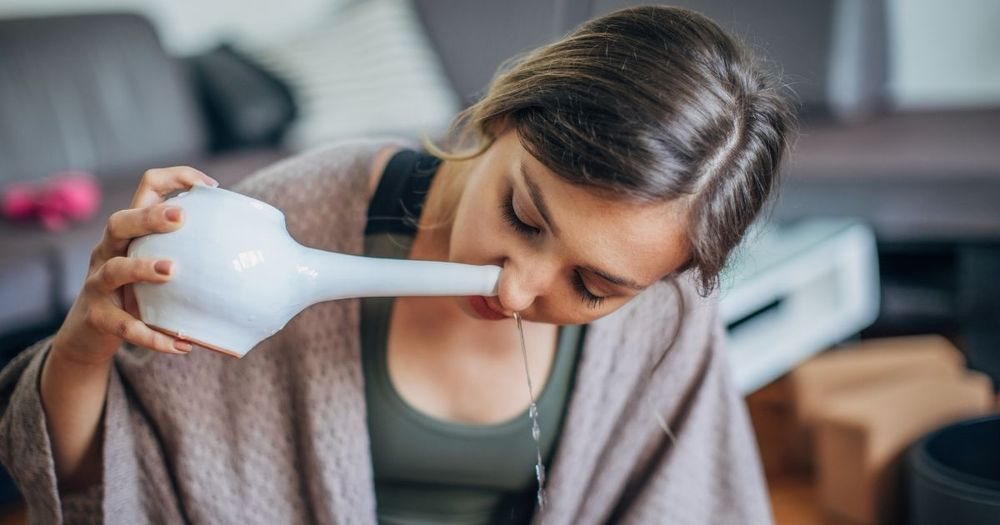
And the oldest of the lot. Washing the nose with a neti pot goes back to Indian Ayurveda, where it was a daily habit of personal hygiene. It's also the one on this list with the best support, and a with saline packets does the job. Natural Sinus Relief: What Works, and What Makes It Worse has the tests and the one rule that matters: never use water straight from the tap.
As for drinking water to thin the mucus, I can't show you a good trial. It's the right drink anyway. And since alcohol and aged food carry their own histamine, Your Hay Fever May Start on the Road, Not in the Field has what to leave out in your worst weeks.
When it is more
Swelling of the lips, tongue or throat, trouble breathing or a sudden faint is an emergency. Call for help straight away. Wheezing or a tight chest is worth getting checked too, because that's asthma territory, and everything above comes second to that.
Small changes, big relief
None of this takes a personality transplant. Think about your own home for a minute. Where do you sneeze? Is it worse in bed, on the sofa, in one room, in the morning? Your house has been dropping hints for years, and it costs nothing to listen.
Tonight, sniff your bedroom as if you were buying the place. This week, wash the bedding hot and put a humidity gauge by the bed.
Reacting to something and not sure what? Unconventional Remedies for Chronic Allergies — what an allergy is, why the farm protects, how to find your triggers, the bedroom, butterbur, local honey, and training the immune system on purpose.
Worse when the pollen is out? Your Hay Fever May Start on the Road, Not in the Field — what comes in with the pollen, what comes in with food and drink, how to keep it outside, and relief for a bad day.
Know someone who bought the hypoallergenic dog and is still sneezing? Send them this, and say hello to the dog.
Disclaimer: This article is general information. For advice about your own health, talk to a qualified health professional.
Affiliate Disclosure: This article contains affiliate links. As an Amazon Associate, All For Life earns from qualifying purchases, at no extra cost to you. We only link to products we would recommend without the commission.
Sources
Wikipedia. Bo (dog). en.wikipedia.org
Vredegoor DW, Willemse T, Chapman MD, et al. (2012). Can f 1 levels in hair and homes of different dog breeds: Lack of evidence to describe any dog breed as hypoallergenic. Journal of Allergy and Clinical Immunology 130(4):904–909.e7. doi.org/10.1016/j.jaci.2012.05.013
Nicholas CE, Wegienka GR, Havstad SL, et al. (2011). Dog Allergen Levels in Homes with Hypoallergenic Compared with Nonhypoallergenic Dogs. American Journal of Rhinology & Allergy 25(4):252–256. doi.org/10.2500/ajra.2011.25.3606
Wikipedia. Hypoallergenic dog breed. en.wikipedia.org
Arbes SJ, Cohn RD, Yin M, et al. (2004). Dog allergen (Can f 1) and cat allergen (Fel d 1) in US homes: Results from the National Survey of Lead and Allergens in Housing. Journal of Allergy and Clinical Immunology 114(1):111–117. doi.org/10.1016/j.jaci.2004.04.036
Wood RA, Chapman MD, Adkinson NF, Eggleston PA (1989). The effect of cat removal on allergen content in household-dust samples. Journal of Allergy and Clinical Immunology 83(4):730–734. doi.org/10.1016/0091-6749(89)90006-7
Almqvist C, Wickman M, Perfetti L, et al. (2001). Worsening of Asthma in Children Allergic to Cats, after Indirect Exposure to Cat at School. American Journal of Respiratory and Critical Care Medicine 163(3):694–698. doi.org/10.1164/ajrccm.163.3.2006114
Hodson T, Custovic A, Simpson A, et al. (1999). Washing the dog reduces dog allergen levels, but the dog needs to be washed twice a week. Journal of Allergy and Clinical Immunology 103(4):581–585. doi.org/10.1016/s0091-6749(99)70227-7
Wikipedia. Fel d 1. en.wikipedia.org
Satyaraj E, Li Q, Sun P, Sherrill S (2019). Anti-Fel d1 immunoglobulin Y antibody-containing egg ingredient lowers allergen levels in cat saliva. Journal of Feline Medicine and Surgery 21(10):875–881. doi.org/10.1177/1098612X19861218
Purina. Purina Pro Plan Announces the First and Only Allergen-Reducing Cat Food. newscenter.purina.com
Hesselmar B, Hicke-Roberts A, Lundell AC, et al. (2018). Pet-keeping in early life reduces the risk of allergy in a dose-dependent fashion. PLoS One 13(12):e0208472. doi.org/10.1371/journal.pone.0208472
Wegienka G, Johnson CC, Havstad S, et al. (2011). Lifetime dog and cat exposure and dog- and cat-specific sensitization at age 18 years. Clinical & Experimental Allergy 41(7):979–986. doi.org/10.1111/j.1365-2222.2011.03747.x
Arlian LG, Neal JS, Morgan MS, et al. (2001). Reducing relative humidity is a practical way to control dust mites and their allergens in homes in temperate climates. Journal of Allergy and Clinical Immunology 107(1):99–104. doi.org/10.1067/mai.2001.112119
Nurmatov U, van Schayck CP, Hurwitz B, Sheikh A (2012). House dust mite avoidance measures for perennial allergic rhinitis: an updated Cochrane systematic review. Allergy 67(2):158–165. doi.org/10.1111/j.1398-9995.2011.02752.x
McDonald LG, Tovey E (1992). The role of water temperature and laundry procedures in reducing house dust mite populations and allergen content of bedding. Journal of Allergy and Clinical Immunology 90(4):599–608. doi.org/10.1016/0091-6749(92)90132-l
Tovey ER, Woolcock AJ (1994). Direct exposure of carpets to sunlight can kill all mites. Journal of Allergy and Clinical Immunology 93(6):1072–1074. doi.org/10.1016/s0091-6749(94)70058-3
Jaakkola MS, Quansah R, Hugg TT, et al. (2013). Association of indoor dampness and molds with rhinitis risk: A systematic review and meta-analysis. Journal of Allergy and Clinical Immunology 132(5):1099–1110.e18. doi.org/10.1016/j.jaci.2013.07.028
Rosenstreich DL, Eggleston P, Kattan M, et al. (1997). The Role of Cockroach Allergy and Exposure to Cockroach Allergen in Causing Morbidity among Inner-City Children with Asthma. New England Journal of Medicine 336(19):1356–1363. doi.org/10.1056/NEJM199705083361904
Arbes SJ, Sever M, Mehta J, et al. (2004). Abatement of cockroach allergens (Bla g 1 and Bla g 2) in low-income, urban housing: month 12 continuation results. Journal of Allergy and Clinical Immunology 113(1):109–114. doi.org/10.1016/j.jaci.2003.10.042
Zajac AE, Adams AS, Turner JH (2015). A systematic review and meta-analysis of probiotics for the treatment of allergic rhinitis. International Forum of Allergy & Rhinology 5(6):524–532. doi.org/10.1002/alr.21492
Hesselmar B, Hicke-Roberts A, Wennergren G (2015). Allergy in children in hand versus machine dishwashing. Pediatrics 135(3):e590–e597. doi.org/10.1542/peds.2014-2968
Johnston CS, Martin LJ, Cai X (1992). Antihistamine Effect of Supplemental Ascorbic Acid and Neutrophil Chemotaxis. Journal of the American College of Nutrition 11(2):172–176. doi.org/10.1080/07315724.1992.12098241
Hoff S, Seiler H, Heinrich J, et al. (2005). Allergic sensitisation and allergic rhinitis are associated with n-3 polyunsaturated fatty acids in the diet and in red blood cell membranes. European Journal of Clinical Nutrition 59(9):1071–1080. doi.org/10.1038/sj.ejcn.1602213
Wu S, Xiao D (2016). Effect of curcumin on nasal symptoms and airflow in patients with perennial allergic rhinitis. Annals of Allergy, Asthma & Immunology 117(6):697–702.e1. doi.org/10.1016/j.anai.2016.09.427
Halegoua-DeMarzio D, Navarro V, Ahmad J, et al. (2023). Liver Injury Associated with Turmeric—A Growing Problem: Ten Cases from the Drug-Induced Liver Injury Network [DILIN]. The American Journal of Medicine 136(2):200–206. doi.org/10.1016/j.amjmed.2022.09.026
Wikipedia. Nasal irrigation. en.wikipedia.org