
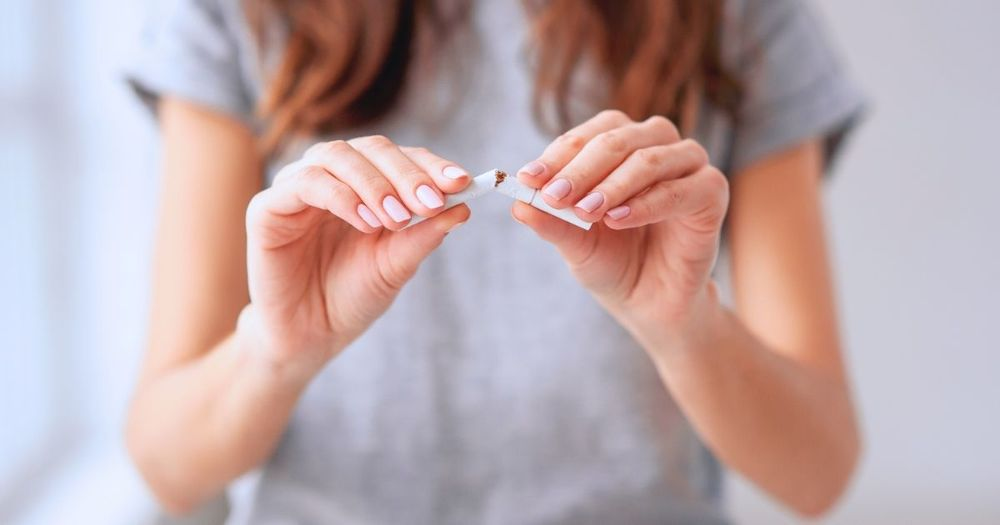
If you've tried to quit smoking on willpower alone and failed, you're in the vast majority. When people stop with no help at all, about 3 to 5% are still off cigarettes 6 to 12 months later, and most of the relapses come in the first 8 days. That doesn't make you weak. It means you've been fighting one of the hardest addictions there is with the least effective method available.
The internet would like to sell you a natural way out: herbs, needles, hypnosis, a juice cleanse. Some of these are harmless and useless. One of them can put you in hospital. And the medicines they tell you to avoid are what works best, along with one natural compound you've probably never heard of.
So here are the natural strategies, tested. It's worth getting right, because nothing else a smoker can do for their health comes close.
What you get back
Set against those who kept smoking, people who stopped at 25 to 34 gained about 10 years of life. Those who stopped at 35 to 44 gained about 9, and those who stopped at 45 to 54 gained about 6. Stopping before 40 removes about 90% of the extra risk of dying.
If you're reading this at 65 and thinking it's too late, it isn't. In a review of 17 studies of people aged 60 and over, smokers had 1.83 times the death rate of people who'd never smoked. Former smokers had 1.34 times, and that gap kept narrowing the longer they'd stopped. The benefit showed up in every age group, including people over 80.
Your lungs do something remarkable too. When researchers sequenced the genes of individual cells from the airways, smoking had typically added 1,000 to 10,000 mutations to each one. But some cells in people with a smoking history looked like those of people who'd never smoked, and these near-undamaged cells were four times as common in ex-smokers as in current smokers. That doesn't mean your lungs reset completely. They do seem to keep a reserve that comes back once you stop feeding them smoke.
The people you live with get something back as well. The NHS says most of the smoke from a cigarette goes into the air around you, not your lungs, and that people who regularly breathe it are more likely to get the same diseases as smokers. It's especially dangerous for children. So until you've stopped, keep the home and the car smoke-free. For some readers, that's a better reason than their own lungs.
All at once, or bit by bit?
Cutting down feels like the gentler, more sensible way. It's what you'd probably choose. In a trial, smokers were assigned to one or the other. At 6 months, 22% of those who stopped abruptly were still off cigarettes, against 15.5% of those who cut down first. Even the people who preferred cutting down did worse with it than the ones who preferred stopping.
So pick a date, and stop on that date.
Know what's coming, because it's less alarming if you've been told. In the first days and weeks you can expect cravings, irritability, anxiety, low mood, restlessness, trouble sleeping, hunger and poor concentration. That's withdrawal. The main symptoms peak within the first week and last 2 to 4 weeks, which is why the first week is so hard, and why it ends. It doesn't mean something has gone wrong, or that you're someone who can't do this. If you're still low after that, ask for help.
Lobelia
The herb you most need to avoid is the one the natural lists love. It's called Indian tobacco, and it's sold as a nicotine substitute. A review found no long-term trials showing that lobeline, its active compound, helps people stop, and the one large short-term trial found no benefit. Taking lobelia can cause sweating, nausea, vomiting, tremors, a racing heart, confusion and convulsions, and possibly death. Leave it on the shelf.
Needles and hypnosis
Both have their devoted clients, and you'll read of studies proving them. A review of 38 studies found that acupuncture was no clearer than a waiting list for long-term quitting, and that it did worse than nicotine replacement. The bigger studies showed smaller effects, which is what you'd expect from a weak result.
For hypnosis, 14 studies with 1,926 people gave no reliable evidence of a benefit over other treatments or nothing at all. Most of them found no difference at six months or more, and only one was rated as well run. So the claim that hypnosis beats nicotine replacement has nothing behind it. If you've quit with it, I'm genuinely pleased for you. You did the quitting.
Exercise, breathing and the juice
Exercise. Across 24 trials with 7,279 people, adding exercise to a quit programme didn't improve quit rates, though a modest benefit can't be ruled out. It's worth doing anyway, for what it does for everything else, and a walk is a decent place to take a craving.
Breathing. Slow breathing can help you ride out a bad moment, and it costs nothing. It doesn't "re-oxygenate" you. Stopping smoking does that. How Breathing Affects Your Emotional State has what slow breathing does.
Detox and juicing. No trial supports them. Your liver and kidneys clear what's left without any help, and What a Liver Detox Cannot Do That Your Liver Already Does has why. A glass of beetroot and apple is mostly sugar, and you can't juice your way out of an addiction.
The natural one that works
Now for the surprise. It comes from the seeds of a golden-rain shrub, and it has been sold in Bulgaria as a quit aid since 1964. It's called cytisine, and it works on the same receptors as nicotine. It was barely known outside eastern Europe until researchers tested it properly.
In a trial with 1,310 people, 40% of those on cytisine had stayed off cigarettes at one month, against 31% on nicotine replacement, and it stayed ahead at 6 months. It did come with more reported side effects, mostly nausea and sleep trouble. A large Cochrane review agrees that it helps more people quit than a dummy pill or no medication, and the WHO lists it as an essential medicine.
It isn't available everywhere. In June 2026 the FDA turned down the US application, citing problems at a manufacturing site and unfinished labelling, so that's a decision about paperwork rather than about whether it works. Elsewhere, ask a pharmacist or a qualified health professional. Natural doesn't mean do-it-yourself: this is a real drug from a toxic plant, so don't go near the seeds. The shrub is not a starter kit.
What works best
Here's what the natural lists leave out, because there's nothing natural about it.
Nicotine replacement. Patches, gum, lozenges, sprays and inhalers raise quit rates by 50 to 60%, on high-quality evidence, whether or not you also get extra support. A Cochrane review found high-certainty evidence that using more than one form together, such as a patch with gum, works better than one alone. The nicotine isn't what kills you. It's what keeps you lighting the thing that does.
Prescription medicines. Varenicline, in that same review, beat single forms of nicotine replacement, though people taking it were probably more likely to have serious side effects. Talk it over with a qualified health professional.
Vaping. You may not want to hear this, but it can't honestly be left out. The latest Cochrane review, from August 2026, finds high-certainty evidence that nicotine vapes help more people quit than nicotine replacement does, with similar rates of serious side effects. That's not a recommendation to take up vaping if you don't smoke. The long-term effects aren't known yet, and the goal is to end up on no nicotine at all. But as a way off cigarettes, it has now got the evidence.
The one course with a result
There's a drug-free method with real evidence behind it, and it isn't on the usual lists. In a trial of 300 smokers, 22% of those who went on Allen Carr's Easyway course were off cigarettes at 12 months, against 11% of those given a free national quit service. Its message is that smoking gives you nothing, so there's nothing to give up. They did gain more weight, 3.8 kg against 1.8 kg.
That trial tested the live course, and it was a single trial. The book, , is the cheap way in, and it hasn't had that test.
In the moment
A craving passes, and it helps to have something to do while it does. Three minutes of Tetris cut cravings by about 14 points out of 100 in The Hidden Science of Sugar Cravings, and cigarettes were on the list. It's the most useful thing Tetris has ever done. Digital Overwhelm: Breaking Free from Phone Addiction and Information Overload has the 123 student smokers taught to watch a craving rise and fall. Their urges were no weaker, but they smoked less over the following week.
Your hands will want a job. , a pen, a puzzle or a pack of all do it, so keep a small kit where the lighter used to be. And get rid of the cigarettes. The Real Reason Your Habits Never Stick has why every extra step between you and a habit counts. The spare pack in the glove box is a plan to fail.
The Real Reason Your Habits Never Stick has a longer course as well. 88 smokers had four weeks of mindfulness training or the usual course, and 17 weeks on, 31% of the first group were still off cigarettes against 6% of the second. It's one small trial, but it's cheap to try.
Who you quit with, and what you bet
Smoking travels through people, and so does stopping. The Real Reason Your Habits Never Stick has the Framingham study, in which a husband or wife stopping cut the other's chance of smoking by 67%. So if there are two of you, try to do it together.
It also has the commitment accounts. Smokers paid in for six months, passed a nicotine test to get the money back, and otherwise lost it to charity. Only 11% took it up, and yet the offer alone raised the pass rate by 3 points, and that still showed at twelve months. That's a small effect, and you can copy it for nothing with a friend and a sum you'd hate to lose. Pick a charity you can't stand.
Your weight
This is what keeps a lot of smokers smoking, so let's put a number on it. Across 62 studies, people who quit with no treatment had gained an average of 4.67 kg by 12 months. That's an average with a wide spread: 16% lost weight, and 13% gained more than 10 kg.
It's a real cost, and it's nowhere near the cost of smoking. You can lose four kilos later. You can't buy back the ten years. Put meat, fish and eggs at the centre of your meals, because they keep you full, and watch what you reach for in place of the cigarette.
Coffee
Smoking speeds up how fast your body clears caffeine, so when you stop and keep your usual coffee, your caffeine levels climb. How to Quit Coffee: Getting Through Caffeine Withdrawal has the smokers whose levels had doubled three weeks on. So some of the jitters and broken sleep you blame on the missing cigarettes may come from the cup. Cut back at the same time, and drink water.
What to do, in order
Set a date, and stop on it. Don't taper. If you're pregnant, the NHS says it's never too late, and that you can use nicotine replacement if you can't stop without it, though not stop-smoking tablets such as varenicline. Ask a qualified health professional what suits you.
Get your help lined up first. Nicotine replacement, or a medicine from a qualified health professional. Using something isn't cheating, and it's the best way to beat that 3 to 5%.
Tell someone, or do it together. A partner who quits with you beats a shelf of herbs. Put some money on it if that helps.
Clear the house. Cigarettes, lighters, ashtrays, and the spare pack in the car.
Plan for the first 8 days. That's when most relapses come, so don't book the stag weekend.
Have your kit ready. Something for your hands, something for your mouth, a game on your phone.
Cut the coffee back.
If you slip, go again. One cigarette isn't the end of it, unless you decide it is. Set a new date.
You've probably been told that quitting is about wanting it enough. Mostly it's about having the right help for the worst 8 days of the job, and those 10 years are what you get for it. Pick your date tonight, and write it down.
Worried the habit will come back? Why Motivation Fails — and What Keeps Habits Going After It Does — why the first burst fades, how long a new habit takes, and what to do on the day you slip.
Not sleeping now you've stopped? The Stress-Sleep Vicious Cycle: How to Break It — why stress and bad nights feed each other, and how to break the loop.
Know someone with a spare pack in the glove box? Send them this, and offer to quit with them.
Disclaimer: This article is general information. For advice about your own health, talk to a qualified health professional before starting any quit-smoking medicine, especially if you're pregnant or have a heart condition. If stopping smoking leaves you low or unwell, ask for help.
Affiliate Disclosure: This article contains affiliate links. As an Amazon Associate, All For Life earns from qualifying purchases, at no extra cost to you. We only link to products we would recommend without the commission.
Sources
Hughes JR, Keely J, Naud S (2004). Shape of the relapse curve and long‐term abstinence among untreated smokers. Addiction 99(1):29–38. doi.org/10.1111/j.1360-0443.2004.00540.x
Jha P, Ramasundarahettige C, Landsman V, et al. (2013). 21st-Century Hazards of Smoking and Benefits of Cessation in the United States. New England Journal of Medicine 368(4):341–350. doi.org/10.1056/NEJMsa1211128
Yoshida K, Gowers KHC, Lee-Six H, et al. (2020). Tobacco smoking and somatic mutations in human bronchial epithelium. Nature 578(7794):266–272. doi.org/10.1038/s41586-020-1961-1
Gellert C, Schöttker B, Brenner H (2012). Smoking and all-cause mortality in older people: systematic review and meta-analysis. Archives of Internal Medicine 172(11):837–844. doi.org/10.1001/archinternmed.2012.1397
NHS. Passive smoking. nhs.uk
Lindson-Hawley N, Banting M, West R, et al. (2016). Gradual Versus Abrupt Smoking Cessation. Annals of Internal Medicine 164(9):585–592. doi.org/10.7326/M14-2805
Hughes JR (2007). Effects of abstinence from tobacco: valid symptoms and time course. Nicotine & Tobacco Research 9(3):315–327. doi.org/10.1080/14622200701188919
Wikipedia. Nicotine withdrawal. en.wikipedia.org
Stead LF, Hughes JR (2012). Lobeline for smoking cessation. Cochrane Database of Systematic Reviews 2012(2). doi.org/10.1002/14651858.CD000124.pub2
Wikipedia. Lobelia inflata. en.wikipedia.org
White AR, Rampes H, Liu JP, et al. (2014). Acupuncture and related interventions for smoking cessation. Cochrane Database of Systematic Reviews 2014(1). doi.org/10.1002/14651858.CD000009.pub4
Barnes J, McRobbie H, Dong CY, et al. (2019). Hypnotherapy for smoking cessation. Cochrane Database of Systematic Reviews 2019(6). doi.org/10.1002/14651858.CD001008.pub3
Ussher MH, Faulkner GEJ, Angus K, et al. (2019). Exercise interventions for smoking cessation. Cochrane Database of Systematic Reviews 2019(10). doi.org/10.1002/14651858.CD002295.pub6
Walker N, Howe C, Glover M, et al. (2014). Cytisine versus Nicotine for Smoking Cessation. New England Journal of Medicine 371(25):2353–2362. doi.org/10.1056/NEJMoa1407764
Wikipedia. Cytisine. en.wikipedia.org
Livingstone-Banks J, Fanshawe TR, Thomas KH, et al. (2023). Nicotine receptor partial agonists for smoking cessation. Cochrane Database of Systematic Reviews 2023(5). doi.org/10.1002/14651858.CD006103.pub8
Hartmann-Boyce J, Chepkin SC, Ye W, et al. (2018). Nicotine replacement therapy versus control for smoking cessation. Cochrane Database of Systematic Reviews 2019(1). doi.org/10.1002/14651858.CD000146.pub5
Lindson N, Chepkin SC, Ye W, et al. (2019). Different doses, durations and modes of delivery of nicotine replacement therapy for smoking cessation. Cochrane Database of Systematic Reviews 2019(4). doi.org/10.1002/14651858.CD013308
Lindson N, Livingstone-Banks J, Butler AR, et al. (2026). Electronic cigarettes for smoking cessation. Cochrane Database of Systematic Reviews 2026(8). doi.org/10.1002/14651858.CD010216.pub11
Keogan S, Li S, Clancy L (2019). Allen Carr’s Easyway to Stop Smoking - A randomised clinical trial. Tobacco Control 28(4):414–419. doi.org/10.1136/tobaccocontrol-2018-054243
Skorka-Brown J, Andrade J, Whalley B, May J (2015). Playing Tetris decreases drug and other cravings in real world settings. Addictive Behaviors 51:165–170. doi.org/10.1016/j.addbeh.2015.07.020
Bowen S, Marlatt A (2009). Surfing the urge: Brief mindfulness-based intervention for college student smokers. Psychology of Addictive Behaviors 23(4):666–671. doi.org/10.1037/a0017127
Brewer JA, Mallik S, Babuscio TA, et al. (2011). Mindfulness training for smoking cessation: Results from a randomized controlled trial. Drug and Alcohol Dependence 119(1-2):72–80. doi.org/10.1016/j.drugalcdep.2011.05.027
Christakis NA, Fowler JH (2008). The Collective Dynamics of Smoking in a Large Social Network. New England Journal of Medicine 358(21):2249–2258. doi.org/10.1056/NEJMsa0706154
Giné X, Karlan D, Zinman J (2010). Put Your Money Where Your Butt Is: A Commitment Contract for Smoking Cessation. American Economic Journal: Applied Economics 2(4):213–235. doi.org/10.1257/app.2.4.213
Aubin HJ, Farley A, Lycett D, et al. (2012). Weight gain in smokers after quitting cigarettes: meta-analysis. BMJ 345:e4439. doi.org/10.1136/bmj.e4439
Swanson JA, Lee JW, Hopp JW, Berk LS (1997). The impact of caffeine use on tobacco cessation and withdrawal. Addictive Behaviors 22(1):55–68. doi.org/10.1016/S0306-4603(96)00023-8
NHS. Stop smoking in pregnancy. nhs.uk