
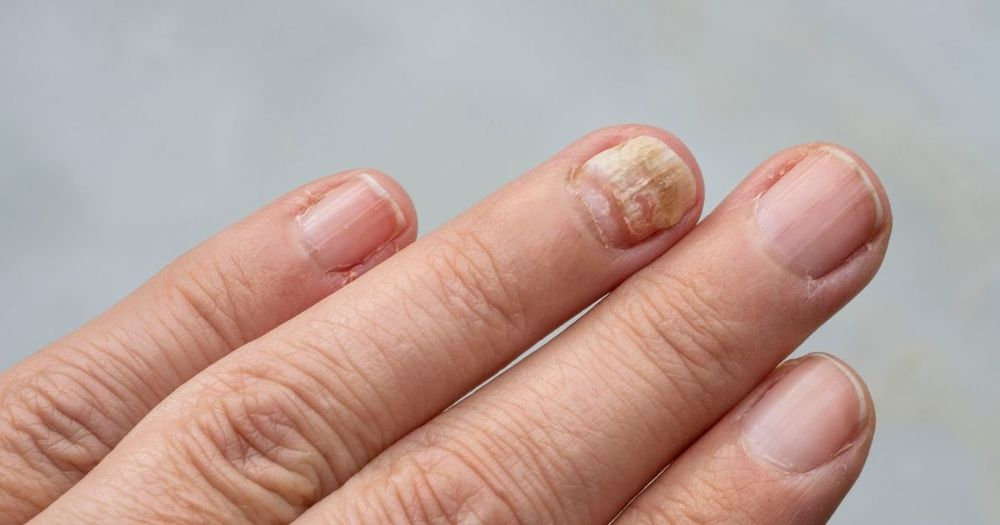
Have you ever struggled with a stubborn fungal nail infection that won't go away? The thick, discoloured nail hides in your shoe all winter, then comes the first warm day and the first pair of sandals. Suddenly you have strong opinions about closed shoes in July. It can take a real toll on your confidence and your comfort.
Nail fungus is common. About one adult in ten has it, and the older you get, the likelier it is. It is also slow, stubborn and very good at coming back, which is why so many natural remedies are sold for it, and why it pays to know which of them have been tested.
So before you reach for anything, let's start with three questions. Is it really fungus? How did it get in? And what will stop it coming back? The remedies make far more sense after that.
Is it really fungus?
This comes first, because it often isn't.
Fungus accounts for only about half of nail disease. Psoriasis, an old injury, a shoe that has been pressing for years: any of them can leave a nail thick, yellow and brittle, and none of them will answer to an antifungal. You can't cure a fungus you don't have. Rarely, a dark mark under a nail is something more serious, a melanoma, and that needs looking at without delay.
So it's essential to ensure that your nail problems are indeed due to a fungal infection. A clipping can be tested in a laboratory, and it is worth doing before you spend months treating the wrong thing.
Traditional Chinese medicine has long read the nails as a window into overall health, and it isn't wrong that they can tell you things. What Your Eyes, Tongue, Nails, Skin, and Breath Are Telling You About Your Health, linked below, has what else a nail can show.
How it gets in
It took until 1853 for a German anatomist, Georg Meissner, to show that a fungus was behind it. The usual culprit today is a fungus called Trichophyton rubrum, which is also behind most athlete's foot, and it likes what shoes offer: warmth, damp and the dark. To a fungus, your trainer is a holiday home.
It may be a modern problem. Athlete's foot was first described only in 1908, and it is believed to have been rare until the 20th century, when shoes, health clubs, war and travel spread it. One strain of the fungus has stayed mostly in Africa and southern Asia. The one that infects feet and nails has gone around the world.
The way in is usually a small one. Athlete's foot between the toes can spread to the nail. A knock or a nail torn too short opens a gap. Walking barefoot on the wet floors of pools, gyms and shower rooms gives it the chance, and socks and shoes that hold sweat do the rest.
Fingernails are a slightly different story. They are often infected by a yeast, Candida, usually after the nail has been damaged, in people whose hands are often in water. If that is you, wear rubber gloves for long stretches at the sink.
Some bodies are easier to get into. Age is the biggest risk of all, because circulation slows, nails thicken and grow more slowly, and the immune system weakens. Diabetes and poor circulation raise the risk too. If you have either of those, take a nail problem seriously and have your feet checked, because an infection that spreads to the skin of the leg is a much bigger problem than an ugly nail.
Tea tree, the best tested
Of the natural remedies, tea tree oil has the most behind it, and the results are honest rather than dazzling.
In one trial, 117 people with fungus confirmed by a laboratory applied either pure tea tree oil or a standard antifungal solution, clotrimazole, twice a day for six months. The fungus was gone in 18% of the tea tree group and 11% of the clotrimazole group. In both, about 60% saw the nail partly or fully improve. So tea tree did as well as the standard solution. An honest draw, and honest draws rarely make the label. Neither was a miracle, and on the present data tea tree oil is still not a recommended treatment.
You may also see a more exciting figure. In a smaller trial, 80% of people using a cream were cured, against none on a dummy cream. But that cream also contained 2% butenafine, an antifungal drug, so it says little about tea tree on its own.
If you try it, a small bottle of goes a long way. Tea tree oil is for the outside of the body only. It is poisonous if swallowed, and it can irritate the skin. Essential Oils: What They Can Do and How to Use Them Safely, linked below, has why it causes more skin allergies than any other essential oil, and why an old bottle is worse than a fresh one.
Whatever you use, file the nail down first. Removing the affected part appears to improve results, and the tea tree trial filed nails at each visit. A thick nail keeps a remedy out, so keep it filed thin, with a file you keep for that foot. If you have diabetes or poor circulation, have someone trained do it, because a small cut on the foot can matter a great deal.
The plant you haven't heard of
The most promising plant in the research rarely appears on the lists. Ageratina pichinchensis has long been used in Mexican traditional medicine for fungal skin problems, and researchers there have made it into a nail lacquer.
In a double-blind trial of 122 people with mild to moderate infections, painted on for six months, the lacquer worked in 67% at the lower strength and 79% at the higher one, with no side effects reported. That trial compared two strengths and had no dummy group, so read it with care. In a later trial in people with type 2 diabetes, it did about as well as a prescription lacquer, ciclopirox, at around 78% each, and those figures count nails that got better, not only nails that were cured.
It is harder to buy than tea tree, but it is the one to watch.
Propolis, the resin bees make, is another lead. In one study, an extract was shown to get through the nail in the lab, and patients who used it and were followed for six months reached a complete cure in 56% of cases. The summary mentions no comparison group, so it is a promising lead and nothing more.
Chest rub
You may have heard about rubbing a mentholated chest rub such as on the nail. A small pilot tested it: 18 people, 48 weeks. Five were cured, ten cleared in part and three saw no change, and all 18 were satisfied with how the nail looked at the end. There was no comparison group, so it is a hint and no more.
Camphor: The Cooling Remedy That Needs Respect has what else is in the jar, and how to use it safely.
The kitchen remedies, honestly
Apple cider vinegar, coconut oil, oregano oil, garlic and Epsom salt fill the usual lists, including, until now, this one. I looked for good trials on fungal nails and did not find them. Some of them can slow fungus in a laboratory dish, but a dish is not a thick nail with fungus living underneath it. The nail protects the fungus better than any dish could.
That doesn't make them useless. A warm foot soak is pleasant, and if it gets you looking at your feet every day, so much the better.
Just be careful with them. Dry your feet thoroughly afterwards, between the toes and around the nails, because damp is what the fungus wants. Oregano oil is very strong, so always dilute it with a carrier oil and stop if it stings. Raw garlic left on the skin can burn. And Epsom salt does not draw out toxins, because that isn't how skin works.
What the prescriptions do
You deserve the whole picture, so here it is. The strongest treatment is terbinafine taken by mouth, which is about 76% effective. It also carries a risk of liver problems, which is why it is only recommended once the fungus has been confirmed. Prescription nail paints are gentler and weaker: with one of the better ones, efinaconazole, about 17% of people were cured, against 4% on a dummy. This fungus has earned its reputation.
A newer option may change that. Terbinafine in a form applied to the nail launched in Sweden in 2024 and is rolling out across Europe. In two large studies it cleared the fungus in 76% of people, with levels in the blood about 1,000 times lower than when taken by mouth.
Laser is often advertised, and as of 2014 the evidence for it was unclear and of low quality. A different approach, a dye activated by light, looks more promising: in a 2025 review of 18 studies and 591 people, cure rates ranged from 20% to 80%. That is a wide range, so treat it as a lead.
Those numbers tell you how hard this fungus is to shift. They also put the natural remedies in perspective.
And here is something the adverts don't say: a fungal nail does not always need treating. If it doesn't hurt, you are otherwise well and it bothers you only a little, leaving it alone and keeping it trimmed is a reasonable choice.
Why it takes so long
Patience and consistency are key, and there is a simple reason. Nothing repairs the damaged part of a nail. It has to grow out. A toenail keeps its own calendar, and it is in no hurry.
When healthy young adults marked their nails and measured them, fingernails grew about 3.5 mm a month and toenails only 1.6 mm. At that speed, a big toenail needs a year or more to replace itself, and nails grow more slowly as we age. 12 Signs Your Body Is Trying to Tell You Something Important has what else that slow growth records.
So take a photograph on the first day, look for clear nail growing up from the base, and don't judge the result for months.
Stop it coming back
This is the part that matters most, because the infection returns in up to half of cases.
Wash hot. In laboratory tests, the fungus survived a wash at 30°C, and about a tenth of it passed from infected fabric to clean fabric in the laundry basket. A wash at 60°C killed it. So wash socks and towels hot, and keep them apart from the rest.
Retire the old shoes. Fungus lives in them, and not going back to old shoes after treatment may lower the risk of the infection returning. Sentiment is no reason to reinfect yourself.
Keep feet dry. Good Hygiene: The Everyday Habits That Matter Most has the habit: dry between the toes, and give shoes a day to dry out between wears.
Treat athlete's foot quickly. It is the usual route to the nail. And wear sandals on the wet floors of pools, gyms and shower rooms.
Keep nails short. Trimming the affected nail during treatment also seems to help. Keep separate clippers for that foot.
Share nothing. Living with someone who has it raises the risk, and so does a family history. Keep towels, bath mats and clippers to yourself.
Clean your tools. A 2025 review found that fungus lingering in shoes, socks and foot tools is a common reason infections return. Steam sterilising was the most reliable way to clean reusable tools, so if you can't do that, keep a set that never touches your other foot.
What you eat
No trial has shown that cutting sugar clears a fungal nail, so I won't tell you it does. But reducing sugar and refined carbohydrates is still worth doing here. Diabetes is a clear risk for fungal nails, and in the diabetes trial above, blood sugar control played an important part in how well treatment worked.
A plate built on meat, fish and eggs, with little sugar or flour, keeps blood sugar steady. How to Fix Blood Sugar Spikes Naturally has how. Protein also gives your body what it needs to build new nail, which is made of keratin, a protein.
One nail at a time
Dealing with a fungal nail infection can be challenging, but you now know more than most of the labels will tell you. Check that it is fungus. Close the way in. Choose a remedy with your eyes open, and give it the months it needs.
Tonight, take a photograph of the nail, and put your socks in the hot wash.
Thinking of using the oil? Essential Oils: What They Can Do and How to Use Them Safely — what is in the bottle, what the evidence supports, where the claims go too far, and how to use them safely.
Wondering what else your nails are saying? What Your Eyes, Tongue, Nails, Skin, and Breath Are Telling You About Your Health — the nails, the skin, the tongue and the rest of the signs, and how to read them together.
Know someone who won't take their socks off at the pool? Send them this, gently.
Disclaimer: This article is general information. For advice about your own health, talk to a qualified health professional.
Affiliate Disclosure: This article contains affiliate links. As an Amazon Associate, All For Life earns from qualifying purchases, at no extra cost to you. We only link to products we would recommend without the commission.
Sources
Wikipedia. Onychomycosis. en.wikipedia.org
Wikipedia. Athlete's foot. en.wikipedia.org
Wikipedia. Trichophyton rubrum. en.wikipedia.org
Buck DS, Nidorf DM, Addino JG (1994). Comparison of two topical preparations for the treatment of onychomycosis: Melaleuca alternifolia (tea tree) oil and clotrimazole. The Journal of Family Practice 38(6):601–605. pubmed.ncbi.nlm.nih.gov
Syed TA, Qureshi ZA, Ali SM, et al. (1999). Treatment of toenail onychomycosis with 2% butenafine and 5% Melaleuca alternifolia (tea tree) oil in cream. Tropical Medicine & International Health 4(4):284–287. doi.org/10.1046/j.1365-3156.1999.00396.x
Romero-Cerecero O, Román-Ramos R, Zamilpa A, et al. (2009). Clinical trial to compare the effectiveness of two concentrations of the Ageratina pichinchensis extract in the topical treatment of onychomycosis. Journal of Ethnopharmacology 126(1):74–78. doi.org/10.1016/j.jep.2009.08.007
Romero-Cerecero O, Islas-Garduño AL, Zamilpa A, Tortoriello J (2020). Effectiveness of an encecalin standardized extract of Ageratina pichinchensis on the treatment of onychomycosis in patients with diabetes mellitus. Phytotherapy Research 34(7):1678–1686. doi.org/10.1002/ptr.6644
Veiga FF, Gadelha MC, da Silva MRT, et al. (2018). Propolis Extract for Onychomycosis Topical Treatment: From Bench to Clinic. Frontiers in Microbiology 9:779. doi.org/10.3389/fmicb.2018.00779
Derby R, Rohal P, Jackson C, et al. (2011). Novel Treatment of Onychomycosis using Over-the-Counter Mentholated Ointment: A Clinical Case Series. The Journal of the American Board of Family Medicine 24(1):69–74. doi.org/10.3122/jabfm.2011.01.100124
Alves RdO, Urzedo LOR, de Toledo PTA, et al. (2025). Antimicrobial photodynamic therapy in onychomycosis management: A systematic review of clinical trials. Photodiagnosis and Photodynamic Therapy 54:104640. doi.org/10.1016/j.pdpdt.2025.104640
Yaemsiri S, Hou N, Slining M, He K (2010). Growth rate of human fingernails and toenails in healthy American young adults. Journal of the European Academy of Dermatology and Venereology 24(4):420–423. doi.org/10.1111/j.1468-3083.2009.03426.x
Hammer TR, Mucha H, Hoefer D (2011). Infection Risk by Dermatophytes During Storage and After Domestic Laundry and Their Temperature-Dependent Inactivation. Mycopathologia 171(1):43–49. doi.org/10.1007/s11046-010-9347-9
Gupta AK, Taylor D, Wang T, et al. (2025). Hygiene Practices Against Dermatophytic Fungi: A Review of Strategies to Combat Antifungal Resistance. Biology 14(8):1016. doi.org/10.3390/biology14081016