The word started at a dinner party. In ancient Greek, a parásitos was a person who ate at someone else's table, from pará, beside, and sîtos, food. It was a social insult long before it was biology: the guest who always turns up, eats well and brings nothing. It kept its sting, too. From 1961 the Soviet Union prosecuted people for leading "an anti-social, parasitic way of life", and one of those charged was the poet Joseph Brodsky, who was later pushed into exile and won the Nobel Prize in Literature in 1987.
Biology kept the idea. A parasite lives on or in another creature and feeds at its expense. That much is real, and some parasites cause serious illness. What's less real is the picture sold online, in which almost everyone is secretly full of worms, almost any symptom is a clue, and a kit of powders and tinctures will flush them out. Real parasites are less dramatic than that, and more useful to understand.
Understanding parasites starts with their types and how they're transmitted, because most infections in everyday life come by a handful of specific routes. Most symptom lists can't tell you whether you have one. And the remedies with real evidence behind them are few, though one of them became a Nobel Prize-winning malaria drug.
The three kinds
Protozoa are single-celled organisms that can multiply inside you. Giardia, which causes diarrhoea, is one of the commonest parasitic diseases there is. Plasmodium causes malaria. Toxoplasma is the quiet one, of which more in a moment.
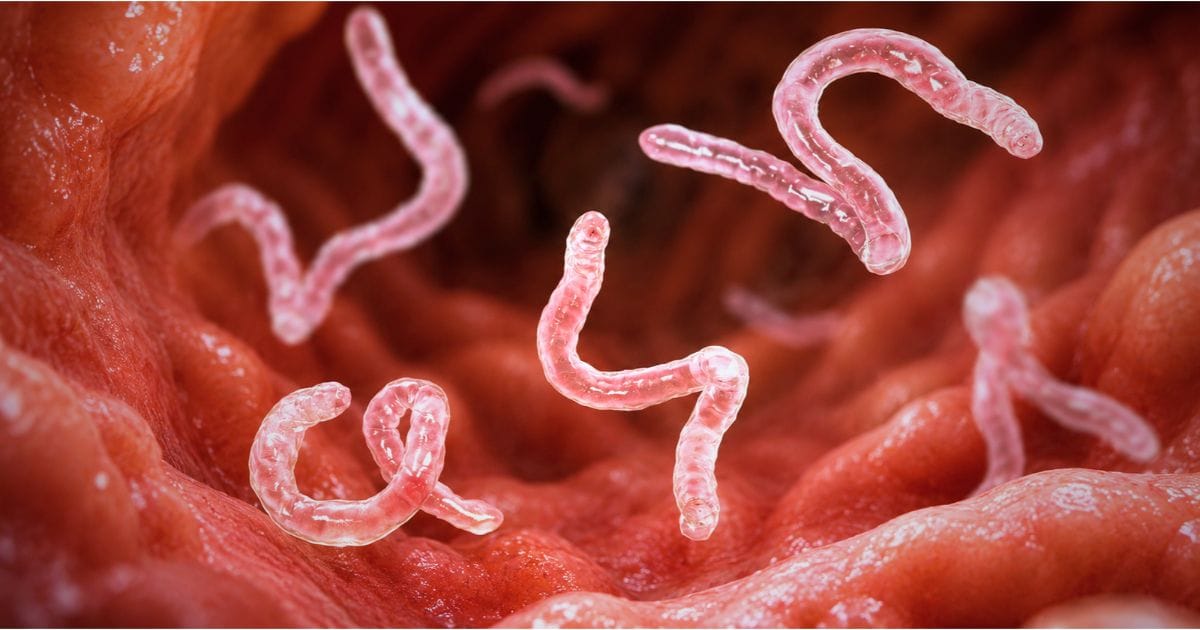
Worms, or helminths, are larger and made of many cells. They include tapeworms, which are flat, and roundworms, among them pinworms and hookworms.
Ectoparasites live on you rather than in you: lice, fleas and ticks.
Not every one is a villain. Blastocystis, one of the commonest human parasites in the world, has not been clearly shown to make a healthy person ill, and whether it does any good is still being studied. The "old friends" idea goes further, holding that some of the microbes humans have carried all through history helped train the immune system, an idea Unconventional Remedies for Chronic Allergies explores.
Some researchers have taken that idea literally. In helminthic therapy, people are deliberately given worms or worm eggs, such as hookworm or the eggs of a pig whipworm, to calm immune diseases like Crohn's, ulcerative colitis, coeliac disease and multiple sclerosis. It worked in animals, and early small studies in people looked promising, but larger trials have been inconclusive. It's still an experiment, not a treatment, and certainly not a reason to welcome a worm.
The commonest one is the least exotic
The worm most likely to turn up in a home in Western Europe or the United States isn't from a tropical holiday. It's the pinworm, called threadworm in the UK, and it's most common in children of school age.
Its main sign is itching around the bottom, often at night, when the female worms come out to lay their eggs. The eggs end up on fingers, then on food, toys, bedding and bathroom taps, and can survive for up to three weeks. That's why it spreads round a household so easily. Some who have it feel nothing at all.
The usual way to find it is low-tech. A strip of clear sticky tape is pressed against the skin around the anus first thing in the morning, then looked at under a microscope. The treatment is a medicine from a pharmacy or a qualified health professional, with bedding and towels washed in hot water and a strict round of handwashing. The others in the house may need treating too.
Up to half the world carries one
If you want an unsettling fact about parasites, here it is. Up to half the people on Earth are thought to carry Toxoplasma gondii. Most never know. It can cause a mild, flu-like illness for a few weeks, and it matters most in pregnancy, when an infection can harm the baby, and in people with a weakened immune system.
It completes its life cycle in cats, and it has a trick for getting there. Infected rats lose their natural aversion to the smell of cat urine, which makes them more likely to be caught and eaten, carrying the parasite back to its host. Infected people show differences too, among them less aversion to cat urine and a higher risk of schizophrenia, though whether the parasite causes them hasn't been settled. People pick it up from cat faeces in soil or litter trays, and from raw or undercooked meat, especially pork, lamb and venison. A knife or chopping board used for raw meat can pass it on too.
If you're pregnant, let someone else empty the litter tray. If you can't, wear gloves, wash your hands afterwards and empty it every day, because the eggs in cat faeces take about a day to become infectious. Cook meat through, wash produce, and wear gloves in the garden.
The routes in
Parasites don't arrive at random, and transmission is where prevention starts. Each has its way in, and most can be closed.
Water. Giardia cysts are passed in faeces and can survive for nearly three months in cold water. Streams that look clean, wells, and water in places with poor sanitation are the classic sources. Boil, filter or treat water you can't trust. Lakes and pools count too: one gut parasite, Cryptosporidium, is especially common in people who spend time in fresh water, swimming pools included, because it shrugs off disinfectants like chlorine bleach. Try not to swallow it.
The clearest example of what clean water can do comes from a worm. The Guinea worm is caught by drinking water that holds tiny crustaceans carrying its larvae. A year later the adult female, often more than a metre long, breaks out through a painful blister, usually on the lower leg, and leaves over several weeks.
No medicine treats or prevents it. In the 19th and early 20th centuries it affected as many as 48 million people a year. Filtering drinking water, and teaching people to keep the blister out of drinking water, brought it down to 10 cases in 2025. Clean water did what no remedy could.
Hands. Pinworm eggs and other parasites travel on unwashed hands. Washing before eating and after the toilet does more than any supplement.
Insects. Malaria arrives through the bite of an infected mosquito. Travel to malaria areas calls for nets, repellent and advice before you go.
Skin. Hookworm larvae can enter through bare feet on warm, damp soil. Health Benefits of Walking Barefoot has where that risk lies.
Animals. Cats and toxoplasma are the best-known pair. Washing your hands after the litter tray or the garden, and wearing gloves for both in pregnancy, deals with most of it.
Travel. Poor sanitation raises every one of the risks above at once.
On the plate
The salad bowl. The food route people think of first is undercooked meat, but raw produce is the bigger one for several parasites. Cyclospora, which causes watery diarrhoea, has caused outbreaks traced to leafy greens, basil, coriander and fresh berries, and washing reduces the risk without reliably removing it. In Europe, the liver fluke reaches people on watercress, lamb's lettuce, dandelion leaves and mint, especially wild-grown.
The pork tapeworm's eggs can arrive on vegetables contaminated with faeces too, and that route is the more dangerous one. Swallowed as eggs, from food or water contaminated by someone who carries the worm, they form cysts in the body instead, a disease called cysticercosis, and the most harmful form is when the cysts reach the brain. Wild berries and mushrooms carry a risk of their own: the eggs of the fox tapeworm, picked up from contaminated food, vegetables or water, grow into cysts in the liver that can spread to the lungs or brain.
Even Toxoplasma, the parasite most linked with undercooked meat, often comes the other way. When researchers tested the mothers of 76 babies born with toxoplasmosis in North America, 59 of them, 78%, had been infected by the form shed in cat faeces, which reaches people through soil, water and unwashed produce, not by the cysts in meat. Only half of those mothers could name a risk they'd been exposed to.
Meat and fish. These routes are real, and easy to close. Raw or undercooked pork can carry the cysts of the pork tapeworm, Taenia solium, which grow into a tapeworm in the gut. Freezing the meat at −10 °C for five days kills them, as does cooking it through, and freezing pork cuts under 15 cm thick at −20 °C for three days also kills Trichinella. Trichinella, a roundworm, comes from undercooked meat too, and wild meat is more likely to carry it than farmed pork; in North America the commonest source is bear. Freezing doesn't make wild meat safe, because the species found in wild game survive it; that meat has to be cooked.
Raw fish can carry Anisakis, a worm whose larvae can lodge in the gut. Cooking above 60 °C kills it, and fish meant to be eaten raw should first be frozen to −20 °C or below for seven days, or blast frozen.
Cook the meat and fish, wash or skip the raw salad, and the food routes are closed.
Why the symptom lists don't help
Look up "signs you have parasites" and you'll find a list that fits almost everyone: tiredness, weight gain or loss, skin trouble, allergies, poor sleep, aches and pains. All of those have far commoner causes, and many parasite infections cause no symptoms at all.
The ones that do show tend to be more specific. Gut parasites can bring cramps, gas, bloating and diarrhoea that drags on for weeks; with Giardia, that diarrhoea is the main sign. Some worms cause blood loss, and the result can be anaemia: tiredness, breathlessness and pale skin with a reason behind them. Pinworms itch. Undercooked-meat infections like Trichinella can start with stomach upset and move on, about a week later, to muscle pain, fever, swelling of the face and inflamed eyes.
None of that is something to diagnose from a list. It's something to test for. A stool sample, examined under a microscope or by more modern methods, finds most gut parasites, though one sample can miss them. For Giardia, several samples over about a week are the standard. A blood test can show anaemia, or a raised count of eosinophils, a kind of white blood cell that parasites, worms especially, commonly drive up, and some infections have blood tests of their own.
If you've been somewhere with poor sanitation, eaten something risky, or have gut symptoms that won't settle, ask a qualified health professional for those tests. Say where you've travelled and what you've eaten, where you swam, what water you drank, and whether anyone who shared the trip or the meal fell ill too.
Some signs can't wait for a slow test. A fever after time in a malaria area needs testing the same day, even weeks after you're home: malaria usually shows 10 to 15 days after the bite but can take months. Blood in the stool, diarrhoea with signs of dehydration, and worms or pieces of worm you can see all need prompt attention too.
Say you come back from a camping trip, and two weeks later the diarrhoea still hasn't settled. The first stool sample comes back clear, so you give several more over about a week, and Giardia shows up in one of them.
You get a short course of an antiparasitic medicine, the treatment that clears it. Anyone else in the house with symptoms gets checked too, because it passes between people who live together. The bedding and towels go in a hot wash. And next time, the stream water goes through a filter before you drink it.
Looking has been the answer since the 17th century. The first likely description of Giardia comes from 1681, when Antonie van Leeuwenhoek wrote to Robert Hooke about the "animalcules" he'd seen under his microscope in his own stool.
Most upset guts have a commoner cause than a parasite. For the usual ones, read The Foods That Upset Your Gut Are Mostly Plants.
The remedies with a trial behind them
The "natural parasite cleanse" is a big business, and most of what it sells has never been tested in people. A few traditional remedies have, and the results are more interesting than the marketing. The trials below measured something you can check: one group got the remedy, another didn't, and their stools were examined afterwards.
Feeling ill on a cleanse measures nothing. The "die-off" or "Herxheimer" reaction that cleanse sellers warn about, as proof the product is working, is borrowed from medicine: the real Jarisch–Herxheimer reaction is a fever and chills that can follow antibiotics for infections such as syphilis, thought to be caused by substances released as the bacteria die. A powder does nothing of the kind.
Papaya seeds. In a 2007 pilot study in Nigeria, 60 children whose stool samples showed intestinal parasites were given either an elixir of dried papaya seeds with honey, or honey alone. A week later, the stools of 23 of the 30 children on papaya seeds were clear, against 5 of the 30 on honey. It was a small study, in children who had no symptoms, and the authors called for larger trials. But it's a real result, if not yet a reason to skip a test.
Pumpkin seeds, with a partner. In Sichuan, in China, researchers treated people with suspected tapeworm using pumpkin seeds combined with an extract of areca nut. Of the 45 whose infection was confirmed beforehand, 40 passed the whole worm. That's a traditional combination with a real effect against tapeworm; areca nut has long been used to expel tapeworms, and its main active substance is the alkaloid arecoline. It isn't pumpkin seeds sprinkled on a salad, and areca nut carries serious risks of its own: chewing it is linked to mouth cancer.
Sweet wormwood, the remedy that became a medicine. In the 1970s the Chinese chemist Tu Youyou searched old texts for a malaria treatment and found one written by the scholar Ge Hong in the year 340: soak a handful of qinghao, sweet wormwood, in water, wring out the juice and drink it. Hot-water extracts didn't work, because heat damaged the active ingredient, so she used a cold method instead. The result was artemisinin, now one of the main drugs against malaria, and in 2015 it won her a share of the Nobel Prize. Today it's given alongside a second, longer-lasting drug, because the parasite has begun to resist it on its own. The lesson cuts both ways. Wormwood held a real medicine, and it took a laboratory to turn it into a dependable one.
The rest of the cleanse shelf has less behind it. Diatomaceous earth, black walnut hulls, oregano oil and garlic are sold for parasites on the strength of tradition rather than trials in people showing they clear an infection. The long strands people photograph after a cleanse, as proof of what came out, aren't worms either. These so-called rope worms are pieces of damaged gut lining and other bowel content, shed after bleach enemas and similar harsh cleanses.
None of these has been tested well enough to replace a medicine, and none is for pregnancy without asking first. The honest place for them is supportive, not primary. If a test confirms an infection, treat it with what's known to clear it, and test again if the symptoms don't settle.
Keeping them out
Prevention comes down to closing the routes above. The body has a barrier of its own first: the human stomach runs at a pH of 1 to 3, about as acid as a carrion-eating animal's, and that acid kills many of the germs we swallow. It isn't a complete shield. Some parasite cysts are built to survive it, and Giardia's even use the acid as the signal to hatch. Low stomach acid is commoner than it sounds; for the evidence, see Indigestion? Your Stomach May Need More Acid, Not Less.
Cook meat through, or freeze it first. Freezing works for pork; wild meat and game need cooking, because their parasites survive the freezer. If you eat raw fish, buy it frozen for raw use or freeze it yourself. Any meat is safe at 74 °C or more inside for at least 15 seconds, and a takes the guessing out of it.
Keep raw meat to itself. A separate board and knife, and wash both, and your hands, after use. A set of makes it easy; mark one for raw meat and keep it for nothing else.
Wash your hands. Before eating, after the toilet, after the garden, the litter tray and changing nappies. Of everything here, it's the habit that closes the most routes.
Trust your water, or treat it. At home it's usually fine. On the trail and in places with poor sanitation, boil it or filter it; a does it without power.
Wash produce in clean water. Under running water, rubbing leaves and fruit as you go. Especially salad and fruit eaten raw, and wild berries and mushrooms most of all.
Cover food on the table. Flies carry germs on their bodies and contaminate what they land on. The net your grandmother put over the plate had a point.
Get tested, not guessed. If symptoms fit or you've had a risky meal, trip or contact, a stool test beats any quiz.
The guest at the table
The Greeks had the right word. A parasite is the uninvited guest who eats at your table. You don't get rid of one with a detox powder and a hopeful week of feeling rough. You keep it out with cooking, clean water, washed produce and clean hands, and if one has got in, you find out which it is and show it the door properly. This week, give raw meat a board of its own, and wash the salad as if it came from the garden.
Food sitting like a stone? Indigestion? Your Stomach May Need More Acid, Not Less — the signs of a stomach short of acid, and why simpler meals help.
Gut upset that won't settle? The Foods That Upset Your Gut Are Mostly Plants — the usual culprits, and when a gut needs looking at.
Know someone who's about to buy a parasite cleanse? Send them "The remedies with a trial behind them".
Tried something here, or got a question it didn't answer? Write to us at contact@allforlife.club. Your questions shape the next articles.
Disclaimer: This article is general information, not medical advice. If you think you have a parasite infection, are pregnant, or have diarrhoea that won't settle, talk to a qualified health professional before trying any remedy.
Affiliate Disclosure: This article contains affiliate links. As an Amazon Associate, All For Life earns from qualifying purchases, at no extra cost to you. We only link to products we would recommend without the commission.
Sources
Wiktionary. parasite. en.wiktionary.org
Wikipedia. Social parasitism (offense). en.wikipedia.org
Wikipedia. Joseph Brodsky. en.wikipedia.org
Wikipedia. Giardiasis. en.wikipedia.org
Wikipedia. Blastocystis. en.wikipedia.org
Wikipedia. Helminthic therapy. en.wikipedia.org
Wikipedia. Pinworm infection. en.wikipedia.org
Wikipedia. Toxoplasmosis. en.wikipedia.org
Wikipedia. Toxoplasma gondii. en.wikipedia.org
Wikipedia. Dracunculiasis. en.wikipedia.org
Wikipedia. Cryptosporidiosis. en.wikipedia.org
Wikipedia. Cyclosporiasis. en.wikipedia.org
Wikipedia. Fasciolosis. en.wikipedia.org
Wikipedia. Echinococcus multilocularis. en.wikipedia.org
Wikipedia. Taenia solium. en.wikipedia.org
Boyer K, Hill D, Mui E, Wroblewski K, Karrison T, Dubey JP, et al. (2011). Unrecognized Ingestion of Toxoplasma gondii Oocysts Leads to Congenital Toxoplasmosis and Causes Epidemics in North America. Clinical Infectious Diseases 53(11):1081–1089. doi.org/10.1093/cid/cir667
Wikipedia. Trichinosis. en.wikipedia.org
Wikipedia. Anisakis. en.wikipedia.org
Wikipedia. Eosinophilia. en.wikipedia.org
Wikipedia. Malaria. en.wikipedia.org
Wikipedia. Giardia duodenalis. en.wikipedia.org
Wikipedia. Jarisch–Herxheimer reaction. en.wikipedia.org
Okeniyi JA, Ogunlesi TA, Oyelami OA, Adeyemi LA (2007). Effectiveness of Dried Carica papaya Seeds Against Human Intestinal Parasitosis: A Pilot Study. Journal of Medicinal Food 10(1):194–196. doi.org/10.1089/jmf.2005.065
Li T, Ito A, Chen X, Long C, Okamoto M, Raoul F, et al. (2012). Usefulness of pumpkin seeds combined with areca nut extract in community-based treatment of human taeniasis in northwest Sichuan Province, China. Acta Tropica 124(2):152–157. doi.org/10.1016/j.actatropica.2012.08.002
Wikipedia. Areca nut. en.wikipedia.org
Wikipedia. Tu Youyou. en.wikipedia.org
Wikipedia. Artemisinin. en.wikipedia.org
Wikipedia. Rope worms. en.wikipedia.org
Wikipedia. Gastric acid. en.wikipedia.org
Wikipedia. Housefly. en.wikipedia.org