
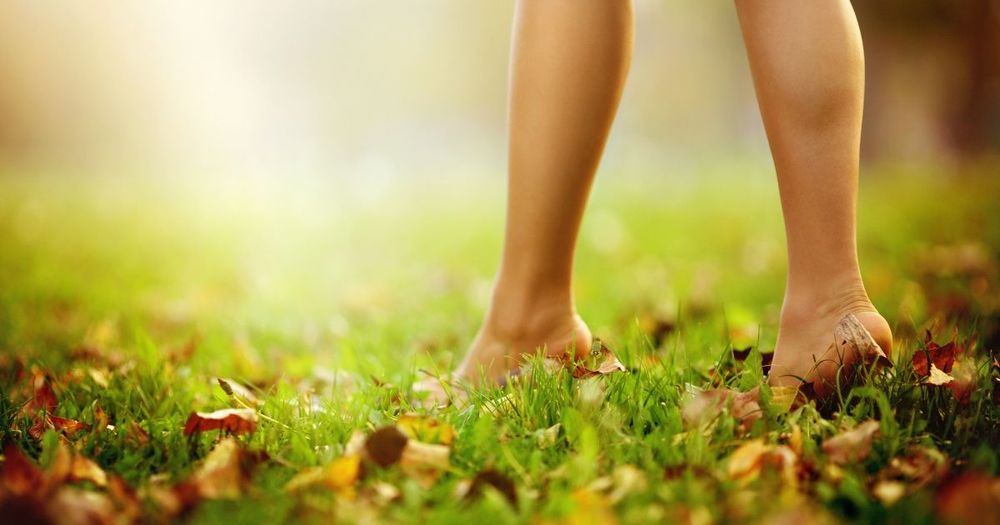
A simple walk barefoot on the beach or through the grass can leave you feeling more relaxed and refreshed. You don't need a study to tell you that. What you get instead is a theory: that the ground is passing electrons into your body, and that this one contact can fix your sleep, your stress, your blood and your immune system.
Some of what bare feet do has been measured properly, and it is more interesting than the theory. Your feet were built to feel the ground. Shoes changed that, very recently. And the case for the electrons, once you read it, comes from a surprisingly small circle of people.
So here are the health benefits of walking barefoot that have been shown, what earthing claims to do, who ran the tests, and how to take your shoes off without hurting yourself.
What shoes changed
For almost all of human history, the soles of our feet were the only thing between the body and the ground. Sandals and moccasins may have been invented within the past 40,000 years. The oldest footwear ever found is about 8,000 years old. Cheap shoes with cushioned heels only arrived with the Industrial Revolution.
In the life of the foot, the padded trainer is a very recent arrival. The foot underneath it hasn't changed.
In 1960 Abebe Bikila of Ethiopia won the Olympic marathon in Rome running barefoot, in world record time. His feet had not read the brochure. To be fair, he went barefoot because the new shoes he had bought in Rome gave him blisters, and four years later in Tokyo he won again in shoes, in another world record. Christopher McDougall's tells the wider story of people who run on almost nothing.
Feet that can feel
The foot had its own answer to rough ground long before anyone made a shoe: the callus.
Researchers compared people in Kenya and the United States, some who often walked barefoot and some who usually wore shoes. As you would expect, the barefoot walkers had thicker, harder calluses.
What was less expected is what those calluses didn't cost. Thick shoe soles protect the foot and dull what it can feel. Thick calluses protect the foot and leave the feeling intact. The people with the hardest soles could still sense the ground just as well. The best sole you own is the one you were born with.
Cushioned shoes also change how the body takes the impact of each step, in ways the researchers said still need study. Whether that matters for the bones isn't known yet. It is an open question, and a good one.
Runners show the same pattern. The modern running shoe only dates from the 1970s. Runners used to going barefoot often land on the front of the foot, while runners in shoes mostly land on the heel, and the barefoot, front-of-foot runners hit the ground with smaller forces, even on hard surfaces.
Stronger feet
There is a good reason to think that feet weaken when shoes do their work for them, and it can be undone.
Fifty-seven runners were split into three groups for eight weeks. One group walked more each week in minimal shoes, with thin soles and no support. One did foot-strengthening exercises. One changed nothing. The foot muscles of both active groups grew bigger and stronger, and the shoes did as well as the exercises, without the exercises.
A cushioned shoe does your foot's job for it, and the foot takes the hint. A later review of 28 trials agreed that minimal shoes and foot exercises may increase foot strength, though it rated the certainty of the evidence low to very low.
Those are minimal shoes rather than bare feet, but the logic is the same: give the foot its work back. Strong feet are part of staying upright as you age. The Harsh Truth About Aging, linked below, has the one-leg balance test and what failing it predicted.
Toes matter more than they get credit for. When 312 people aged 60 to 90 were followed for a year, the 35% who fell had weaker big toes and other toes than those who didn't, and bunions and toe deformities raised the risk.
Children may have the most to gain. A study of children in India found the strongest, highest arches in those who grew up barefoot, and flat feet were less common in children who wore sandals or slippers than in those who wore closed shoes.
It isn't all one way. When 385 barefoot and 425 shoe-wearing children in South Africa and Germany were compared, the barefoot 6- to 10-year-olds balanced better and jumped further, but the children in shoes sprinted faster.
When you can't go barefoot, choose flat, flexible shoes with room for your toes.
The earthing claim
Earthing, or grounding, rests on one idea. The Earth's surface carries a natural electric charge, and when your bare skin touches it, your body takes up electrons. Those electrons are said to act as antioxidants, neutralising free radicals, and from there the claims spread: less inflammation, better sleep, lower stress, more energy, thinner blood, a stronger heart and immune system. A lawn has rarely had such a job description.
The first half of this is ordinary physics. The ground does carry a charge, and your body can pick up electrons from it. The question is whether that does anything to your health, and that takes a test.
Who ran the tests
There have been tests, and they are worth reading closely.
The main early one is a month-long study by Clint Ober, who supplied the equipment himself. Sixty people with poor sleep and chronic pain slept on conductive mattress pads. Half the pads were really wired to the ground and half were not. The grounded group reported far better sleep and less pain. In another pilot, 58 healthy adults wore conductive patches on their soles, and their muscle signals changed within moments of the wire being connected, along with the brain signals of about half of them. In a third, 12 people slept grounded for eight weeks and reported better sleep and less pain, with no comparison group.
Some of that is interesting. But these are small pilots, mostly measured by asking people how they felt. And look at the small print of a main review of the field. Three of its five authors declare that they are contractors of the company sponsoring earthing research, and that they own shares in it. To their credit, they said so.
That doesn't prove them wrong. It means the work has to be repeated by people with nothing to sell, and until then "scientifically backed" is the wrong phrase. Reset Your Body Clock, linked below, looked for a solid test of earthing for sleep and could not find one. So I'd leave the grounding mats, sheets and socks in the shop.
What you get anyway
None of this makes the walk worthless. A barefoot walk on the grass comes with things worth having, whatever the electrons are doing.
Daylight. Morning light is what sets your body clock, and Reset Your Body Clock has how.
Calm. 5 Relaxation Techniques, and the One That Revs You Up First has the 280 young men in Japanese forests, whose pulse, blood pressure and stress hormones were all lower after a walk among the trees than after one in a city.
Attention. Walking on uneven ground without padding makes you notice each step. It is hard to worry about your inbox while finding out which stones are sharp.
Soil. Getting your hands dirty in the garden has the same appeal, and you may as well go barefoot while you do it, if the ground is safe.
How to start
Your feet have probably spent decades in padding, so take it slowly. Begin at home, then move outdoors onto grass, sand or dirt for a few minutes at a time, and add a little each week. Soft ground comes first. Calluses take time to grow. Thirty years in trainers isn't undone by a weekend on gravel.
Watch for pain in the arch, heel or the front of the foot, and if it comes, back off for a few days. If you run, do not switch straight to running barefoot. Walk first, for weeks.
And look where you are going. That is part of the point.
Who should keep their shoes on
Going barefoot isn't for everyone.
Diabetes or numb feet. Nerve damage can stop you feeling a cut or a blister, and a small wound on a diabetic foot can turn into a serious one. If this is you, keep your feet covered and check them every day.
Older people, at first. When 70 adults aged 60 and over tried walking barefoot, in everyday shoes and in minimal shoes, they were faster, took fewer steps and landed more softly in their everyday shoes. If your balance is unsteady, stay in your shoes outdoors and build up foot strength at home first.
Warm, damp soil. Hookworm larvae enter through the skin of barefoot walkers, and they thrive where soil stays warm and moist, especially in poor rural areas. Travelling in the tropics is no time to try this.
Wet public floors. Going barefoot on the wet floors of pools, gyms and shower rooms is how nail fungus gets in. Holistic Remedies for Severe Fungal Nail Infections has the rest. Wear sandals there.
Cuts and rubbish. Parks and beaches can hide glass and sharp metal. Check the ground first, and clean any cut properly.
Back to the ground
The electrons may do something, or they may do nothing. You don't need them to justify taking your shoes off. Your feet are built for this, and they have the muscles and the nerves to prove it.
Why not start today? This evening, take your shoes and socks off in the garden or the park, and walk for five minutes on the grass.
Sleeping badly, and tempted by the mat? Reset Your Body Clock: Sleep Hacks, Tested — morning light, warm feet, a cool head, eating early, melatonin, and what the barefoot claims are worth.
Want to stay on your feet for decades? The Harsh Truth About Aging: Decline or Longevity? — grip, walking pace, standing on one leg, getting down to the floor and up again, and why it is never too late to start.
Know someone who hasn't seen their own feet since last summer? Send them this, and meet them on the grass.
Disclaimer: This article is general information. For advice about your own health, talk to a qualified health professional.
Affiliate Disclosure: This article contains affiliate links. As an Amazon Associate, All For Life earns from qualifying purchases, at no extra cost to you. We only link to products we would recommend without the commission.
Sources
Holowka NB, Wynands B, Drechsel TJ, et al. (2019). Foot callus thickness does not trade off protection for tactile sensitivity during walking. Nature 571(7764):261–264. doi.org/10.1038/s41586-019-1345-6
Wikipedia. Abebe Bikila. en.wikipedia.org
Lieberman DE, Venkadesan M, Werbel WA, et al. (2010). Foot strike patterns and collision forces in habitually barefoot versus shod runners. Nature 463(7280):531–535. doi.org/10.1038/nature08723
Ridge ST, Olsen MT, Bruening DA, et al. (2019). Walking in Minimalist Shoes Is Effective for Strengthening Foot Muscles. Medicine & Science in Sports & Exercise 51(1):104–113. doi.org/10.1249/MSS.0000000000001751
Peters-Dickie JL, Detrembleur C, Guallar-Bouloc M, et al. (2025). The effects of foot core exercises and minimalist footwear on foot muscle sizes, foot strength, and biomechanics: A systematic review and meta-analysis. Clinical Biomechanics 122:106417. doi.org/10.1016/j.clinbiomech.2024.106417
Mickle KJ, Munro BJ, Lord SR, et al. (2009). ISB Clinical Biomechanics Award 2009: toe weakness and deformity increase the risk of falls in older people. Clinical Biomechanics 24(10):787–791. doi.org/10.1016/j.clinbiomech.2009.08.011
Wikipedia. Flat feet. en.wikipedia.org
Zech A, Venter R, de Villiers JE, et al. (2018). Motor Skills of Children and Adolescents Are Influenced by Growing up Barefoot or Shod. Frontiers in Pediatrics 6:115. doi.org/10.3389/fped.2018.00115
Chevalier G, Sinatra ST, Oschman JL, et al. (2012). Earthing: Health Implications of Reconnecting the Human Body to the Earth's Surface Electrons. Journal of Environmental and Public Health 2012:291541. doi.org/10.1155/2012/291541
Park BJ, Tsunetsugu Y, Kasetani T, et al. (2010). The physiological effects of Shinrin-yoku (taking in the forest atmosphere or forest bathing): evidence from field experiments in 24 forests across Japan. Environmental Health and Preventive Medicine 15(1):18–26. doi.org/10.1007/s12199-009-0086-9
Wikipedia. Diabetic foot. en.wikipedia.org
Breet MC, Venter R, Menz HB, Vanwanseele B (2026). Intercontinental differences in immediate response to everyday and minimalist footwear on functional mobility in healthy older adults. Gait & Posture 127:110166. doi.org/10.1016/j.gaitpost.2026.110166
Wikipedia. Hookworm. en.wikipedia.org