
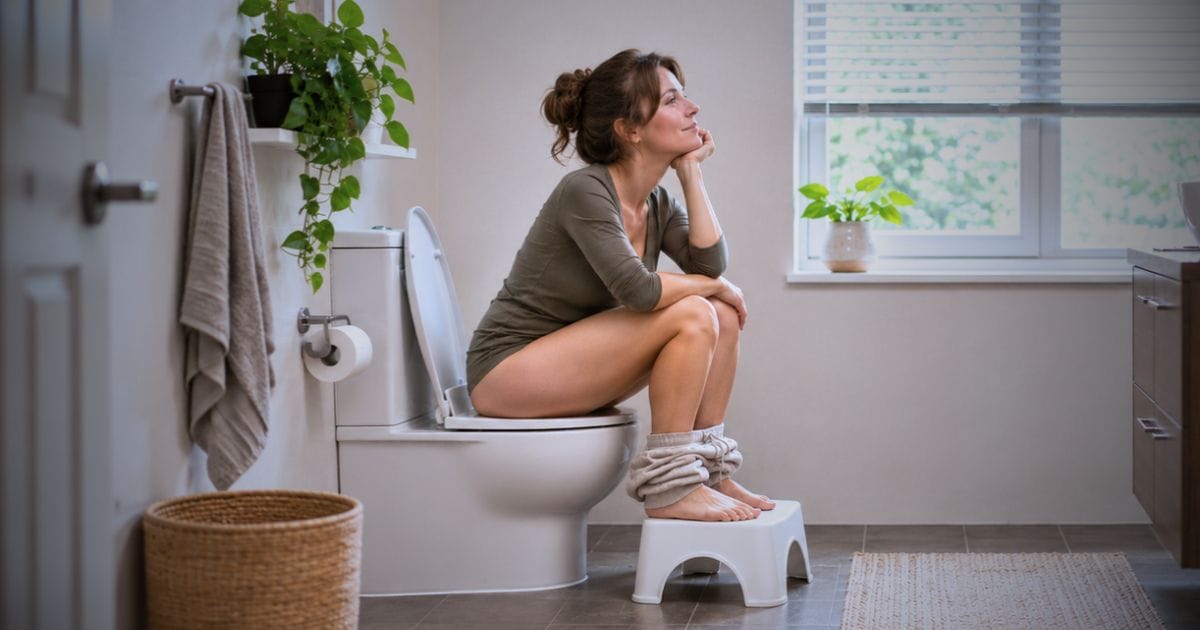
"Eliminate" is a polite word for an impolite job. It comes from the Latin eliminare, to turn out of doors, built on limen, a threshold. The image is of something being shown out of the house and the door closing behind it.
Your body has two such doors for its waste, the bowel and the kidneys, and both open without help. You don't need a cleanse, a tea or a kit to make them work. What a Liver Detox Cannot Do That Your Liver Already Does explains why the organs that clear waste don't need clearing themselves. What they do respond to is habit: what goes in, how often you go, how you sit, and whether you go when the urge comes. Most of that is in your hands, and it's rarely talked about. And if you came wondering how often is normal, once a day turns out to be less common than you'd think, and the shape of what comes out tells you more than the count.
Once a day isn't the rule
A common belief says a healthy bowel empties once a day, like clockwork. In 1992 a team in Bristol tested it. They questioned 838 men and 1,059 women from a random sample of people in East Bristol, and most of them kept a record of three bowel movements in a row.
Once a day was indeed the commonest habit, but it was still a minority. A regular daily rhythm, going once a day at much the same time, showed up in only 40% of the men and 33% of the women. Another 7% of men and 4% of women went regularly two or three times a day. Everyone else was irregular. A third of the women went less often than once a day, and 1% once a week or less. Women of child-bearing age leaned furthest towards the constipated end.
So irregular isn't the same as unhealthy. Anything from three times a day to three times a week counts as normal for adults, and a bowel that goes every day at a different time, or every other day, may be doing exactly what it should.
The reverse is true too. You can go every day and still be constipated. Hard or lumpy stools, a lot of straining and a feeling you haven't finished are all part of it, however often you go.
The question that tells you most is what has changed for you. Going every other day for years is one story. Going daily as always, but straining lately, is another. The more useful question isn't how often you have a bowel movement, but what comes out. Your stool's shape matters more than the count.
Shape tells you more than the count
The same Bristol group gave the world a chart for that question. The Bristol stool scale, published in 1997 by Stephen Lewis and Ken Heaton, sorts stools into seven types:
Types 1 and 2 are separate hard lumps, like nuts, or a lumpy sausage. Repeated hard, lumpy stools are a sign of constipation.
Types 3 and 4 are a sausage with cracks on the surface, or a smooth, soft sausage or snake. That's the ideal, easy to pass without excess water.
Type 5 is soft blobs with clear edges, between the ideal and diarrhoea; the scale doesn't put it in either group.
Types 6 and 7 are fluffy, ragged pieces and then liquid. That's diarrhoea.
What made the scale useful was the test behind it. Lewis and Heaton measured how long food took to travel through 66 volunteers, by having them swallow small markers that show up on an X-ray. Then they sped the gut up with a laxative, and slowed it down with an anti-diarrhoea drug. The shape of the stool tracked the travel time better than the number of trips to the toilet did. Hard lumps meant slow transit. Loose stools meant fast.
The reason is water. One of the colon's main jobs is to draw water and salt back out of what passes through it. The longer stool sits there, the more water it loses, so a slow passage leaves small, hard, dry lumps and a rush leaves it loose. A count can't show you that. The shape can.
So if you want to know how your bowel is doing, look before you flush, and ask two questions the chart can't answer. Was it easy to pass? Did you feel finished? A type 3 or 4 every other day is a better sign than hard lumps twice a day.
And if the stool is soft but you still strain and feel blocked, that's worth mentioning to a qualified health professional; the next sections explain why. Mostly 1s and 2s? The habits below are aimed at you. Watery stools that don't settle? The section on getting checked is further down.
The urge after meals
The colon doesn't wait for instructions. When food stretches the stomach and the products of digestion reach the small intestine, the colon answers with strong waves of movement that push what's already there along to make room. It's called the gastrocolic reflex, and it's why the urge to go so often comes soon after a meal.
Waking up does the same, only more so. In 2001 a team put pressure sensors into the colons of 25 healthy adults and recorded them for a full day as they walked about and ate normal meals. The colon went quiet at night. Waking up tripled its activity, and meals doubled it. The strongest pushing waves, about 10 a day, came mostly after waking, after meals, or with a bowel movement.
That's the body's timetable, morning and mealtimes, and it's the best time to go.
Don't hold it in
Going used to be a sociable business. The public latrines of ancient Rome had long benches with keyhole-shaped openings in a row, and little privacy. With them came a sea sponge on a stick, the xylospongium. It was long assumed to be a shared wiping tool, though recent research suggests it was more likely a toilet brush. Either way, nobody there was waiting for an empty house. Now the wait is for privacy: the office, someone else's flat, a queue.
The urge isn't an order, though, and it can be ignored. The question is what that costs. In 1990 a research team asked 12 men to live under identical conditions for two weeks, eating the same food and doing the same amount of activity. For one week they went whenever they needed to. For the other, they put it off as long as they were able.
The difference was large. Their bowel movements fell from about 9 a week to under 4. Food took 53 hours to pass through instead of 29, and most of the delay built up in the last stretch of the colon. The researchers concluded that habits like these can produce changes in the bowel like those seen in constipation.
Twelve men for a week is a small study. But it points one way: a bowel that keeps being told to wait learns to wait.
How you sit
The seated toilet is a recent arrival. In 1596 Sir John Harington, Elizabeth I's godson, described a flushing one he had built at his house, in a book called The Metamorphosis of Ajax, a pun on "a jakes", the slang of the day for a privy. Thomas Crapper, often credited with inventing the thing, didn't; he improved the plumbing and invented the U-bend in 1880.
For far longer than any of that, people squatted, and it works for a reason. A sling of muscle round the end of the bowel, the puborectalis, keeps it kinked when you sit or stand. Squatting relaxes that sling and straightens the bend, so less pushing is needed. In 2003 a researcher named Dov Sikirov asked 28 healthy volunteers to time six bowel movements each in three positions: on a standard toilet seat, on a lower seat, and squatting. Squatting cut both the time needed and the effort of straining, for every volunteer.
Posture can only do so much if the sling won't let go. In some people the pelvic floor tightens when they push instead of relaxing, a pattern called dyssynergic defecation, or anismus. Pushing harder then works against a closed door. Some researchers think it's diagnosed too often, because the same tightening turns up in healthy people during the tests, but if you're straining against soft stool it's one reason to get checked rather than push on.
A later study tried the halfway house, a small footstool that raises the knees above the hips. Across 52 people and 1,119 recorded bowel movements, the stool made people more likely to feel they'd emptied fully and less likely to strain, and it shortened the time spent on the toilet. Those were healthy volunteers, though. When a 2023 trial gave 41 people who had constipation a balloon to pass, with no footstool and then with a 7-inch and a 9-inch one, their posture changed but neither the time nor how easy it felt improved. A footstool is worth a try. It isn't a cure.
The simplest version costs little. Put a stable, non-slip footstool or a sturdy box under your feet, lean forward with your forearms resting on your thighs, and let your knees come up. Giulia Enders' explains the plumbing behind it, and the rest of the colon's habits, with a good deal of humour.
What goes in
The usual advice for regularity is more fibre: fruit, vegetables, whole grains. It's not that simple. Fibre is the part of plants your body can't digest, and for a gut that's struggling already, more of it can mean more bulk, more gas and more discomfort. In one study, 63 people in Singapore with long-term constipation were asked to cut back on fibre. Those who gave it up completely were soon going every day instead of every few days, without the bloating.
The participants chose how much fibre to bring back, so the study shows a pattern rather than a rule. If you've already added fibre, feel more bloated and still struggle, tell a qualified health professional or a pharmacist exactly what you tried. What Happens to the Body When You Remove Most Plant Foods tells the story in full.
Meat, fish and eggs leave little behind. They're digested almost completely, so there's less bulk to move along and less left to ferment. If what comes out is easy to pass, how often matters less than the shape. Cooking them in butter or tallow helps in another way. Fat brings bile into the gut, and bile acids reaching the colon loosen stools; when too many arrive, the result is watery stools, types 6 and 7.
Water keeps stools soft. Make it your main drink. The simple colour check, pale yellow meaning you're drinking enough, is in 7 Fun and Tasty Ways to Stay Hydrated Without the Boredom.
Move. Exercise gets the gut going as well as the legs, and a walk after a meal works with the gastrocolic reflex.
Chew. Food that's chewed properly arrives in the stomach ready to be digested, and a slower meal means less swallowed air.
Check the medicine cabinet. Opioid painkillers constipate about nine in ten of the people who take them, and some antacids, calcium channel blockers and anticholinergic drugs can too, as can calcium and iron supplements. If one of these is yours, keep taking it and ask whoever prescribed it about the constipation.
The other door
The kidneys are the quieter half of the system. Each one holds a million or more tiny filtering units called nephrons, and between them they filter your blood around the clock. They also help set your blood pressure and keep the balance of salts and water in the body steady. What Your Body Is Working Against Every Day — and How to Make It Easier shows how much they filter each day, and what changes when you're short of water.
They need little from you beyond water and time. The same hydration article has the trial in which people who'd had a first kidney stone and drank more water had far fewer repeat stones.
Salt is the usual worry. Your body needs it. Cutting it blindly can do more harm than good, as Why "Drink More Water" Is Incomplete Advice sets out. Choose good-quality unrefined salt; is one with nothing added. But if you already live with kidney disease or raised blood pressure, how much salt is right for you is a question for the people treating you, not for an article.
The one thing kidneys don't do is complain early. In chronic kidney disease, the early stages usually bring no symptoms at all, and the problem shows up first in a urine or blood test. That's the reason for regular check-ups, especially with raised blood pressure or diabetes, two of its commonest causes. Foam in the toilet bowl that keeps appearing is one visible clue, because protein in the urine makes it foam. Only about a third of foamy urine is caused by that, so it's a prompt for the test rather than an answer.
When to get checked
Most changes in bowel habit settle on their own. Some don't, and they shouldn't be waited out. Blood in the stool, stools that turn black, pale or clay-coloured stools with dark urine, a change in bowel habit that lasts for weeks, persistent difficulty going, and weight you lose without trying all need an appointment with a qualified health professional. So do watery stools that don't settle within a few days, or come with a fever.
Some things can't wait for an appointment. Constipation with constant or severe belly pain, vomiting, or being unable to pass wind needs urgent help, and if it's severe, call the emergency number. The changes below are for the mild kind that comes and goes, not for any of this. The full list of warning signs is part of The Foods That Upset Your Gut Are Mostly Plants.
Working with the doors
Look before you flush. For a week, note the type on the Bristol scale and roughly when you went. You'll learn more from that than from counting.
Go when the urge comes. Especially after a meal. If you have to wait, don't make it a habit.
Raise your feet. A stable footstool or a sturdy box, knees above hips, leaning slightly forward. A purpose-made tucks under the toilet when it isn't in use.
Give it time without straining. Sit, breathe, and let the reflex do the work. Don't hold your breath and push; breathe out slowly instead. If nothing happens within a few minutes, get up and try again later.
And leave the phone outside. In a 2025 study of 125 adults having a screening colonoscopy, two-thirds used a phone on the toilet, and 37% of them stayed longer than five minutes, against 7% of those who didn't. The phone users had 46% higher odds of haemorrhoids, even after allowing for age, weight, exercise, straining and fibre. It was a single snapshot and can't prove the phone did it, but the minutes add up.
Eat what your gut can digest. Let meat, fish and eggs do most of the work on the plate. If you already eat a lot of fibre and things are still slow, cut back on it rather than adding more.
Drink water and move. Pale yellow urine, and a walk after meals.
Get your kidneys checked now and then. A simple blood and urine test catches what symptoms won't.
A week with the feet up
Picture someone who's out of the door each morning before the urge has a chance, holds it all day at work, and finally goes in the evening. Their week of notes is mostly types 1 and 2, hard and lumpy, with a lot of straining.
So they change one thing. They leave ten quiet minutes after breakfast to sit. For a week they note three things each morning. Did the urge come? Could they act on it? Did it feel easier?
A week later they might still be going every other day. What could change is that they go when the urge comes and leave feeling finished. If that works, the next change gets its own week, and they'll know which one helped.
Out of doors
The Latin had it right. Elimination is the body showing things out, and it's good at it when you let it. Watch the shape of what leaves more than how often it goes, and the colour of what leaves by the other door: types 3 and 4, and pale yellow. Stop holding the door shut, sit in a way that helps it open, and give it food it can deal with. Then ask a better question than "Did I go today?": was it comfortable, and was it usual for me? This week, keep a note of the shape, and go when the urge comes.
Constipated on a plate full of fibre? What Happens to the Body When You Remove Most Plant Foods — a quieter gut in the first weeks, and the salt dip that can follow.
Thinking of cutting sodium? Why "Drink More Water" Is Incomplete Advice — why sodium matters for hydration, and who needs more of it.
Know someone who thinks once a day is the only normal? Send them "Once a day isn't the rule".
Tried something here, or got a question it didn't answer? Write to us at contact@allforlife.club. Your questions shape the next articles.
Disclaimer: This article is general information, not medical advice. If you see blood in your stool, have a lasting change in bowel habit, or have kidney disease or high blood pressure, talk to a qualified health professional.
Affiliate Disclosure: This article contains affiliate links. As an Amazon Associate, All For Life earns from qualifying purchases, at no extra cost to you. We only link to products we would recommend without the commission.
Sources
Wiktionary. eliminate. en.wiktionary.org
Heaton KW, Radvan J, Cripps H, Mountford RA, Braddon FE, Hughes AO (1992). Defecation frequency and timing, and stool form in the general population: a prospective study. Gut 33(6):818–824. doi.org/10.1136/gut.33.6.818
Wikipedia. Constipation. en.wikipedia.org
Wikipedia. Bristol stool scale. en.wikipedia.org
Lewis SJ, Heaton KW (1997). Stool Form Scale as a Useful Guide to Intestinal Transit Time. Scandinavian Journal of Gastroenterology 32(9):920–924. doi.org/10.3109/00365529709011203
Wikipedia. Large intestine. en.wikipedia.org
Wikipedia. Gastrocolic reflex. en.wikipedia.org
Rao SS, Sadeghi P, Beaty J, Kavlock R, Ackerson K (2001). Ambulatory 24-h colonic manometry in healthy humans. American Journal of Physiology-Gastrointestinal and Liver Physiology 280(4):G629–G639. doi.org/10.1152/ajpgi.2001.280.4.G629
Wikipedia. Sanitation in ancient Rome. en.wikipedia.org
Wikipedia. Xylospongium. en.wikipedia.org
Klauser AG, Voderholzer WA, Heinrich CA, Schindlbeck NE, Müller-Lissner SA (1990). Behavioral modification of colonic function. Can constipation be learned? Digestive Diseases and Sciences 35(10):1271–1275. doi.org/10.1007/BF01536418
Wikipedia. John Harington (writer). en.wikipedia.org
Wikipedia. Thomas Crapper. en.wikipedia.org
Wikipedia. Puborectalis muscle. en.wikipedia.org
Sikirov D (2003). Comparison of Straining During Defecation in Three Positions: Results and Implications for Human Health. Digestive Diseases and Sciences 48(7):1201–1205. doi.org/10.1023/a:1024180319005
Wikipedia. Anismus. en.wikipedia.org
Modi RM, Hinton A, Pinkhas D, Groce R, Meyer MM, Balasubramanian G, Levine E, Stanich PP (2019). Implementation of a Defecation Posture Modification Device: Impact on Bowel Movement Patterns in Healthy Subjects. Journal of Clinical Gastroenterology 53(3):216–219. doi.org/10.1097/MCG.0000000000001143
Trieu RQ, Prott G, Sequeira C, Jones M, Mazor Y, Schnitzler M, Malcolm A (2023). Using a footstool does not aid simulated defecation in undifferentiated constipation: A randomized trial. Neurogastroenterology & Motility 35(7):e14580. doi.org/10.1111/nmo.14580
Wikipedia. Bile acid malabsorption. en.wikipedia.org
Wikipedia. Nephron. en.wikipedia.org
Wikipedia. Chronic kidney disease. en.wikipedia.org
Wikipedia. Proteinuria. en.wikipedia.org
Wikipedia. Cholestasis. en.wikipedia.org
Ramprasad C, Wu C, Chang J, Rangan V, Iturrino J, Ballou S, et al. (2025). Smartphone use on the toilet and the risk of hemorrhoids. PLOS One 20(9):e0329983. doi.org/10.1371/journal.pone.0329983