
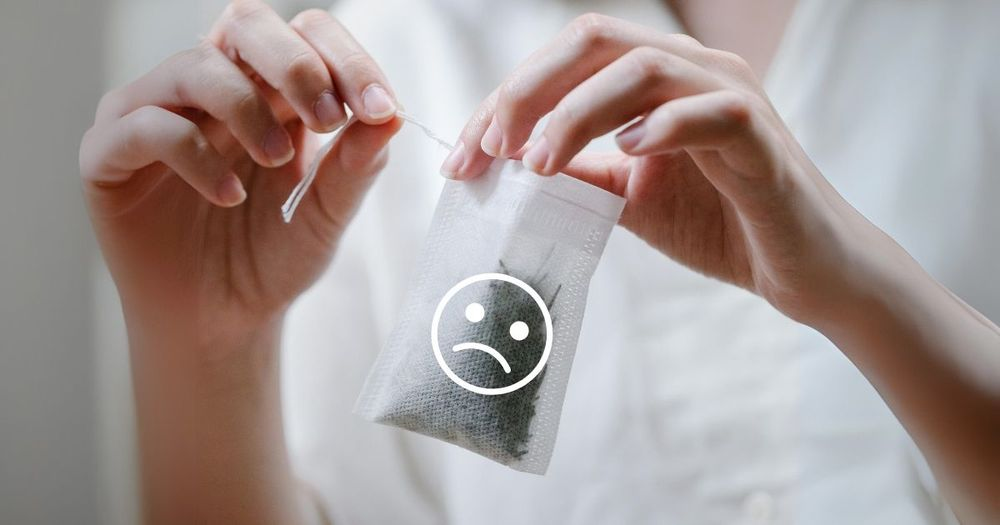
The silky pyramid bag looks like the posh option. You can see whole-looking leaves through the mesh, it costs more than the paper kind, and it sits in your mug like a little piece of luxury.
That mesh is usually plastic. Steep one and it sheds billions of particles into a single cup, and the plain paper bag next to it is often less paper than it looks. Even the oldest insult about tea bags, that they're full of floor sweepings, turns out to be wrong, and the truth flatters the bag. And half the story isn't about the bag at all. It comes from the tea plant itself.
What's inside the bag
English has borrowed the word three times. Cha came first, in the 1590s, through Portuguese traders in Macao. Tea arrived in the 17th century through the Dutch, from the Min Chinese tê. And chai travelled overland along the Silk Road, picking up a Persian ending on the way, before reaching English in the 20th century.
The tea bag started life as cloth. The first patent was filed in 1901 by two women from Milwaukee, Roberta Lawson and Mary McLaren, for a sewn fabric "tea leaf holder". The better-known story credits a New York merchant, Thomas Sullivan, who sent tea samples out in little silk pouches, and the legend goes that his customers dropped the whole pouch into the pot. Machines took over in 1929, when Adolf Rambold built one for the German firm Teekanne that packed 35 gauze bags a minute, and Britain only took to bags in 1953, when Tetley brought them in.
As for what's inside, the floor-sweepings line is a good insult and a bad description. When tea is processed, the leaves break into pieces of every size. The big pieces are sold as loose leaf, and the smallest grades, called fannings and dust, go into bags. They're real tea, just broken small.
That's the whole point of a bag. Small pieces give up their colour, caffeine and flavour fast, so a bag makes a strong cup in a couple of minutes. It also means the bag is rarely the weaker tea. When bagged and loose green tea were brewed side by side, the bagged one put more of tea's best-known antioxidant into the cup. Broken leaf gives everything up at once.
So the case against tea bags has little to do with what's in the tea. It's about what the tea comes wrapped in, and what the plant brings with it.
The plastic in the bag
Tea bags come in three kinds of material, and two of them contain plastic.
Silky mesh bags, usually pyramids, are made of nylon or PET, the plastic used for drinks bottles. The pyramid shape only arrived in the late 1990s, sold as giving the leaves room to move, which makes the plastic the newest thing in your mug. When a single one was steeped at brewing temperature, it put about 11.6 billion microplastic and 3.1 billion nanoplastic particles into that one cup, a load far higher than anything previously measured in other foods.
The exact count has been argued over, since some of what looked like plastic turned out to be tea residue clinging to the mesh. The direction is clear, though. Heat a plastic mesh in hot water and it sheds, and heating the cup a second time with the bag still in makes it shed more.
Paper bags are mostly plant fibre, and some have polypropylene fibres mixed in so the edges can be heat-sealed shut. A gardener in Wales noticed it in 2017, when his composted tea bags left a plastic residue behind in the soil. Some big brands have since changed their bags, others still use the plastic, and the box rarely says which.
"Plant-based" bags are made from PLA, a plastic produced from corn starch. It sounds reassuring, and it's still plastic. When different tea bags were buried in soil for a year, the plain paper ones disappeared within months, the paper-and-plastic blends crumbled into fragments that were still there a year later, and the bags made purely of PLA, sold as completely biodegradable, came out intact.
Where the plastic goes
Plastic particles small enough to come out of a tea bag are small enough to get into the body. When nanoplastics from ordinary tea bags were put on human gut cells in a dish, the cells took them up within a day.
What happens next is the part that should make you put the kettle on more thoughtfully. When people having fatty plaque removed from the arteries in their neck were followed for nearly three years, those whose plaque contained microplastics had heart attacks and strokes, or died, at 4.5 times the rate of those whose plaque was clean. More than half of them had plastic in their arteries. It shows a link, and the plastic in those arteries came from food, water, air and packaging over a lifetime. A tea bag is one of the few sources you can remove for good, by changing one habit. Hidden Food Contamination, linked below, goes through the others.
What the plant brings with it
Now for the half that isn't about the bag. The tea plant pulls fluoride out of the soil and stores it in its leaves, more than almost any other food plant. The older and tougher the leaf, the more fluoride it holds, and the longer you brew it, the more comes out into the cup. In one check of everyday supermarket teas, nearly every cup carried more fluoride than tap water that has fluoride added on purpose.
That matters for bags, because when shop-bought teas were compared in two European countries, the bagged teas carried more fluoride than loose leaf, and in one of them more aluminium too. The tea plant collects both. Black tea carries more than green, and white tea, made from young buds, carries the least of the true teas. Brick tea, pressed from coarse, older leaves, carries the most of all, enough to go over the World Health Organization's guidance at every age. The grade matters more than the packaging, though: cheap loose tea made from older leaves can carry just as much as a bag.
Matcha deserves its own line. It's the leaf itself, ground to powder and whisked into the water, so everything the leaf holds goes down with it. In that supermarket check, matcha carried the most fluoride of all.
For an adult, a few cups a day add a modest amount of fluoride. The trouble comes with heavy drinking, especially where the tap water is fluoridated too. Ireland shows how it adds up: it's among the heaviest tea-drinking countries in the world, it fluoridates its tap water, and every one of 54 bagged black teas sold there released fluoride into the cup, the strongest nearly four times as much as the weakest.
Children are a different matter. They take in more fluoride for their size, so keep a young child's tea weak and occasional, or make it herbal.
A woman in her forties was sent for tests with bone pain and odd-looking X-rays, and the cause turned out to be tea. For seventeen years she had drunk a pitcher a day brewed from 100 to 150 tea bags. The diagnosis was skeletal fluorosis, where fluoride builds up in the bones and makes them dense, stiff and painful. It's an extreme case, and it shows where fluoride ends up when the body takes in too much. Weak kidneys clear fluoride poorly, so heavy tea drinkers with kidney disease are the most exposed.
Lead turns up too. When 30 ordinary bagged teas were checked, every brewed cup contained some lead, and a long steep pulled out more than a short one. Aluminium came out above guideline levels in a fifth of them. The plant takes up what's in the soil, and the cup takes up what's in the plant.
If tea is your all-day drink, herbal blends make good stand-ins for some of the cups, and What to Drink Instead of Plain Water, linked below, sorts out which other drinks earn their place. They carry only a small fraction of black tea's fluoride, and the same bag rules apply to them. is an easy first pick: caffeine-free, with a rich, slightly sweet taste.
Why loose leaf wins anyway
Loose leaf solves both problems at once. No bag means no plastic in the cup, and a good loose tea keeps the fluoride down too. You can see exactly what you're brewing, and if a tea is mostly dust, it shows.
Whole leaves also brew more than once. A good oolong or green tea can give two, three or more cups from the same leaves, with the flavour changing as the leaf opens. That changes the maths. A decent loose tea that costs more per gram than a supermarket box can end up cheaper per cup, because each spoonful is used two or three times.
Taste is easier to test than it sounds. Muriel Bristol insisted she could tell whether the milk or the tea had gone into a cup first, so Ronald Fisher handed her eight cups, four of each, in random order. She named all eight, and the test he designed around her became the textbook example of how a fair experiment works.
And it tastes better. Whole leaves release their flavour slowly, so the cup comes out rounder and forgives you for leaving it a minute too long.
How to switch without the faff
The kit is small. A steel mesh basket that sits in your mug, wide enough for the leaves to open, does the same job as a bag, and a with two handles rests on the rim of most mugs. For a pot, a keeps everything that touches the tea in glass. A spoonful of leaves per mug is the place to start, adjusted to taste.
Water temperature matters more with loose leaf. Black tea likes water straight off the boil. Green and white teas turn bitter in boiling water, so let the kettle sit for a few minutes before pouring. Keep brewing times short, under about five minutes, which also keeps the fluoride down: in black tea bags left for half an hour, it climbed to around 6 milligrams a litre. Then steep the same leaves again for the next cup.
Keep plastic out of the kit too. Brewing loose leaf in a plastic infuser or a plastic tea bottle brings the problem straight back: polypropylene bottles filled with hot water released up to 16 million particles per litre, and hotter water released more. Steel, glass or ceramic for anything that touches the hot water.
The kettle and the cup matter as much. Plastic kettles shed microplastics into hot water, and a layer of limescale inside the kettle cut that release by more than 89 per cent, so descaling a plastic kettle strips away the layer that was holding the plastic back. A steel or glass kettle avoids the question, and an all-steel electric kettle with temperature control also gives green tea the cooler water it needs. Takeaway paper cups are lined with a thin plastic film that sheds into hot drinks, which makes your own cup the better habit.
Store the tea in an airtight tin, away from light and strong smells, because leaves soak up odours from the cupboard.
If you keep using bags
Bags have their place, at work, travelling or when you just want a quick cup. Choose ones sold as plastic-free, and skip the silky mesh pyramids. Heat the water on its own first, and never reheat a cup with the bag still in it.
When the box gives nothing away, the bag will. See-through silky mesh is plastic. A paper bag with edges pressed and fused shut usually has plastic fibres in it, because heat-sealing needs something that melts. Bags that are folded, stitched or tied with cotton string get by without it.
Mind the caffeine
The leaf brings one more thing into the cup, and it's the one that matters most for how you feel: caffeine. A cup of black tea carries roughly half the caffeine of a cup of coffee, and the broken leaf in a bag releases it fast. Caffeine also lingers: the body clears about half of it in five hours or so, and several strong coffees' worth of caffeine, six hours before bedtime, still shortened the night by over an hour. If your nights are short, make the later cups herbal, or better still water.
Pregnancy, or trying for a baby, is the time to drop caffeine entirely, whatever the source: tea, coffee, cocoa, cola or an energy drink. Caffeine passes straight through the placenta, so the baby gets roughly the level you have. Children feel it more for their size too, which gives their tea a second reason to stay weak or herbal.
Tea does count as fluid, at least. When men drank four or six mugs of ordinary black tea through the day, they stayed as well hydrated as on the same amount of water. Across nearly half a million adults in Britain, the ones at two cups a day or more had a death rate about 12 per cent lower across the next eleven years than those who drank none, though that's a link in a survey, not proof that the tea did it. Water still makes the better everyday drink, with tea as the ritual on top.
One smaller caution goes with it. Tea blocks non-haem iron, the kind in plants and some of the iron in meat: drunk with a hamburger meal, it cut the iron absorbed by almost two-thirds. If your iron runs low, keep tea well away from meals.
Change the box, keep the ritual
The silky pyramid was never the luxury option. It's broken tea in a plastic net, and the paper bag beside it may be holding plastic fibres of its own. The leaf inside is innocent by comparison. It does bring fluoride and lead up from the soil, and a short brew of a good leaf keeps both low.
So when the next box runs out, replace it with a pack of loose leaf and a steel basket. Brew it short, steep it twice, and make the last cup of the day herbal. The tea was always the good part, and now the rest of the cup can match it.
Wondering where else plastic gets into your food? Hidden Food Contamination: BPA, Microplastics, and Heavy Metals in Your Clean Diet — the foods sold as clean that carry plastic and metals, and the swaps that cut the load.
Looking for something else to drink through the day? What to Drink Instead of Plain Water — and What the Popular Alternatives Do to Your Body — which drinks hydrate you, and which work against you.
Know someone who buys the silky pyramid tea bags because they look like the good stuff? Send them this. Their next box could be the plastic-free kind.
Tried something here, or got a question it didn't answer? Write to us at contact@allforlife.club. Your questions shape the next articles.
Disclaimer: This article is general information. For advice about your own health, talk to a qualified health professional. If you're pregnant or trying to conceive, keep caffeine out altogether.
Affiliate Disclosure: This article contains affiliate links. As an Amazon Associate, All For Life earns from qualifying purchases, at no extra cost to you. We only link to products we would recommend without the commission.
Sources
Wikipedia. Etymology of tea. en.wikipedia.org
Wikipedia. Tea bag. en.wikipedia.org
Kowalska J, Marzec A, Domian E, et al. (2021). Influence of Tea Brewing Parameters on the Antioxidant Potential of Infusions and Extracts Depending on the Degree of Processing of the Leaves of Camellia sinensis. Molecules 26(16):4773. doi.org/10.3390/molecules26164773
Hernandez LM, Xu EG, Larsson HCE, et al. (2019). Plastic Teabags Release Billions of Microparticles and Nanoparticles into Tea. Environmental Science & Technology 53(21):12300–12310. doi.org/10.1021/acs.est.9b02540
Xu JL, Lin X, Hugelier S, et al. (2021). Spectral imaging for characterization and detection of plastic substances in branded teabags. Journal of Hazardous Materials 418:126328. doi.org/10.1016/j.jhazmat.2021.126328
Wikipedia. Polylactic acid. en.wikipedia.org
Mateos–Cárdenas A (2022). Fate of petroleum-based and plant-based teabags exposed to environmental soil conditions for one year. Frontiers in Bioengineering and Biotechnology 10:966685. doi.org/10.3389/fbioe.2022.966685
Banaei G, Abass D, Tavakolpournegari A, et al. (2024). Teabag-derived micro/nanoplastics (true-to-life MNPLs) as a surrogate for real-life exposure scenarios. Chemosphere 368:143736. doi.org/10.1016/j.chemosphere.2024.143736
Marfella R, Prattichizzo F, Sardu C, et al. (2024). Microplastics and Nanoplastics in Atheromas and Cardiovascular Events. New England Journal of Medicine 390(10):900–910. doi.org/10.1056/NEJMoa2309822
Jayasingha H, Amarasooriya G, Rajapaksha N, et al. (2025). Fluoride in tea: accumulation, dietary exposure, and future strategies for risk mitigation in food safety; a scoping review. Critical Reviews in Food Science and Nutrition 65(34):8990–9003. doi.org/10.1080/10408398.2025.2516756
Regelson S, Dehghan M, Tantbirojn D, Almoazen H (2021). Evaluation of fluoride levels in commercially available tea in the United States. General Dentistry 69(1):17–20. pubmed.ncbi.nlm.nih.gov/33350950
Pavlovič A, Tavčar G, Ponikvar-Svet M (2023). Fluoride and Aluminium in Tea (Camellia sinensis L.)—Tea Quality Indicators and Risk Factors for Consumers. Molecules 28(17):6396. doi.org/10.3390/molecules28176396
Małyszek A, Zawiślak I, Kulus M, et al. (2025). Fluoride Content in Infusions of Selected Teas Available on the Polish Market—An In Vitro Study. Foods 14(14):2452. doi.org/10.3390/foods14142452
Jakubczyk K, Ligenza A, Gutowska I, Janda-Milczarek K (2022). Fluoride Content of Matcha Tea Depending on Leaf Harvest Time and Brewing Conditions. Nutrients 14(12):2550. doi.org/10.3390/nu14122550
Waugh D, Potter W, Limeback H, Godfrey M (2016). Risk Assessment of Fluoride Intake from Tea in the Republic of Ireland and its Implications for Public Health and Water Fluoridation. International Journal of Environmental Research and Public Health 13(3):259. doi.org/10.3390/ijerph13030259
Kakumanu N, Rao SD (2013). Skeletal Fluorosis Due to Excessive Tea Drinking. New England Journal of Medicine 368(12):1140–1140. doi.org/10.1056/NEJMicm1200995
Hallanger Johnson JE, Kearns AE, Doran PM, et al. (2007). Fluoride-Related Bone Disease Associated With Habitual Tea Consumption. Mayo Clinic Proceedings 82(6):719–724. doi.org/10.4065/82.6.719
Schwalfenberg G, Genuis SJ, Rodushkin I (2013). The Benefits and Risks of Consuming Brewed Tea: Beware of Toxic Element Contamination. Journal of Toxicology 2013:1–8. doi.org/10.1155/2013/370460
Wikipedia. Lady tasting tea. en.wikipedia.org
Li D, Shi Y, Yang L, et al. (2020). Microplastic release from the degradation of polypropylene feeding bottles during infant formula preparation. Nature Food 1(11):746–754. doi.org/10.1038/s43016-020-00171-y
Shi Y, Li D, Xiao L, et al. (2022). The influence of drinking water constituents on the level of microplastic release from plastic kettles. Journal of Hazardous Materials 425:127997. doi.org/10.1016/j.jhazmat.2021.127997
Joseph A, Parveen N, Ranjan VP, Goel S (2023). Drinking hot beverages from paper cups: Lifetime intake of microplastics. Chemosphere 317:137844. doi.org/10.1016/j.chemosphere.2023.137844
Wikipedia. Caffeine. en.wikipedia.org
Drake C, Roehrs T, Shambroom J, Roth T (2013). Caffeine Effects on Sleep Taken 0, 3, or 6 Hours before Going to Bed. Journal of Clinical Sleep Medicine 9(11):1195–1200. doi.org/10.5664/jcsm.3170
Greenwood DC, Thatcher NJ, Ye J, et al. (2014). Caffeine intake during pregnancy and adverse birth outcomes: a systematic review and dose–response meta-analysis. European Journal of Epidemiology 29(10):725–734. doi.org/10.1007/s10654-014-9944-x
Ruxton CH, Hart VA (2011). Black tea is not significantly different from water in the maintenance of normal hydration in human subjects: results from a randomised controlled trial. British Journal of Nutrition 106(4):588–595. doi.org/10.1017/S0007114511000456
Inoue-Choi M, Ramirez Y, Cornelis MC, et al. (2022). Tea Consumption and All-Cause and Cause-Specific Mortality in the UK Biobank. Annals of Internal Medicine 175(9):1201–1211. doi.org/10.7326/M22-0041
Zijp IM, Korver O, Tijburg LBM (2000). Effect of Tea and Other Dietary Factors on Iron Absorption. Critical Reviews in Food Science and Nutrition 40(5):371–398. doi.org/10.1080/10408690091189194
Morck TA, Lynch SR, Cook JD (1983). Inhibition of food iron absorption by coffee. The American Journal of Clinical Nutrition 37(3):416–420. doi.org/10.1093/ajcn/37.3.416