
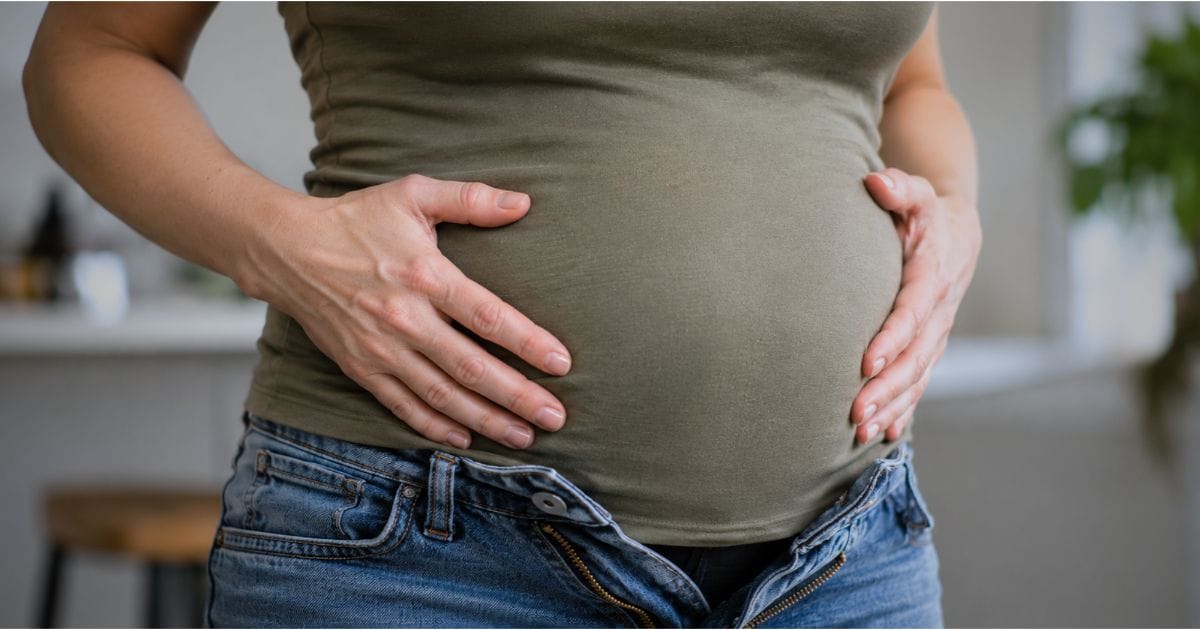
You wake with a flat stomach. By the evening you can't do your trousers up, and it feels as if someone has inflated you through a straw. Then, by morning, it's gone again. A belly that swells by evening and is flat by morning looks like a gas problem. The scans say otherwise, and the reason a bloated stomach can vanish overnight lies elsewhere.
The word itself is about softness. "Bloat" perhaps comes, by way of Middle English, from the Old Norse blautr, soft. It's the right word for how a bloated belly feels: soft, swollen and nothing like your own. But the usual explanation, that you've made too much gas, turns out to be only part of the story. A good deal of bloating comes down to how the body moves gas along and how it holds the belly while it does.
The feeling and the shape
Two things travel under one word. Bloating is the feeling: pressure, fullness, a waistband that seems too tight. Distension is the shape: the belly measurably growing. They often come together, but not always. You can feel bloated with a flat stomach, and look six months pregnant without much pain. The shape, the swelling you can see, is the main subject here.
Bloating, the feeling, has its own explanation. In 1973 the researcher J. Ritchie inflated a small balloon in the lower colon of people with irritable bowel and of people without it. At 60 ml it hurt 6% of the second group and 55% of the first, though the gut wall was stretched no harder in either. A sensitive gut feels an ordinary amount of gas as too much, and the reflex described below turns that feeling into a shape.
The pattern in the opening, flat in the morning and swollen by night, is the classic one, and it's the first clue that something other than a sudden flood of gas is going on. If the swelling were all gas, that much would have to leave overnight. Some does, but the scans below suggest there was little extra to begin with. What changes overnight is the way you carry it.
Even a healthy belly does this, on a smaller scale. In 2001 a research team strapped a band round the waists of 20 healthy women and recorded their girth for 24 hours. It was bigger sitting or standing than lying down, bigger by evening than on waking, and went up after a meal. During sleep it went down. Bloating takes that ordinary daily swing and exaggerates it.
Not more gas
In 2001 three researchers, Jordi Serra, Fernando Azpiroz and Juan-R Malagelada, tried a simple test. Into the small intestine of 20 people with irritable bowel syndrome and 20 healthy volunteers, they fed the same mixture of gases at the same slow rate for four hours, and collected what came out. Within two hours, 18 of the 20 with irritable bowel showed at least one of three problems: they held on to more than 400 ml of the gas, felt worse, or visibly swelled. Only 4 of the 20 healthy volunteers did.
The gas going in was identical. What differed was how it moved through.
Holding gas in has been a social problem for two thousand years at least. The Roman historian Suetonius wrote that the emperor Claudius "is even said to have thought of an edict allowing the privilege of breaking wind quietly or noisily at table, having learned of a man who ran some risk by restraining himself through modesty." The edict never came. The modesty stayed.
In 2009, eight years after the gas test, Azpiroz and colleagues scanned people during a bad bout of bloating, and compared the pictures with scans taken when they felt fine. In people with intestinal dysmotility, gut muscles that barely move the contents along, the belly did fill up, by about 1.4 litres on average. But in the larger group, people with functional bloating, meaning no damage or disease could be found in the gut, the total volume inside the abdomen barely rose, by about 0.3 litres. Their waists still pushed out. Something was moving the contents, not adding to them.
The diaphragm that drops
That something turned out to be the diaphragm, the sheet of muscle under the lungs. In 2011 the same group gave people a measured load of gas in the colon and watched the muscles on electrical recordings. In the healthy volunteers the diaphragm relaxed, and the muscles at the front of the belly tightened to make room. In the people with bloating it went the other way. The diaphragm tightened and pushed down, the belly wall relaxed, and the contents were shoved forward and out.
The researchers called it abdomino-phrenic dyssynergia, a clumsy name for a simple idea: the muscles above and in front of the gut stop working together. The belly grows because it's being pushed, not because it's full.
Training it back
If the push is a reflex, it might be retrained. In 2015 the same group tested that. They took 45 people with visible bloating, 42 of them women, and confirmed the pattern on scans and muscle recordings: during an attack the diaphragm dropped, the chest muscles tightened and the belly wall bulged. Then 15 of them had biofeedback, watching their own muscle activity on a screen while learning to breathe differently. After a median of two sessions, the diaphragm and chest muscles relaxed, the deeper belly muscles switched on, and the girth fell by about 25 mm.
The study was small, and the treatment needed equipment and a trained guide, so it isn't something to copy from an article. But the authors called the distension "a behavioral response", something the body does rather than something that happens to it. It's automatic, a habit of the muscles, not a breathing mistake you're making.
In 2024 the same team ran a stricter test. Forty-two people whose bellies visibly swelled after meals, 36 of them women, were split at random. One group wore belts that showed them on a screen how their chest and belly wall moved, and over three sessions in four weeks, with exercises at home, they learned to stop the reflex. The other group took dummy capsules. After a meal known to set them off, the trained group's waists stopped growing, and their swelling scores fell by 66%. The capsule group didn't change.
An older trial points the same way. In 1984 Peter Whorwell and two colleagues took 30 people with severe irritable bowel that hadn't responded to treatment and gave them, at random, either gut-directed hypnotherapy or talking therapy with a dummy pill. The talking-therapy group improved a little, including in how swollen their bellies felt. The hypnotherapy group improved far more, in all their symptoms, and none had relapsed three months later.
It was a small, early study. But it fits the same picture: the link between the gut and the brain can be trained. Emeran Mayer's explains that two-way traffic in plain language.
What goes in
Food still matters, and the studies above explain why. If a gut over-reacts to ordinary amounts of gas, the less that ferments inside it, the less there is to set the reaction off. The details are covered elsewhere on this site.
The quiet end of the plate is meat, fish and eggs. They're digested almost completely before they reach the bacteria lower down, so the bacteria get very little. The Foods That Upset Your Gut Are Mostly Plants covers why the gut often goes quiet on a meat-based plate, and which plants are the usual troublemakers.
Beans, lentils and the cabbage family ferment. What your small intestine can't absorb, bacteria in the colon break down, and gas is the by-product. That's chemistry, not a fault in you. In one small study, the gas passed in a day fell from a median of 705 ml to 214 after two fibre-free days, as 12 Signs Your Body Is Trying to Tell You Something Important reports.
Fibre is no cure for bloating. The usual advice for constipation is more of it, but What Happens to the Body When You Remove Most Plant Foods has the study in which people with constipation who stopped eating fibre had less bloating, not more. Konstantin Monastyrsky's makes the full case against the fibre-for-everything advice.
Wheat and milk sugar can both be culprits. Why You Feel Better Without Wheat covers what's behind wheat bloating, and why a coeliac test has to come before you cut gluten. Lactose and the other intolerances are explained in Food Allergies, Sensitivities, and Intolerances: Why Your Body Keeps Reacting to Food That's Supposed to Be Good for You.
Swallowed air adds up. Eating fast, talking through a meal, drinking through a straw, chewing gum and fizzy drinks all put air or carbon dioxide into the gut. One fizzy drink is a small dose. A daily habit keeps the dose coming. Large meals eaten fast add to it, stretching the stomach in a hurry and pulling in more air on the way.
Sweeteners and additives can play a part. Sugar alcohols such as sorbitol and xylitol aren't fully absorbed in the small intestine, so they reach the colon to ferment, and processed food tends to bring several of these at once.
Wind has occupied some great minds. Around 1781, Benjamin Franklin wrote a mock letter to the Royal Academy of Brussels, suggesting that its scholars drop their lofty prize questions and find a way to make wind smell pleasant. He never sent it to the academy. Two years later he posted it to a friend to pass on to Joseph Priestley, the chemist famous for his work on gases, "who is apt to give himself Airs".
The calendar
For some women, bloating follows the month. Over 90% of women report some premenstrual symptoms, and bloating is one of the commonest physical signs of premenstrual syndrome, which shows up in the one to two weeks before a period and settles when bleeding starts. Menopause can bring it too. That's why it can come and go whatever you ate.
Keeping a note of the date alongside the bloating is often enough to show whether this is your pattern.
When the swelling isn't the gut
A belly can grow for reasons unrelated to digestion. Fluid can build up inside the abdomen, a condition called ascites, from the Greek askos, a bag or sac. In the developed world its commonest cause is liver cirrhosis, and heart failure and some cancers can cause it too. Kidney disease, in its later stages, can leave the body holding fluid as well. The abdomen gets bigger and heavier, often with weight gain and shortness of breath, and it doesn't go down overnight.
The stomach itself can be slow. In gastroparesis, food sits in the stomach far longer than it should, bringing nausea, early fullness and bloating.
And some swelling is low in the belly for gynaecological reasons, from ovarian cysts to, more rarely, ovarian cancer. The symptoms researchers ask women to look out for are an increase in the size of the abdomen or persistent bloating, pain in the pelvis or abdomen, difficulty eating or feeling full quickly, and needing to pass urine more often.
These tend to be new, to keep coming back or to keep getting worse. Ordinary bloating goes down overnight, so swelling that's still there in the morning, day after day, needs checking. But a flatter belly by morning doesn't rule anything out.
Get checked whatever your mornings look like if bloating is new for you and keeps returning, is there most days or is getting worse, or comes with weight loss, blood in your stool, vomiting, a change in your bowel habits, pelvic pain, feeling full quickly or needing to pass urine more often. Sudden, severe pain in the belly with swelling means calling the emergency number. Those call for a check-up, not a new diet. More of the gut signs are listed in The Foods That Upset Your Gut Are Mostly Plants.
Finding your pattern
If any of the warning signs above apply to you, get checked first. The steps below are for the ordinary kind that comes and goes.
Keep a log for two weeks, and change nothing yet. Note what you ate, when the bloating started and, if you menstruate, the day of your cycle. Note your bowel too: were the stools hard, did you strain or feel you hadn't finished, and did the pressure ease afterwards? If you like numbers, put a tape measure round your waist at the navel when you get up and again in the evening. Patterns show up quickly on paper. After that, try the changes below one at a time, starting with whatever the log points to.
Eat slower and simpler. Sit down, chew, and leave the fork on the plate between mouthfuls. Build meals around meat, fish or eggs, with few ingredients, leaving less to ferment and less to guess at. Why simple meals help, and why drinks belong away from them, is covered in Indigestion? Your Stomach May Need More Acid, Not Less.
Move after meals. A gentle walk does more than it seems to. In 2006 the same research group fed gas into the gut of eight people with bloating, once while they lay still and once while they pedalled gently. At rest they held on to 45% of it; while pedalling, 24%, and they felt better too. The more gas they kept in, the more their bellies swelled. The study was tiny, but a walk after dinner costs nothing.
Cut the air. Drop the fizz, the gum and the straw for a fortnight and see what changes.
Test one suspect at a time. Take one food out for ten days, bring it back, and watch. Changing five things together teaches you nothing about any one of them.
Notice your breathing when it starts. If the swelling comes on with a tight chest and shallow, high breaths, just notice it. The reflex is automatic, so it isn't your fault, and the two biofeedback studies above retrained it with a guide and a screen that showed the muscles at work. If your swelling follows meals and fits that pattern, breathing-guided biofeedback is worth asking about. James Nestor's follows how much changes when the way you breathe does.
Get it checked if it doesn't fit the pattern. New, constant or worsening bloating, or bloating with any of the warning signs above, is for a qualified health professional to look at. Take the log with you. A few plain sentences help more than a guess: "It happens most evenings. I feel the pressure even when my waist looks the same. It's worse when I've had to strain, and it eases after a bowel movement."
Two weeks in a notebook
Your notes might show something like this. The swelling came on in the evenings after lentil soup, and on the days with a fizzy drink at lunch. A steak dinner left the belly flat. It was worst in the week before a period. On the days with a walk after dinner, it went down sooner. That's three suspects and one help, from nothing more than a notebook.
Treat them as suspects, not verdicts. The soup may also have had onion in it, been a bigger bowl, or come on a day you were constipated, and one flat evening after steak proves little.
The log also tells you where to start. Take the soup out first, because it showed up most often, then the fizz. Keep the walks.
Soft, but not a mystery
The old word was right about the feeling. A bloated stomach is soft, swollen and strange, and it can vanish overnight for the same reason it appeared. The clues are often there to read: the food, the speed you ate it at, your bowel, where you are in the month, and what the muscles around your gut are doing. If your notes still don't add up, take them to someone who can help you read them. Start the log tonight.
Gut always noisy after meals? The Foods That Upset Your Gut Are Mostly Plants — which foods ferment, and why meat leaves the gut quiet.
Curious what happens without most plants? What Happens to the Body When You Remove Most Plant Foods — how the gut settles in the first days, and what it does after.
Know someone who's flat in the morning and bloated by night? Send them "The diaphragm that drops".
Tried something here, or got a question it didn't answer? Write to us at contact@allforlife.club. Your questions shape the next articles.
Disclaimer: This article is general information, not medical advice. If bloating is new, constant or getting worse, or comes with weight loss, blood in your stool or vomiting, talk to a qualified health professional.
Affiliate Disclosure: This article contains affiliate links. As an Amazon Associate, All For Life earns from qualifying purchases, at no extra cost to you. We only link to products we would recommend without the commission.
Sources
Wiktionary. bloat. en.wiktionary.org
Ritchie J (1973). Pain from distension of the pelvic colon by inflating a balloon in the irritable colon syndrome. Gut 14(2):125–132. doi.org/10.1136/gut.14.2.125
Lewis MJ, Reilly B, Houghton LA, Whorwell PJ (2001). Ambulatory abdominal inductance plethysmography: towards objective assessment of abdominal distension in irritable bowel syndrome. Gut 48(2):216–220. doi.org/10.1136/gut.48.2.216
Serra J, Azpiroz F, Malagelada JR (2001). Impaired transit and tolerance of intestinal gas in the irritable bowel syndrome. Gut 48(1):14–19. doi.org/10.1136/gut.48.1.14
Suetonius. The Lives of the Twelve Caesars: Claudius, translated by J. C. Rolfe. en.wikisource.org
Accarino A, Perez F, Azpiroz F, Quiroga S, Malagelada JR (2009). Abdominal Distention Results From Caudo-ventral Redistribution of Contents. Gastroenterology 136(5):1544–1551. doi.org/10.1053/j.gastro.2009.01.067
Villoria A, Azpiroz F, Burri E, Cisternas D, Soldevilla A, Malagelada JR (2011). Abdomino-Phrenic Dyssynergia in Patients With Abdominal Bloating and Distension. American Journal of Gastroenterology 106(5):815–819. doi.org/10.1038/ajg.2010.408. Corrigendum 106(7):1405, doi.org/10.1038/ajg.2011.177
Barba E, Burri E, Accarino A, Cisternas D, Quiroga S, Monclus E, Navazo I, Malagelada JR, Azpiroz F (2015). Abdominothoracic Mechanisms of Functional Abdominal Distension and Correction by Biofeedback. Gastroenterology 148(4):732–739. doi.org/10.1053/j.gastro.2014.12.006
Barba E, Livovsky DM, Accarino A, Azpiroz F (2024). Thoracoabdominal Wall Motion–Guided Biofeedback Treatment of Abdominal Distention: A Randomized Placebo-Controlled Trial. Gastroenterology 167(3):538–546.e1. doi.org/10.1053/j.gastro.2024.03.005
Whorwell PJ, Prior A, Faragher EB (1984). Controlled trial of hypnotherapy in the treatment of severe refractory irritable-bowel syndrome. The Lancet 324(8414):1232–1234. doi.org/10.1016/S0140-6736(84)92793-4
Wikipedia. Sugar alcohol. en.wikipedia.org
Wikipedia. A Letter to a Royal Academy. en.wikipedia.org
Wikipedia. Premenstrual syndrome. en.wikipedia.org
Wikipedia. Ascites. en.wikipedia.org
Wikipedia. Chronic kidney disease. en.wikipedia.org
Wikipedia. Gastroparesis. en.wikipedia.org
Dilley J, Burnell M, Gentry-Maharaj A, et al. (2020). Ovarian cancer symptoms, routes to diagnosis and survival – Population cohort study in the 'no screen' arm of the UK Collaborative Trial of Ovarian Cancer Screening (UKCTOCS). Gynecologic Oncology 158(2):316–322. doi.org/10.1016/j.ygyno.2020.05.002
Villoria A, Serra J, Azpiroz F, Malagelada JR (2006). Physical Activity and Intestinal Gas Clearance in Patients with Bloating. American Journal of Gastroenterology 101(11):2552–2557. doi.org/10.1111/j.1572-0241.2006.00873.x