
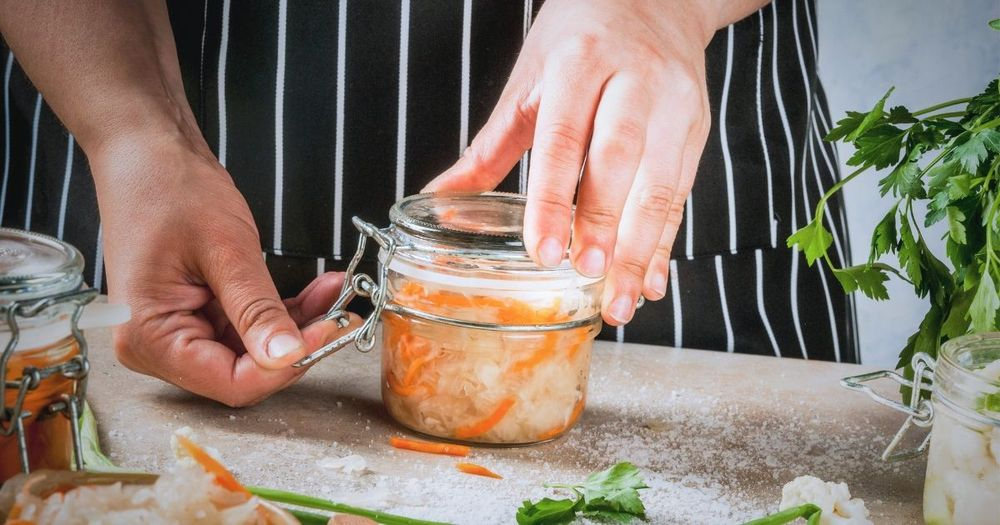
A few days into a jar of sauerkraut, you lean close and hear it. A faint fizz. Tiny bubbles climbing through the cabbage. Nobody added anything. The bacteria that were sitting on those leaves all along have woken up and gone to work, and the jar on your counter has turned into something alive.
Making it yourself means you know it's alive. A shop-bought jar may or may not carry live cultures, depending on whether it was heated to keep on the shelf. Yours never sees heat, costs a cabbage and some salt, and tastes the way you like it. Sauerkraut, pickles, yoghurt and kefir all fit in an ordinary kitchen, and none needs more skill than patience. The rules that matter fit on a postcard: enough salt, everything under the brine, and a nose that knows when to say no. The tricks are smaller and stranger, like the sliver you cut off one end of a cucumber to keep your pickles crisp.
What you need
A clean jar or crock. Glass or a stone crock both work. For a single head of cabbage, a large wide-mouth mason jar is plenty, though jars lose a little more to spoilage than a crock does. Wash everything in hot, soapy water and rinse it well before you start.
Something to keep the food under its brine. This is the one rule that matters most. Vegetables need to sit an inch or two (a few centimetres) below the liquid while they ferment. A small plate, a smaller jar filled with water, or glass weights made for the job all do it. Airlock lids let the gas out and keep air and insects away from the surface. A comes with both.
The right salt. Use canning or pickling salt. Table salt with anti-caking agents can cloud the brine, iodised salt can darken it, and flaky salt is too unpredictable to measure. A box of covers a lot of cabbage.
The right materials. Glass, stoneware, stainless steel or unchipped enamel. Brass, iron, copper and zinc can discolour the food, and pickles made with brass, copper or zinc utensils belong in the bin.
A kitchen thermometer for yoghurt, where a few degrees decide whether it sets.
Fresh food. Firm cabbage and cucumbers, started within a day or two of picking. Vegetables left too long before fermenting turn out hollow or shrivelled.
Sauerkraut, step by step
Sauerkraut has survived worse than a beginner's mistakes. During the First World War, American makers worried that shoppers would shun anything German, so they relabelled it "liberty cabbage" until the war was over.
Shred. Take off the outer leaves, quarter the cabbage, cut out the core and slice it thin, about the thickness of a coin.
Salt. The tested ratio is about 3 tablespoons of pickling salt for every 2.3 kilos (5 pounds) of cabbage. Toss the salt through the shreds with clean hands. Keep to the full amount: salt lets the right bacteria take over and holds the others back, so cutting it makes the kraut less safe as well as softer.
Squeeze. Work and press the cabbage until it softens and gives up its juice. This takes a few minutes, and it's oddly satisfying. That juice is your brine.
Pack. Press the cabbage down hard into the jar, layer by layer, until the brine rises over the top. If the juice falls short, top it up with a little salt water you've boiled and cooled.
Weigh it down and wait. Put the weight on, cover the jar, and leave it somewhere out of direct sun. At 21 to 24°C (70 to 75°F), sauerkraut is fully fermented in about three to four weeks. At 15 to 18°C (60 to 65°F), give it five to six. Below 15°C it may stall, and above 24°C it tends to go soft.
Check on it. Look in two or three times a week. A thin white film can form on the surface; skim it off. When the bubbling stops, the fermentation is done.
Chill. Fully fermented sauerkraut keeps for several months tightly covered in the fridge.
Pickles the old way
Cucumbers ferment the same way, only whole and in salt water, because a whole cucumber holds on to its juice, where shredded cabbage gives it up. A fermented pickle is sour from the bacteria, a world away from the vinegar pickles on supermarket shelves. Two tricks make the difference. Slice a thin sliver off the blossom end of each cucumber, the end opposite the stalk, because it carries an enzyme that softens pickles. And use a tested recipe for the brine, because the salt strength decides whether the right bacteria win. The USDA's home canning guide has one for dill pickles.
Kimchi works on the same principle with more personality. Napa cabbage or Korean radish is salted first, then mixed with a paste of Korean chilli powder (gochugaru), garlic, ginger and spring onions, often with a little salted seafood. Every family seasons it differently, so start from a tested recipe and keep to its salt.
Yoghurt in a warm spot
Yoghurt began by accident. Herders in Eastern Europe and Western Asia stored milk in bags made from animal stomachs, and the natural enzymes inside curdled it. The milk kept longer, people liked the taste, and they kept doing it. Today it needs milk, a few spoons of live yoghurt and a way to keep it warm.
Heat the milk. Bring it to 82°C (180°F) and hold it there for 10 minutes for a thinner yoghurt or 20 for a thicker one. This clears out competing bacteria and firms up the milk proteins.
Cool it. Let it drop to 42 to 44°C (108 to 112°F). Any hotter and you'll kill the starter.
Add the starter. Stir in 2 to 3 teaspoons of plain live yoghurt for every cup of milk. Go easy here: too much starter crowds the bacteria and turns tart into sour.
Keep it warm. Leave it undisturbed for 6 to 8 hours somewhere that stays warm. A switched-off oven warmed for a few minutes or a cool box filled with warm water both work, and a holds the temperature for you.
Chill it straight away once it has set like a soft jelly. Cold stops the souring. Made with clean equipment and kept below 4°C (40°F), homemade yoghurt lasts 10 to 21 days before moulds and yeasts start to win. Save a few spoons from each batch to start the next, and refresh your starter with a new pot of live yoghurt every five or six batches. Spare starter can be frozen for later.
If it stays runny, one of three things is usually to blame: a tired or heat-treated starter, a temperature that drifted outside 42 to 44°C, or a trace of washing-up liquid left on the jars. Rinse everything well and try again.
For something thicker, tip the finished yoghurt into a sieve lined with a clean cloth and let the whey drain off. What's left is labneh, or Greek-style yoghurt, rich enough to stand in for sour cream in dips and sauces.
Kefir with grains
Kefir is the easiest of all. Kefir grains look like little lumps of cauliflower, and they're a living mix of bacteria and yeasts.
Drop a spoonful of into a jar of fresh pasteurised milk, cover it with a cloth and leave it somewhere around 20 to 25°C. In 12 to 24 hours the milk thickens and turns tangy. Strain out the grains with a plastic or stainless-steel sieve, drink or chill the kefir, and put the grains into fresh milk to start again. They grow and split as they go, so you'll soon have enough to share. Kefir is slightly alcoholic and a little fizzy, which is part of its charm, and the alcohol is worth knowing about if you're pregnant.
Kombucha, with care
Kombucha is the trickiest of the home ferments and has the least evidence behind it, so brew it for the taste and leave the health claims to the label. If you do, follow a tested recipe closely. Sanitise everything, check that your starter liquid tests at pH 4.0 or lower on a test strip before you brew, ferment at 20 to 25°C for about a week to ten days, then bottle and chill it and drink it within a month. Watch the bottles: kombucha sealed airtight keeps making gas, and a bottle left too long can burst.
Spoilage and safety
Fermenting is forgiving, but your nose and eyes are the final check. A thin white film on the surface is normal; skim it off. Fuzzy mould in blue, green, black or pink, a slimy texture or a rotten smell means spoilage, and the whole batch goes in the bin. Soft sauerkraut usually means it fermented too warm or rose above the brine.
A few more habits keep it safe. Use pasteurised milk for yoghurt and kefir. Keep fermenting vegetables under their brine. And keep to tested amounts of salt, because the salt and the acid the bacteria make are what keep the wrong microbes out. Botulism, the one to worry about, comes from badly canned food and from ferments made without enough salt or acid, so the salt rule is the safety rule. Garlic or herbs kept in oil are a different thing entirely and a rarer botulism risk, which is why infused oils need acidifying and keeping in the fridge.
Start with one jar
A pantry full of crocks can wait. One cabbage, a jar, some salt and a few weeks will give you a sauerkraut you know is alive, and low enough in carbohydrate for a keto or carnivore plate. Plain whole-milk yoghurt and kefir fit too, at under 5 grams of carbohydrate per 100 grams. Once you've heard that first fizz, it's hard not to start the next jar, and Sandor Katz's will take you from there.
Shred a cabbage this weekend, salt it, pack it and give it a month. Then lean in and listen.
Wondering what fermented foods do for you? Are Fermented Foods Good for Your Gut? — which ones still carry live cultures, what they do, and when they cause trouble.
Curious what else settles or upsets your gut? Foods That Upset Your Gut: What's Real and What's Personal — fibre, fermentable carbohydrates, and what probiotic capsules miss.
Know someone who keeps buying sauerkraut that's been heated for the shelf? Send them this. One cabbage and a jar will give them the live kind.
Disclaimer: This article is general information. For advice about your own health, talk to a qualified health professional, especially if you are pregnant or have a weakened immune system.
Affiliate Disclosure: This article contains affiliate links. As an Amazon Associate, All For Life earns from qualifying purchases, at no extra cost to you. We only link to products we would recommend without the commission.