
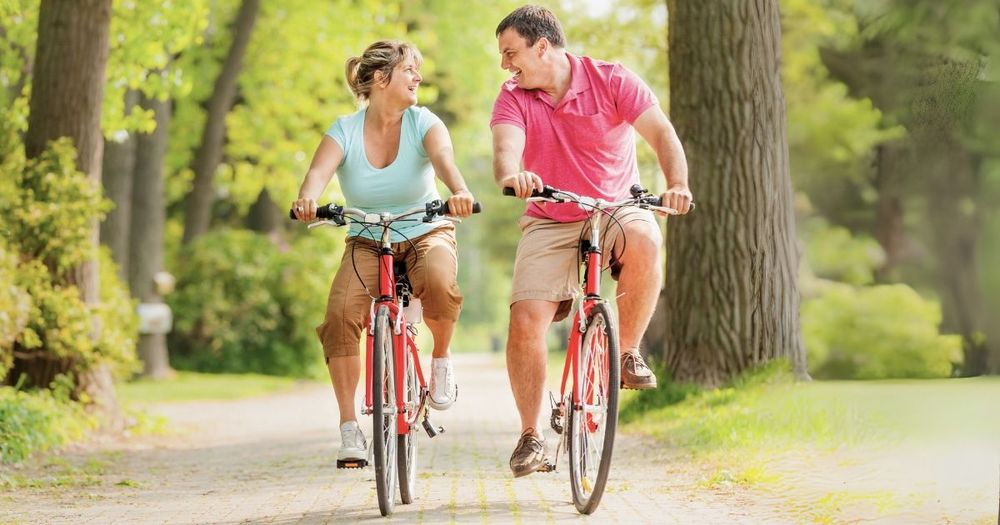
You're tired of feeling sluggish. You've read enough to know that moving would help, and you've been meaning to start for a while, perhaps for a few years. So you buy the trainers, sign up for something, and go at it hard on the first Monday.
That's the classic start, and it's the wrong one. It's unpleasant, it's how you quit by March, and for somebody who has done nothing for years, it's the one part of this that carries real risk.
Defy Aging with Movement, linked below, has why you should move. This is about Monday: what to do in your first month, starting from the sofa. If you'd like to know why exercise feels so unnatural in the first place, Daniel Lieberman's has the evolutionary reason, and it may make you feel better about the sofa.
Don't start hard
Here's the number that should change your first week. Researchers asked heart attack survivors what they'd been doing just beforehand. In the hour after heavy exertion, people who usually exercised less than once a week had 107 times their normal risk. People who exercised five or more times a week had 2.4 times theirs.
The risk in any single hour is small, even multiplied by 107, and the people who moved regularly were clearly protected overall. But that's the shape of it: the danger sits with the sudden effort in the unprepared body. So the first month isn't the time for a boot camp, a charity 10K or sprinting for the bus to prove a point.
If you have a heart condition, chest pain on exertion or a long list of risk factors, talk to a qualified health professional first. Chest pain, or sudden breathlessness that doesn't settle, means stop and get help.
How hard, then?
Hard enough to notice and easy enough to want to do again. When 25 sedentary middle-aged women walked on a treadmill for 20 minutes at a speed they chose, their pleasure held steady. When the speed was just 10% higher, it fell. That's a tiny push, and it's enough to turn something pleasant into something you'd rather not repeat.
It matters because what you feel now predicts what you do later. In one study, how good people felt during moderate exercise predicted how active they were 6 and 12 months on. Why Motivation Fails, linked below, has this from another angle: enjoying it is what keeps you going.
So use your own pace. You should be able to talk, in sentences, and to finish feeling better than you started.
You may notice the reward sooner than you expect. The Stress-Sleep Vicious Cycle: How to Break It has 48 people with chronic insomnia who did one session of moderate exercise, and fell asleep 55% faster that night. Hard aerobic exercise and weights didn't do the same, so there's another reason to keep it gentle.
Do you need a goal?
Every list says to set a clear, measurable one: three runs a week for 20 minutes. It may suit people who are already active. In one small interview study, insufficiently active people responded better to loose goals, such as seeing how far they could walk, and worse to specific ones. Active people were the other way round.
That's a small study, but it fits common sense. If you haven't walked further than the car park in five years, a number can feel like a test you're about to fail. Your first goal is to go out the door. If you need a reason other than being good, Hidden Habits Sabotaging Your Productivity—and How to Fix Them has the walkers whose creative output rose while they were on their feet and for a while afterwards.
Week one
Take a 10-minute walk after dinner. That's it. Do it most days, and go at a pace that lets you talk.
After a meal suits it, because you already eat dinner, so the walk has something to hang on to, and 7 Simple Changes to Improve Your Health, Starting Today has the short bursts of ordinary effort, stairs taken briskly or a hurried walk to the shop, that count for more than you'd think. Those can come in once the walking feels easy.
Weeks two to four
Add a little. A few minutes, a slightly longer loop, a hill you've been avoiding.
You'll be told about the 10% rule, which says never to add more than 10% a week. It sounds very responsible. When it was tested in novice runners, those on a careful 13-week build-up had the same injury rate as those on a standard 8-week plan: 20.8% against 20.3%. So there's no magic number. Go by how your legs feel the next day.
If you want a plan to follow, Couch to 5K is the classic, and How to Reach Your Health Goals Without Losing Your Sanity has where it came from. Walking is enough, though. You don't have to run at all.
Is it too late?
You may be 55 and wondering whether there's any point. Defy Aging with Movement has 315,059 Americans who were asked how active they'd been through their lives. Those who only began between 40 and 61, after years of doing little, had a death rate 35% below that of lifelong non-movers. Those who'd been active all along were at 36%.That relies on what people remembered about themselves, so don't lean on the single point between them. But it isn't the picture you'd expect. The Harsh Truth About Aging: Decline or Longevity? has the people of ninety who got stronger in eight weeks of lifting.
Sore?
Probably. A dull, spread-out ache over the next day or two is normal, and it eases as your body gets used to the work. Read Your Body's Signals: The Sense Most People Let Fade has how to tell that from the sharp kind of pain, which isn't.
You may be told to stretch it away. A review of 12 studies found that stretching before or after exercise cut next-day soreness by about half a point to one point on a 100-point scale. If you enjoy stretching, carry on. It just won't do that.
If it's your knees you're worried about, What Your Workouts Are Doing to Your Joints has the reassurance. The higher rates of arthritis turn up at the elite, high-mileage end of running, and for the rest of us a chair is the bigger threat.
Gear
You need shoes you can walk in, and you probably own some. If you take up running, you'll be told your feet need matching to a shoe. When 927 novice runners were all given the same neutral shoe and followed for a year, those whose feet rolled inward were no more likely to be injured than the rest. They actually had fewer injuries per 1,000 km. A second-hand pair that feels comfortable is fine, and so is an old T-shirt. The shop won't tell you that.
The tracker
The advice is to track your progress, and writing down what you did is fine. Just don't assume a gadget will do it for you. In a two-year trial with 471 people on a weight loss programme, those given a wearable tracker lost less weight than those who weren't, 3.5 kg against 5.9 kg.That's about weight rather than fitness, and the reason isn't clear. But the tracker clearly wasn't the magic ingredient. A line on a calendar costs nothing. It also won't buzz at you in a meeting.
While we're on the scales, don't judge the month by them. Why Diet and Exercise Are Non-Negotiable for Fat Loss has the sums: across eight tests with 1,022 people, exercise by itself lost 5.3 kg less than exercise plus diet. If you're walking and the number hasn't moved, the walk hasn't failed. Weight mostly gets settled at the table.
Friends, fun and the day you miss
Why Motivation Fails has most of this. It has the gym members who paid over $17 a visit, the audiobooks kept for the treadmill, and the large test in which the best scheme rewarded people for returning after a miss. let you try the audiobook trick on a walk and still hear the traffic. The reward for returning is worth remembering. You will miss a day. What matters is the day after.
Company helps too. How to Start Taking Care of Yourself Today: Why Your Body Can't Wait has the numbers on signing up with friends or relatives: far more of them finished. And pick something you don't dread. Dancing in your kitchen counts. The neighbours can look away.
A dog helps as well. Why Petting an Animal Calms You and Looking Doesn't has the Cheshire comparison: 191 dog owners against 455 without, with the owners 14 times as likely to walk for pleasure and four times as likely to hit 150 active minutes a week. Owners may simply differ, of course, but a dog is one partner who never cancels.
The first strength exercise
Sit down on a chair slowly, without dropping the last bit. Stand up again without using your hands. Do it a few times, and then do it again tomorrow. That's strength training, and it's where you start. You've been doing the first half for years.
Defy Aging with Movement has what it does for you later on, and The Harsh Truth About Aging has why getting to the floor and back is worth practising, and a makes the floor a little kinder. It also has the balance test: of 1,702 people aged 51 to 75, one in five couldn't manage ten seconds on one leg, and over seven years they were 84% more likely to have died. That's a link rather than proof, but you can practise while you brush your teeth. Meat, fish and eggs give that muscle the protein it needs.
What to do, in order
This week. Walk for 10 minutes after dinner, most days, at a talking pace. Stand up from a chair a few times.
Week two. Make it 15 minutes when that feels easy. Tell someone what you're doing, or ask them along.
Week three. Try 20 minutes, or add a hill. Take the stairs when they're there.
Week four. Add a second walk or something you like. Keep the chair going, and make it harder by going slower.
If you miss a day. Go the next day. There's no making up to do. In a heatwave, walk early or late, and Smart Strategies to Stay Cool and Comfortable During Summer Heatwaves has what helps.
Warning signs. Chest pain, sudden breathlessness or dizziness means stop.
And if you're wondering how much you'll eventually need, the standard target is 150 minutes of moderate activity a week. Defy Aging with Movement has 661,137 adults among whom even those below it were 20% less likely to have died than people doing nothing. It's a comparison and no proof, but the first minutes seem to buy the most, and those are the ones you've just done.
A month from now, you won't be fit. You'll be someone who goes for a walk after dinner, and that's the harder change of the two. Tonight, put your shoes by the door. Tomorrow, after you've eaten, put them on.
Struggling to keep it going? Why Motivation Fails — and What Keeps Habits Going After It Does — why the first burst fades, how long a habit takes, and what to do on the day you miss.
Want to know what all this walking is doing for you? Defy Aging with Movement: How Exercise Keeps You Strong, Sharp, and Independent for Life — what movement does for your heart, brain and joints, and how much is enough.
Know someone about to sign up for a boot camp after ten years on the sofa? Send them this first.
Disclaimer: This article is general information. For advice about your own health, talk to a qualified health professional, especially if you have a heart condition or haven't been active for a long time. Stop and get help if you have chest pain, sudden breathlessness or dizziness.
Affiliate Disclosure: This article contains affiliate links. As an Amazon Associate, All For Life earns from qualifying purchases, at no extra cost to you. We only link to products we would recommend without the commission.
Sources
Mittleman MA, Maclure M, Tofler GH, et al. (1993). Triggering of Acute Myocardial Infarction by Heavy Physical Exertion — Protection against Triggering by Regular Exertion. New England Journal of Medicine 329(23):1677–1683. doi.org/10.1056/NEJM199312023292301
Lind E, Ekkekakis P, Vazou S (2008). The Affective Impact of Exercise Intensity That Slightly Exceeds the Preferred Level. Journal of Health Psychology 13(4):464–468. doi.org/10.1177/1359105308088517
Williams DM, Dunsiger S, Ciccolo JT, et al. (2008). Acute affective response to a moderate-intensity exercise stimulus predicts physical activity participation 6 and 12 months later. Psychology of Sport and Exercise 9(3):231–245. doi.org/10.1016/j.psychsport.2007.04.002
Passos GS, Poyares D, Santana MG, Garbuio SA, Tufik S, Mello MT (2010). Effect of acute physical exercise on patients with chronic primary insomnia. Journal of Clinical Sleep Medicine 6(3):270–275. doi.org/10.5664/jcsm.27825
Hawkins RM, Swann C, Jackman PC (2024). Exploring How Active and Insufficiently Active Individuals Respond to Specific and Non-Specific Physical Activity Goals. Research Quarterly for Exercise and Sport 95(1):60–68. doi.org/10.1080/02701367.2022.2147894
Buist I, Bredeweg SW, van Mechelen W, et al. (2008). No Effect of a Graded Training Program on the Number of Running-Related Injuries in Novice Runners. The American Journal of Sports Medicine 36(1):33–39. doi.org/10.1177/0363546507307505
Saint-Maurice PF, Coughlan D, Kelly SP, et al. (2019). Association of Leisure-Time Physical Activity Across the Adult Life Course With All-Cause and Cause-Specific Mortality. JAMA Network Open 2(3):e190355. doi.org/10.1001/jamanetworkopen.2019.0355
Herbert RD, de Noronha M, Kamper SJ (2011). Stretching to prevent or reduce muscle soreness after exercise. Cochrane Database of Systematic Reviews 2011(7):CD004577. doi.org/10.1002/14651858.CD004577.pub3
Nielsen RO, Buist I, Parner ET, et al. (2014). Foot pronation is not associated with increased injury risk in novice runners wearing a neutral shoe: a 1-year prospective cohort study. British Journal of Sports Medicine 48(6):440–447. doi.org/10.1136/bjsports-2013-092202
Jakicic JM, Davis KK, Rogers RJ, et al. (2016). Effect of Wearable Technology Combined With a Lifestyle Intervention on Long-term Weight Loss. JAMA 316(11):1161–1171. doi.org/10.1001/jama.2016.12858
Johns DJ, Hartmann-Boyce J, Jebb SA, Aveyard P (2014). Diet or Exercise Interventions vs Combined Behavioral Weight Management Programs: A Systematic Review and Meta-Analysis of Direct Comparisons. Journal of the Academy of Nutrition and Dietetics 114(10):1557–1568. doi.org/10.1016/j.jand.2014.07.005
DellaVigna S, Malmendier U (2006). Paying Not to Go to the Gym. American Economic Review 96(3):694–719. doi.org/10.1257/aer.96.3.694
Milkman KL, Gromet D, Ho H, et al. (2021). Megastudies improve the impact of applied behavioural science. Nature 600(7889):478–483. doi.org/10.1038/s41586-021-04128-4
Westgarth C, Christley RM, Jewell C, et al. (2019). Dog owners are more likely to meet physical activity guidelines than people without a dog: An investigation of the association between dog ownership and physical activity levels in a UK community. Scientific Reports 9:5704. doi.org/10.1038/s41598-019-41254-6
Araujo CG, de Souza e Silva CG, Laukkanen JA, et al. (2022). Successful 10-second one-legged stance performance predicts survival in middle-aged and older individuals. British Journal of Sports Medicine 56(17):975–980. doi.org/10.1136/bjsports-2021-105360
Arem H, Moore SC, Patel A, et al. (2015). Leisure Time Physical Activity and Mortality: A Detailed Pooled Analysis of the Dose-Response Relationship. JAMA Internal Medicine 175(6):959–967. doi.org/10.1001/jamainternmed.2015.0533