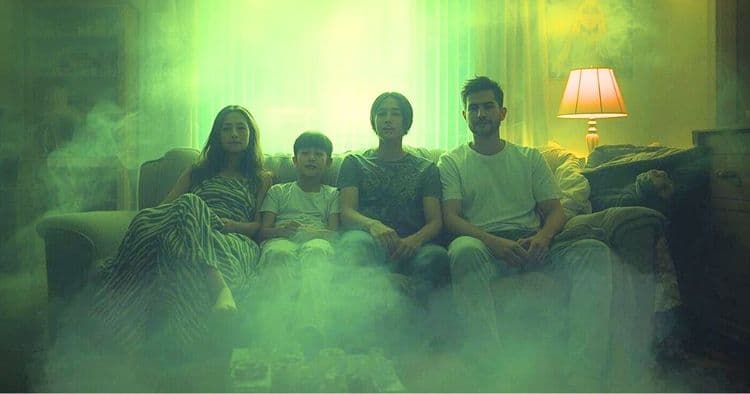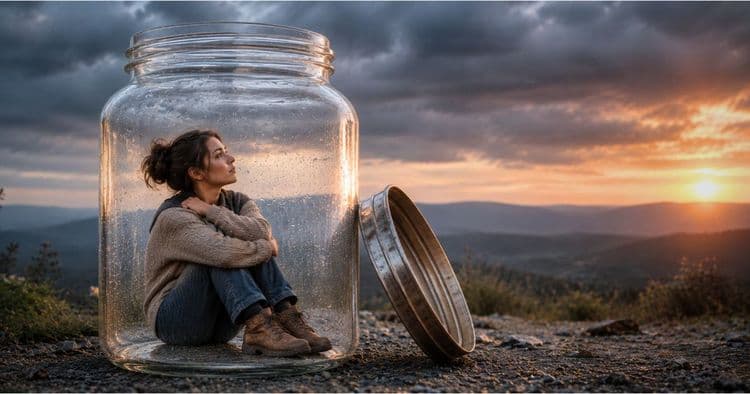
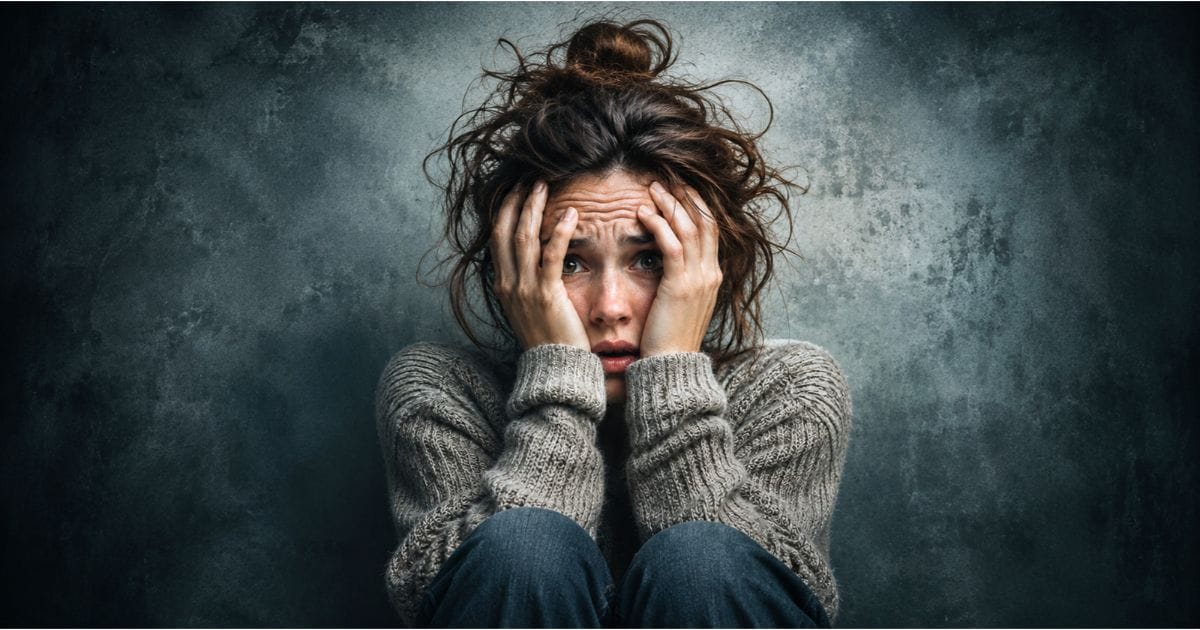
The word "fear" began as the danger, not the feeling. In Old English, fǣr meant a sudden attack, a calamity, peril. German still uses its cousin that way: Gefahr means the danger itself. Somewhere along the road, English moved the word from the thing outside to the reaction inside. That small shift is a good picture of the trouble with fear. The feeling stands in for a danger that may or may not be there.
Do you ever feel held back by fear? Of failing, of what you can't see coming, of dying. The email you never send, the test result you leave unopened, the thought of the end that turns up in the dark. The usual advice on how to deal with fear comes as an acronym, F.E.A.R., False Evidence Appearing Real. It's half right, and the half it misses is what keeps you alive. Fear is an alarm, and dealing with it means learning when the alarm gets it wrong, and when it doesn't.
The woman who walked towards danger
Researchers know her as S.M. A rare condition, Urbach–Wiethe disease, destroyed the amygdala on both sides of her brain by late childhood. The amygdalae are two almond-shaped clusters deep in the brain, and in 2011 a team of American neuroscientists set out to see what a person without them would feel. They let her handle live snakes and spiders, walked her through a haunted house, and showed her horror films. She never showed fear, and she never reported more than a trace of it. What she showed was interest and curiosity.
Her history is hard to read. She has been held up at knifepoint and at gunpoint, was almost killed in a domestic violence incident, and has received death threats more than once. In none of it did she show the urgency that would normally come with being in danger. That sheer number has been put down partly to the poor, dangerous area she lived in, and partly to her trouble sensing danger coming and steering clear of it.
So fear isn't false evidence by nature. It's an alarm, and a person without one walks towards what everyone else backs away from. So keep the alarm, and ask a better question each time it goes off: is this ring a fire, or burnt toast?
False evidence, appearing real?
Worry is where the acronym fits best. How many times have you worried about something that never happened? In a study described in Workplace Trauma Recovery: How to Heal, Rebuild Confidence, and Protect Yourself Going Forward, people with generalised anxiety wrote their worries down and checked them over the following month. More than nine in ten didn't happen during the study.
But fear isn't always wrong. Gavin de Becker, a security expert, made his name reading the signals that come before violence. One he called forced teaming, a stranger talking about "we" before there is any we. Love Bombing in Relationships: How to Recognize and Stop Emotional Manipulation shows the same signals turning up in a romance that moves too fast. A bad feeling about a person can be reading something real before you can put a name to it. His book makes the case for taking that first unease seriously.
So the acronym works better as a question. What's the evidence, and does it point where the fear points?
When fear aims at the wrong risk
The first piece of advice for fear is usually to learn more about what you're afraid of, on the idea that knowledge proves the fear false. Sometimes knowledge shows something stranger: the fear is real, and it's aimed at the wrong thing.
After the attacks of September 11, 2001, Americans flew less and drove more. Gerd Gigerenzer, a German psychologist who studies how risk is judged, went through the US road deaths for the three months that followed. By his estimate, more Americans died on the roads by avoiding the risk of flying than the passengers killed on the four planes.
He later looked at the whole year after the attacks. Every month had more fatal crashes on the highways than the level of earlier years, and he put the extra toll at about 1,500 lives. Road records can't say why each driver chose the car, so these are estimates. He called the attack a dread risk: a rare event with a terrible outcome, the kind that frightens far more than a common risk that kills more people a few at a time.
The fear of flying that autumn was a real feeling about a real event. It just pushed people towards the more dangerous of the two choices. That's where knowledge earns its place. It leaves the feeling alone and checks what it's aimed at. If I avoid this risk, what risk am I taking instead? Gerd Gigerenzer's shows how to do that with the numbers in front of you.
The alarm inside the body
S.M.'s story has a twist. In 2013 researchers gave her and two other people with the same damage a breath of air with 35% carbon dioxide, which feels like suffocating. All three felt fear, and all three had panic attacks. They described the feeling as completely new to them.
The amygdala, it seems, is needed for fear of what's out there, the snake and the knife. Fear that starts inside, the body's own alarm about air, can run without it.
Ancient Greece gave that kind of fear a god of its own. Pan, god of fields and woods, was blamed for the strange sounds that set off sudden fear in herds and crowds, or in someone alone in a lonely place, fear with nothing in front of it. His name is still in the word: panic, from the Greek panikós, "of Pan".
So when panic arrives with no danger in the room, the alarm may be reading your breathing or your heart rather than anything outside. A pounding heart and short breath can set it off on their own, and Emergency Stress Relief: What to Do When You're Completely Overwhelmed covers the first minute.
How a fear is learned
In 1920 the American psychologist John Watson and his student Rosalie Rayner set out to teach a baby to be afraid. Albert was about nine months old when they first showed him a white rat, and he wasn't afraid of it. At eleven months they started striking a steel bar with a hammer behind his head each time he touched it. After a few pairings the rat alone made him cry and crawl away, and the fear spread to a rabbit, a dog, a fur coat and a Santa Claus mask. Nobody would be allowed to run that experiment now. But it made the point that a fear can be built from nothing.
A fear doesn't even need a bad experience of your own. In 1989 Michael Cook and Susan Mineka showed rhesus monkeys videos of other monkeys reacting with terror. The tapes were edited so that the fear seemed aimed either at toy snakes and a toy crocodile, or at flowers and a toy rabbit. The watching monkeys picked up a fear of the snakes and the crocodile, and none of the flowers or the rabbit. Fear can be caught by watching, and it catches more easily on some things than others, which fits the idea that brains come ready to learn some fears faster.
How a fear is unlearned
In 1924, four years after Albert, Mary Cover Jones, who had heard Watson lecture, tried the reverse. Peter was two years and ten months old and terrified of a white rabbit, and of fur coats, feathers and cotton wool along with it. Jones sat him in a high chair with food he liked and brought the caged rabbit as close as she could without putting him off eating. Children who weren't afraid of it played nearby, which after the monkeys looks like more than company. Session by session the rabbit came closer.
She logged 17 steps, from fear at a rabbit anywhere in the room to letting it nibble his fingers. His fear of the cotton, the fur coat and the feathers went too.
It didn't go in a straight line. Peter caught scarlet fever and spent about two months in hospital, and on his way back a large dog jumped at him as he was getting into a taxi. His fear fell back to near where it had started, and the steps had to be climbed again.
Joseph Wolpe later called Jones "the mother of behavior therapy". The method has been refined since. How to Rebuild Confidence When Your Nervous System Doesn't Trust Motivational Quotes sets out how to build your own steps, and why the small comforts that get you through a fear can also keep it in place. Peter's lesson is simpler. A fear learned by pairing can be unlearned by pairing, a rung at a time, and a setback is a step back down, not the end of the climb.
It also explains the dog. Facing a fear doesn't wipe out the old lesson. It writes a newer one on top, and a bad scare can let the old one through again for a while. Avoiding does the opposite job. Each escape teaches "I got away, so I'm safe", and the newer lesson never gets written at all.
Fear of the unknown
Of the three fears from the start, failure, the unknown and death, the middle one may sit underneath the other two. In 2016 Nicholas Carleton, who studies anxiety in Canada, put forward the idea that "fear of the unknown may be a, or possibly the, fundamental fear" behind anxiety. Fear of failure is fear of an outcome you can't see yet. Fear of death is fear of the one thing nobody comes back to describe.
That's an argument, not a finding, and Carleton set it out to provoke debate. But it explains why learning about a fear works when it does. Every piece of real information turns a little of the unknown into something you can plan for. A contract you've read to the end, an interview you've rehearsed, a route you've walked in daylight: the danger may be the same size, but the dark around it is smaller.
Fear of death
The best-known answer to the biggest fear is about 2,300 years old. In a letter to a student, Menoeceus, the Greek philosopher Epicurus argued that "death is nothing to us", because "when we are, death is not come, and, when death is come, we are not." What hurts, he wrote, isn't death but the prospect of it, which he called "a groundless pain in the expectation".
That answers the fear of being dead. The fear of dying, of pain, of depending on others, of leaving someone behind, is a different fear, and his letter doesn't reach it. Whether his answer settles the first is for you to decide. But look at the move he makes. He separates the thing from the waiting for the thing, and finds the suffering in the waiting. It's the same move as checking a worry against what happened.
Courage isn't the absence of fear
If fear is an alarm, courage isn't switching it off. Even the god of war kept his. In Homer's Iliad, Ares calls up Fear and Fright to go into battle with him. When the American astronomer Asaph Hall found the two moons of Mars in 1877, they were named after that pair, Phobos and Deimos. Phobos, fear, is also where the word "phobia" comes from.
In 1983 a team including the psychologist Stanley Rachman tested bomb-disposal operators: seven who had been decorated for gallantry, and seven who were just as experienced and successful but hadn't. Under the threat of an electric shock, while making difficult judgements, the decorated men kept a lower heart rate. They didn't report feeling any less afraid, and they didn't perform any better.
Fourteen men is a small study, so treat it as a clue rather than a law. The brave ones weren't the fearless ones. They felt it as much as their colleagues did and did the job anyway, with a body that stayed steadier.
What to do with a fear
Sort the alarm. Ask what the fear is about, because the right move changes with it. A stranger who keeps pressing after you've said no is a reason to leave, and you don't need to prove anything about them first. New, severe chest pain or trouble breathing is a reason to call the emergency number. Familiar nerves before you speak in a meeting are a reason to stay and practise. For a symptom that won't go away, How to Respond to a Symptom Without Ignoring It or Panicking covers both ways of getting it wrong. If the fear is about something that might happen, and you keep replaying it with nothing new coming in, it's the kind to check with the steps below.
Find out what it's pointing at. Learn about the thing you fear from one good source. Write down exactly what you think will happen, then check how likely it is, and what the alternative you'd choose instead would cost. Then stop. Looking it up again and again is a comfort, and comforts can keep a fear in place.
Say you've been putting off asking for a pay rise. What exactly do you think will happen? A no, perhaps, or a manager who goes cold on you. How often has asking gone that way before? What does not asking cost? If you delay again, you'll still be guessing what your manager would have said.
And what one fact would shrink the unknown? The going rate for the job is often a search away. Written down like that, the fear is aimed at a no, while staying quiet guarantees you learn nothing.
Suppose the answer is no. You'd still find out that the conversation was bearable, whether you were taken seriously, and what stands in the way. That's more than the fear ever told you.
Notice how easy it is to skip all this. You draft the email, close it without sending, and feel better at once. By the evening, waiting looks like the sensible choice. But you've learned nothing about how your manager would answer, and the fear has learned that hiding works.
Ask for the evidence. When a fearful thought arrives, name the feeling first, in a few exact words: "dread of looking foolish in this meeting", not just "stress". Then step back and ask what supports it. What happened the times before? What would I tell a friend who said this? How Changing Your Thoughts Changes Your Day shows the method for spotting a thought as it arrives and turning it over, and the scan behind naming a feeling.
Face it in small steps. Do what Jones did for Peter. Bring the feared thing a little closer and stay with it. At the end, ask what you predicted and what happened. Then move one step on. If speaking up in meetings frightens you, the first step might be one question in a small meeting, then a comment, then a point you disagree with, then a short update in front of the whole team. A bad day sends you a step back, and you climb on from there.
Watch the comforts, too. If you only ever do it with notes in hand or a friend beside you, the fear can give them the credit for getting you through, so try one part without them and see what happens. Edmund Bourne's walks through building the steps for one particular fear.
Come back to the present. Most fear lives in the prospect, as Epicurus said of death. Attention on your breath, your feet or the room around you pulls you out of the next hour and into this one. When the alarm is in the body, take a breath in, add a second small one on top, and let both out slowly, for longer than they took to come in. The study behind it, and why once or twice is enough, is in Emergency Stress Relief: What to Do When You're Completely Overwhelmed.
Don't face it alone. Peter had braver children around him. A trusted friend, a family member or a mental health professional can do the same for you. The scan in which holding a hand calmed the brain's response to threat is in Why Your Nervous System Fights Some Stress Techniques.
Natural, normal, and negotiable
Fear is a natural and normal part of being human, and S.M.'s life shows what happens when the outside alarm is missing. The word began as the danger and ended up as the feeling, and most of the work is keeping the two apart long enough to see which one you're facing.
That's how to deal with fear without losing what it's for. Keep the alarm. Check each ring, learn which ones are burnt toast, and walk through those anyway. The alarm itself isn't up for negotiation. What you do when it rings is.
Pick one fear that's been holding you back. Write down what you think will happen, find one fact about it you didn't know, and take the first small step this week.
Want to face a fear one step at a time? How to Rebuild Confidence When Your Nervous System Doesn't Trust Motivational Quotes — how to build the steps, and which comforts end up feeding the fear.
Panic with nothing in the room? Emergency Stress Relief: What to Do When You're Completely Overwhelmed — the first minutes of an attack, and the time between them.
Know someone who swears by "False Evidence Appearing Real"? Send them "False evidence, appearing real?".
Tried something here, or got a question it didn't answer? Write to us at contact@allforlife.club. Your questions shape the next articles.
Disclaimer: This article is general information, not medical advice. If fear, anxiety or panic attacks are affecting your daily life, talk to a qualified health professional.
Affiliate Disclosure: This article contains affiliate links. As an Amazon Associate, All For Life earns from qualifying purchases, at no extra cost to you. We only link to products we would recommend without the commission.
Sources
Wiktionary. fear. en.wiktionary.org
Feinstein JS, Adolphs R, Damasio A, Tranel D (2011). The Human Amygdala and the Induction and Experience of Fear. Current Biology 21(1):34–38. doi.org/10.1016/j.cub.2010.11.042
Wikipedia. S.M. (patient). en.wikipedia.org
Gigerenzer G (2004). Dread Risk, September 11, and Fatal Traffic Accidents. Psychological Science 15(4):286–287. doi.org/10.1111/j.0956-7976.2004.00668.x
Gigerenzer G (2006). Out of the Frying Pan into the Fire: Behavioral Reactions to Terrorist Attacks. Risk Analysis 26(2):347–351. doi.org/10.1111/j.1539-6924.2006.00753.x
Feinstein JS, Buzza C, Hurlemann R, Follmer RL, Dahdaleh NS, Coryell WH, Welsh MJ, Tranel D, Wemmie JA (2013). Fear and panic in humans with bilateral amygdala damage. Nature Neuroscience 16(3):270–272. doi.org/10.1038/nn.3323
Wiktionary. panic. en.wiktionary.org
Watson JB, Rayner R (1920). Conditioned emotional reactions. Journal of Experimental Psychology 3(1):1–14. doi.org/10.1037/h0069608
Cook M, Mineka S (1989). Observational conditioning of fear to fear-relevant versus fear-irrelevant stimuli in rhesus monkeys. Journal of Abnormal Psychology 98(4):448–459. doi.org/10.1037/0021-843X.98.4.448
Jones MC (1924). A Laboratory Study of Fear: The Case Of Peter. The Pedagogical Seminary and Journal of Genetic Psychology 31(4):308–315. doi.org/10.1080/08856559.1924.9944851
Wikipedia. Mary Cover Jones. en.wikipedia.org
Carleton RN (2016). Fear of the unknown: One fear to rule them all? Journal of Anxiety Disorders 41:5–21. doi.org/10.1016/j.janxdis.2016.03.011
Epicurus. Letter to Menoeceus, translated by Robert Drew Hicks. en.wikisource.org
Wikipedia. Moons of Mars. en.wikipedia.org
Wiktionary. phobia. en.wiktionary.org
Cox D, Hallam R, O'Connor K, Rachman S (1983). An experimental analysis of fearlessness and courage. British Journal of Psychology 74(1):107–117. doi.org/10.1111/j.2044-8295.1983.tb01847.x