
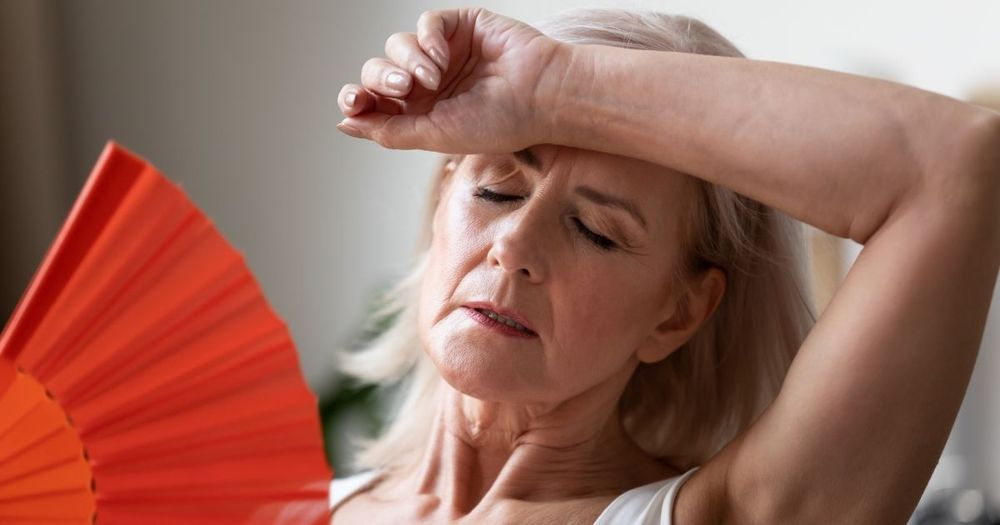
Mention hot flushes to a group of friends and you'll come home with a remedy. Black cohosh. Soy milk. Flaxseed on your yogurt, or a cream with wild yam in it. Your friend swears by hers, and she isn't making it up. Her flushes really did get better.
Here's why that proves so little. In trials of HRT, the women given a dummy pill saw their hot flushes fall by 57.7%. That's a dummy pill. So nearly anything you try in those months may look as if it's working, and a remedy only earns its place on your shelf by beating that.
Most of the popular ones don't. Two things that do may surprise you, and one of them involves a set of weights. Every woman's menopause is her own, and nothing here can tell you how yours will go, but you do deserve to know where your money is going.
What a hot flush is
Your brain keeps your core temperature inside a narrow comfortable band. Go above it and you sweat, go below it and you shiver. In women with hot flushes, that band has shrunk a long way, so that a tiny rise in core temperature is enough to set off the whole alarm: the heat, the flush, the sweat and the shiver afterwards. Falling oestrogen plays a big part.
That matters, because it shows what a real remedy has to do. It has to change how that alarm behaves, or how much it bothers you. Flushes also tend to peak in the early evening, and in the first half of the night they can wake you, which is why they so often come with exhausted mornings. If a cool room and thin layers help, that's why. Smart Strategies to Stay Cool and Comfortable During Summer Heatwaves has which cooling tricks do anything.
How long it lasts
"It's just a phase" deserves a real number. In a major US study, hot flushes and night sweats went on for 7.4 years at the median, and 4.5 years after the last period. The range was wide. Women whose flushes began while they were still having regular periods had them longest, for more than 11.8 years, and women whose flushes began after their periods had stopped had them for 3.4. African American women had the longest of any group, at a median of 10.1 years, and the NHS also notes that women from a Black background are more likely to have severe flushes that last longer.
So a remedy you'll be taking for years has to be worth it, and that's a good reason to look hard at the evidence.
Black cohosh
This is the famous one, used for centuries and sold everywhere. A review of 16 trials with 2,027 women found no significant difference between black cohosh and a dummy pill in how often flushes came, or in menopausal symptom scores overall. The authors said there wasn't enough evidence to support it, though more studies were justified.
It also comes with a warning. In 2006 the UK's medicines regulator moved to label it with a warning that it may rarely cause liver problems, after reports including a woman who needed a liver transplant. So this is a poor bet: little sign of benefit, with a rare but frightening risk.
Soy and red clover
The soy story starts in Japan, where women were found to report far fewer hot flushes than North American women. One account of the anthropologist Margaret Lock's work put it at 12% against 85%. It's a striking difference, and soy got the credit. Lock herself pointed to biology and culture working together, though, and Japanese women have long differed from Western ones in plenty besides soy. The Hidden Signs of Hormone Imbalance, linked below, has an even smaller and more curious clue: in one interview study, no Hadza woman in Tanzania described hot flushes at all, and their diet wasn't built on soy.
When all this went into trials, the picture got much smaller. A review of 43 trials with 4,364 women found no significant effect from the best-known red clover extract, and no evidence overall that these products work. A few trials of extracts high in genistein, one of the soy compounds, did report fewer flushes, and that's worth more study.
So soy isn't the answer it was sold as. Why Plant Protein Delivers Less Than the Label Suggests has what else comes along with it.
Flaxseed
This one had a proper test. 188 women ate either a flaxseed bar or a placebo bar every day for six weeks and kept diaries of their flushes. Scores fell by 4.9 with the flax and 3.5 with the placebo, which isn't a real difference. In both groups, just over a third got 50% better. There's that dummy effect again. Both groups also reported wind, bloating and diarrhoea, so your yogurt is fine without it.
Vitamin E
The usual evidence is one small trial of 51 women, which did report milder and fewer flushes with vitamin E than with a placebo. In 2023, the journal published an expression of concern about that paper. That doesn't prove the result wrong, but you shouldn't build on it. Skip the capsules.
Wild yam cream
The story here is lovely. Wild yam contains diosgenin, the body turns it into progesterone, and your hormones come back into balance. The first part is true, and chemists really did use diosgenin to make progesterone in a factory, which helped give us the early contraceptive pill. But your body has no such factory, and diosgenin isn't something it can make into progesterone. Your thigh is not a laboratory.
It has been tested as well. In a double-blind trial, 23 women used wild yam cream for three months and a matching dummy cream for three months. There was no difference in their symptoms between the two, and their progesterone levels, in blood and in saliva, didn't move.
Exercise, and the weights
You'll read everywhere that exercise relieves hot flushes. A trial of 261 women, using an exercise DVD or a group with social support, found no significant drop in flushes, and its authors said women shouldn't be told it will help. That's a bracing thing to read after years of cheerful advice.
Then there's the other kind of exercise. 65 women who didn't exercise regularly, with an average of about seven moderate or severe flushes a day, were split between carrying on as before and full-body resistance training three times a week for 15 weeks. Flushes fell by 43.6% in the lifting group and by 2% in the others.
It's one trial, and it needs repeating. But that's a very different result from the dummy pills, and nothing else on this list comes close. Not bad for a few lumps of iron. take up little room if the gym isn't for you.
The Harsh Truth About Aging: Decline or Longevity?, linked below, has the post-menopausal women whose low bone density improved after eight months of heavy lifting. Muscle needs protein to grow, and the easiest sources are meat, fish and eggs.
Your evening tea
A warm cup of or peppermint in the evening is a lovely habit, and it doesn't have caffeine in it, which helps. Enjoy it as what it is, a pause that marks the end of the day. Plants like these may help for a while with how you feel, but they don't change why the flushes are happening.
What has the evidence
HRT. It would be dishonest to write this article and leave this out. Across the trials, HRT reduced hot flushes by 75% more than a dummy pill did, and NICE, the UK's health guidance body, makes it the primary treatment for them. It isn't right for every woman, and its risks depend on the type, your age and your history. That's a conversation for a qualified health professional, and you're entitled to have it properly.
CBT. In a trial of 140 women, group or self-help cognitive behavioural therapy made flushes and night sweats much less of a problem, and the benefit was still there at 26 weeks. Night sweats also became less frequent. It works on how much the alarm bothers you, and it has no side effects to weigh up.
Self-hypnosis. Among 250 women using recordings at home for six weeks, flush scores fell by 53.4% with hypnosis and by 40.9% with white noise. So it's a modest gain over a very active comparison, but it's real, and it costs almost nothing. You don't even have to cluck like a chicken.
Newer medicines. There's a recent class of non-hormonal drugs that acts on the brain's temperature circuit directly. One of them, fezolinetant, has carried a US warning since 2024 about rare but serious liver injury. They're worth knowing about if HRT isn't an option.
Your weight
The scales can mislead you here. A long-running US study measured women's bodies through the transition. When it began, the rate of fat gain doubled and lean mass began to fall, and that carried on until two years after the last period. Weight itself didn't speed up at all. So you can weigh the same and be a different shape underneath, with less muscle, and that's another reason for those weights.
Among 17,473 women in one large study, those with symptoms whose weight fell by 10% or more in a year were 1.56 times as likely to lose their symptoms as women whose weight stayed put.
The diet in that study was low in fat and high in fruit, vegetables and grains, and there's a small trial you may hear about that goes further. 84 women were assigned to a low-fat vegan diet with cooked soybeans or to no change, and moderate to severe flushes fell by 88% against 34%. It's a large gap. It also came from a group that campaigns for plant-based eating, with no blinding and no dummy diet, and the same group says that part of the effect ran through weight loss. Weight is the part with the most support behind it, and you can lose it while keeping your protein up.
The rest of it
Sleep. Chronic Insomnia: Why Trying Harder Keeps You Awake has the retraining that works even through night sweats.
Tests. If you're over 45 and the signs fit, you probably don't need one. Hormone Tests Worth Asking Your Doctor For: A Woman's Guide has why a single blood test can mislead you while your hormones are swinging.
Contraception. You can still get pregnant during perimenopause. The NHS says you still need contraception for a year after your final period if you're 50 or over, and for two years if you're 40 to 49.
Fog. Losing words mid-sentence is frightening. Brain Fog: What Causes It, and What the Timing Tells You has the women tested repeatedly through these years, whose memory and speed recovered after the menopause.
Desire. If it has faded, Testosterone in Women: What It Does and When It's Too High has what testosterone does here, and why one blood test settles so little.
Dryness. This is the one that rarely comes up at the book club, and it can carry on after the menopause itself. The NHS lists soreness, itching, pain during sex and repeated urine infections among the signs. Perfumed soaps and washes can make it worse, so drop those first. Moisturisers and lubricants made for the purpose can help, and if they aren't enough, a qualified health professional can talk to you about vaginal oestrogen.
If it's early. The NHS calls it early menopause if your periods stop before 45, and premature menopause before 40. It can happen by itself or after treatment for something else. Don't put it down to stress and leave it. It's worth raising with a qualified health professional, because it changes the conversation about your bones, your heart and treatment. Across 32 studies with 310,329 women, menopause before 45 went with a 1.50 times higher risk of coronary heart disease. Those studies only followed women over time, so they can't prove the cause, but it's a good reason not to shrug.
Tiredness. In the years before the menopause, periods can get heavier, and that drains iron. Why Am I Always Tired: When Chronic Exhaustion Has a Cause That Sleep Can't Fix has how to tell.
Why this happens at all
The word is younger than you'd think. A Parisian medical student, Charles-Pierre-Louis de Gardanne, came up with a version of it in 1812. Writers at the time noted that peasant women had few complaints about the end of their periods, while women in the towns had many, and they blamed city life: too much sitting, too much time indoors, too much food and drink. Take that with a pinch of salt, but it does echo Japan.
Humans are unusual. Nearly every mammal goes on reproducing until close to the end of its life. The exceptions are few: a handful of toothed whales, including orcas and belugas, and more recently wild chimpanzees and gorillas in Uganda. A 2024 study of the whales found that they didn't stop reproducing any earlier. They simply evolved to live much longer, which gave the older females more years alongside their children and grandchildren, without competing with their daughters to breed.
That's whales, and it doesn't prove anything about you. But it's the same route the authors believe human life took. This stage of life may be something evolution kept for a reason. You're in good company, if you don't mind a killer whale.
What to do, in order
Stop paying for what hasn't earned it. Black cohosh, wild yam cream and flaxseed can come off the list.
Start lifting. A few times a week, building up slowly. A costs little to start with, though the trial itself used weights. It has the best non-drug result here, and your bones will thank you.
Keep your protein up. Build your meals around meat, fish and eggs, and if you're carrying extra weight, this is a good time to lose some.
Cool your evenings, and learn your triggers. Thin layers and a cool bedroom help. The usual suspects are alcohol, smoking, caffeine, hot drinks and spicy food, though one study even found fewer flushes among current drinkers, which is no reason to start. Triggers are personal, so a week's diary beats any list.
Try CBT or self-hypnosis. Both are cheap, and neither has much to go wrong.
Have the HRT conversation. Have it properly, with your history on the table, and make the decision yourself.
You've spent years looking after everybody else's bodies, and this one deserves better than whatever was on the shelf at the chemist's. It can go on for years, and much of it can be made easier. This week, take one remedy out of your cupboard and look at what you've been paying for it. Then find out where the nearest weights are, and start with the lightest ones.
Wondering what else your hormones might be up to? The Hidden Signs of Hormone Imbalance, and How to Test for Them Properly — the patterns worth noticing, and which tests are worth having.
Ready to look after your bones and muscle? The Harsh Truth About Aging: Decline or Longevity? — what heavy lifting does for ageing bones, and what actually keeps you strong.
Know someone with a cupboard full of black cohosh? Send them this, and maybe a pair of dumbbells.
Disclaimer: This article is general information. For advice about your own health, talk to a qualified health professional, especially before starting or stopping any treatment, and if you have bleeding after the menopause.
Affiliate Disclosure: This article contains affiliate links. As an Amazon Associate, All For Life earns from qualifying purchases, at no extra cost to you. We only link to products we would recommend without the commission.
Sources
MacLennan AH, Broadbent JL, Lester S, Moore V (2004). Oral oestrogen and combined oestrogen/progestogen therapy versus placebo for hot flushes. Cochrane Database of Systematic Reviews 2009(1). doi.org/10.1002/14651858.CD002978.pub2
Freedman RR (2014). Postmenopausal Physiological Changes. Current Topics in Behavioral Neurosciences 21:245–256. doi.org/10.1007/7854_2014_325
Avis NE, Crawford SL, Greendale G, et al. (2015). Duration of menopausal vasomotor symptoms over the menopause transition. JAMA Internal Medicine 175(4):531–539. doi.org/10.1001/jamainternmed.2014.8063
NHS. Symptoms of menopause and perimenopause. nhs.uk
Leach MJ, Moore V (2012). Black cohosh (Cimicifuga spp.) for menopausal symptoms. Cochrane Database of Systematic Reviews 2012(10). doi.org/10.1002/14651858.CD007244.pub2
NutraIngredients. UK herbal sector agrees black cohosh liver warning. nutraingredients.com
The New Republic. Japanese Women Handle Menopause Differently Than American Women. newrepublic.com
Lethaby A, Marjoribanks J, Kronenberg F, et al. (2013). Phytoestrogens for menopausal vasomotor symptoms. Cochrane Database of Systematic Reviews 2013(12). doi.org/10.1002/14651858.CD001395.pub4
Pruthi S, Qin R, Terstreip SA, et al. (2012). A phase III, randomized, placebo-controlled, double-blind trial of flaxseed for the treatment of hot flashes. Menopause 19(1):48–53. doi.org/10.1097/gme.0b013e318223b021
Ziaei S, Kazemnejad A, Zareai M (2007). The Effect of Vitamin E on Hot Flashes in Menopausal Women. Gynecologic and Obstetric Investigation 64(4):204–207. doi.org/10.1159/000106491
Wikipedia. Diosgenin. en.wikipedia.org
Komesaroff PA, Black CV, Cable V, Sudhir K (2001). Effects of wild yam extract on menopausal symptoms, lipids and sex hormones in healthy menopausal women. Climacteric 4(2):144–150.
Daley A, Thomas A, Roalfe A, et al. (2015). The effectiveness of exercise as treatment for vasomotor menopausal symptoms: randomised controlled trial. BJOG: An International Journal of Obstetrics & Gynaecology 122(4):565–575. doi.org/10.1111/1471-0528.13193
Berin E, Hammar M, Lindblom H, et al. (2019). Resistance training for hot flushes in postmenopausal women: A randomised controlled trial. Maturitas 126:55–60. doi.org/10.1016/j.maturitas.2019.05.005
NICE. Menopause: identification and management (NG23). nice.org.uk
Ayers B, Smith M, Hellier J, et al. (2012). Effectiveness of group and self-help cognitive behavior therapy in reducing problematic menopausal hot flushes and night sweats (MENOS 2). Menopause 19(7):749–759. doi.org/10.1097/gme.0b013e31823fe835
Elkins G, Arring N, Morgan G, et al. (2025). Self-Administered Hypnosis vs Sham Hypnosis for Hot Flashes. JAMA Network Open 8(11):e2542537. doi.org/10.1001/jamanetworkopen.2025.42537
Wikipedia. Fezolinetant. en.wikipedia.org
Greendale GA, Sternfeld B, Huang M, et al. (2019). Changes in body composition and weight during the menopause transition. JCI Insight 4(5):e124865. doi.org/10.1172/jci.insight.124865
Kroenke CH, Caan BJ, Stefanick ML, et al. (2012). Effects of a dietary intervention and weight change on vasomotor symptoms in the Women's Health Initiative. Menopause 19(9):980–988. doi.org/10.1097/gme.0b013e31824f606e
Barnard ND, Kahleova H, Holtz DN, et al. (2023). A dietary intervention for vasomotor symptoms of menopause: a randomized, controlled trial. Menopause 30(1):80–87. doi.org/10.1097/GME.0000000000002080
NHS. Vaginal dryness. nhs.uk
Muka T, Oliver-Williams C, Kunutsor S, et al. (2016). Association of Age at Onset of Menopause and Time Since Onset of Menopause With Cardiovascular Outcomes, Intermediate Vascular Traits, and All-Cause Mortality. JAMA Cardiology 1(7):767–776. doi.org/10.1001/jamacardio.2016.2415
Schilling C, Gallicchio L, Miller SR, et al. (2007). Current alcohol use, hormone levels, and hot flashes in midlife women. Fertility and Sterility 87(6):1483–1486. doi.org/10.1016/j.fertnstert.2006.11.033
NHS. Early or premature menopause. nhs.uk
Wikipedia. Menopause. en.wikipedia.org
Ellis S, Franks DW, Nielsen MLK, et al. (2024). The evolution of menopause in toothed whales. Nature 627(8004):579–585. doi.org/10.1038/s41586-024-07159-9