
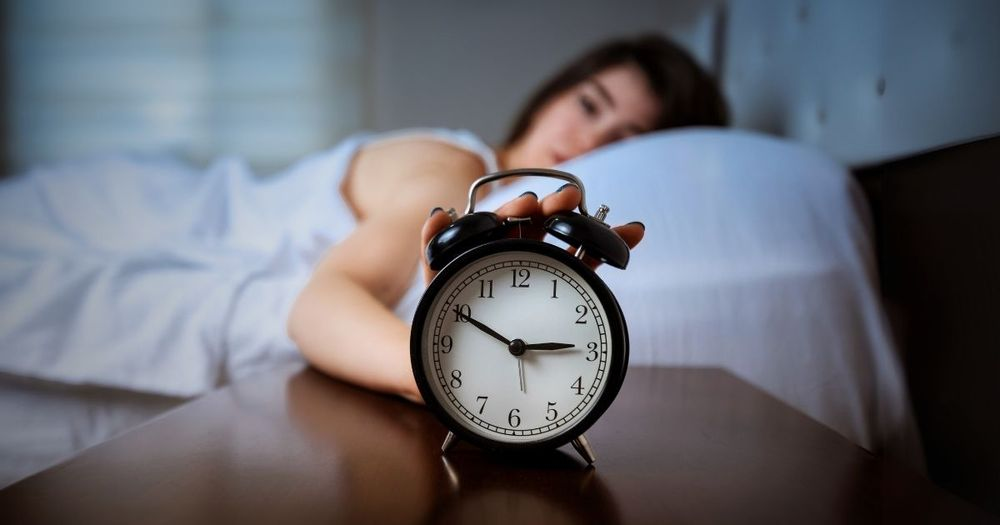
Somewhere in the small hours the maths starts. Asleep now, and there are still three and a half hours left. Then another hour goes, the number shrinks, and you lie very still, as if stillness were the same thing as sleep.
By the third month you've tried the tea, the magnesium, the melatonin and the blackout curtains. Some of it helped for a week, then the nights went back to how they were. All of it missed the thing that keeps insomnia going, and it's something you've been doing every night to help yourself sleep.
The harder you try, the more awake you get
Insomnia usually starts with a real cause, like a stressful month, a new baby or a bout of pain. The cause passes. What stays are the habits you built to cope with it: going to bed earlier to "bank" rest, lying in at the weekend, staying in bed through the small hours because getting up feels like admitting defeat.
Every one of those habits makes the next night worse, and the reason is sleep pressure. From the moment you wake, a chemical called adenosine builds up in your brain, and the longer you're up, the heavier it gets, until your body clock opens the window that lets it pull you under. An early night or a lie-in spends that pressure before you need it.
Nine hours in bed for six hours of sleep means the sleep gets spread thin across the night, with long wakeful gaps in between. And those gaps happen in one specific place, which your brain files away. A few hundred nights of that, and the bedroom sets off alertness all by itself. Pavlov's dogs learned to drool at the tick of a metronome (the famous bell came later, in the retelling); your brain now switches on at the sight of your pillow.
This is why effort backfires. Sleep arrives when you stop steering, and lying there willing it to come is steering.
If this has only been going on for a few weeks, you're at the easiest point to stop it. Keep rising at the same time each morning, whatever the night was like, and skip the lie-in, the afternoon nap and the early night. They feel like recovery, and they're the habits that turn a bad month into chronic insomnia.
The part the sleep tips leave out
There's a short course that retrains the way you sleep, known as CBT-I, cognitive behavioural therapy for insomnia, and it has one big advantage over sleeping pills: the pills help while you take them, and the retraining keeps working after you stop. It has the strongest record of any treatment for chronic insomnia. If you're on sleeping pills now, the retraining works alongside them. Don't come off them on your own: when people tapered with professional support and did the retraining as well, 85 per cent came off, against 48 per cent who only tapered.
Where it does get described, it's usually as relaxation and breathing exercises. Those are a small part of it. The parts doing the heavy lifting are two techniques that sound backwards the first time you hear them: spending less time in bed, and giving the bed one job. On its own, cutting your time in bed does about as much as the whole course, at least in the first months.
A dark room, no screens and no coffee are all good habits. On their own, once insomnia has settled in, they rarely fix it.
Less time in bed, more sleep
This one sounds the most backwards, so the logic comes first. You compress your time in bed down to roughly the amount you're sleeping. Sleep pressure builds higher, the broken sleep pulls together into one solid block, and your brain relearns that bed means sleep. Once the block is solid, you widen the window.
Start with a diary. For a fortnight, note each morning when you went to bed, roughly how long you slept, and when you got up. Estimates are fine.
Find your number. It's your average sleep. If you're lying down for eight and a half hours and sleeping about six, your number is six.
Set your window to that number, with a floor of five and a half hours. Pick your wake time first, because it's the anchor, then count backwards: a six-hour window means going to bed six hours before the alarm.
Hold the wake time every day, weekends included. It's the rule that retrains the clock. Until the window opens, stay up even if you're sleepy well before it, in low light with something dull to do.
Widen it slowly. Once you're asleep for most of the time you're in bed, about 85 to 90 percent of it, add 15 minutes. Keep widening until the extra time stops turning into sleep.
The first few weeks tend to go like this. Say your diary shows eight and a half hours under the covers and about six asleep, so your window becomes six hours, ending at your usual alarm. The first few nights you're yawning long before it opens and fighting to stay up, and the next day drags. Within a few days you're tempted to give up and go to bed early.
That's the moment to hold on. The tiredness is sleep pressure building, which is the whole point, and this is where it's most tempting to quit, right before it starts working. Somewhere in the second week you start falling asleep faster and waking less. By the third, you're asleep for most of the window, and bedtime moves fifteen minutes earlier.
Judge it by how solid the night is, and give the hours time. The first things to change are how fast you fall asleep and how long you lie awake in the night. Total sleep barely moves at first, and the hours come back as you widen the window. Before they do, the night stops being a fight.
If you'd rather follow the programme on paper, the workbook by Jack Edinger and Colleen Carney walks through the same diary, window and weekly adjustments one session at a time.
Get proper guidance first if you have bipolar disorder, epilepsy, suspected sleep apnoea, or if you drive for a living or operate machinery. The short-term sleepiness matters more in those cases, and a gentler, guided version is the safer way in.
Give the bed one job
The shorter window builds the pressure, and this part breaks the link between your bed and lying awake. Go to bed only when you're sleepy, which feels different from tired: sleepy means your eyes are closing. Keep the bed for sleep and sex, and move the scrolling, the work, the series and the arguments somewhere else.
Once lying awake turns into frustration, get out of bed. Go to another room with dim light, read something undemanding, and come back when you're sleepy again, as often as it takes. Keep the fixed wake-up time from above whatever the night was like, and skip daytime naps while you're retraining, even the short ones that help on an ordinary tired day, because they spend the pressure you need at night.
Get the room right once, then leave it alone. Dark, cool and quiet: use or an eye mask for the light, and earplugs or steady background noise if your street is loud. Beyond that, upgrading the bedroom does little.
Answer the small-hours maths
The countdown in your head runs on one belief: a short night means a wrecked day. Test it against your own record. Find the days in your diary that followed your worst nights. Maybe you were slower and shorter-tempered, and the afternoon dragged. Still, you got through every one of them, and some went fine.
Tested side by side with good sleepers, insomnia shows up as slightly lower scores on memory and problem-solving. Attention, reaction speed and a range of other skills hold up just as well. A day after a poor night is harder. It's rarely the disaster the small-hours maths predicts.
The maths is also working from bad figures. Compared with what a sleep lab measures, insomnia makes the night look worse than it was: the time spent lying awake gets overestimated and the hours asleep underestimated, because light sleep and brief awakenings get remembered as being awake. Al Herpin of Trenton, New Jersey, was written up as "the Man Who Never Slept" and claimed he never had. Every human sleeps, though, even without knowing it, which is the misperception at its most extreme.
So when the maths starts, answer it with I've had nights like this before, and I managed the day after. Then turn the clock to the wall, so the countdown has nothing left to feed on. Watching it raises the worry and slows sleep down.
The worries about tomorrow are easier to deal with before bed. The Stress-Sleep Vicious Cycle, linked below, covers what to do about them during the day. Spend five minutes writing tomorrow's to-do list, and make it specific: the email you owe, the call about the car, the form due this week. In a sleep lab, it brought sleep on faster than writing about what had already been done, with the most specific lists bringing sleep on fastest. If the racing mind is the main thing keeping you up, by Colleen Carney and Rachel Manber deals with exactly that.
How the day shapes the night
On their own, the usual daytime habits rarely fix chronic insomnia, which is the sleep tips point from earlier. Alongside the window, a few of them make it work faster.
Morning light is the strongest. Get outside in the first hour after your fixed wake-up time, for a walk or to stand outside with a glass of water. Light is the main signal your body clock uses to set itself, and a regular spell of morning light eases insomnia a little. Being outside pays twice, since sunlight on your skin is also how your body makes vitamin D.
Movement helps as well, and regular exercise tends to improve sleep. Evening exercise is fine, and even helps slightly, with one exception: hard training that finishes within an hour of bed.
Caffeine lasts longer than it feels, and it works by blocking adenosine, the very chemical whose pressure the shorter window is building, so every cup undoes part of the method. Taken six hours before bed, it still cost more than an hour of the night, and a regular cup kept disturbing sleep for nearly nine hours after it was drunk. For a broken sleeper, the cleanest fix is no coffee at all, with water as the everyday drink.
And if hot flushes and night sweats are breaking your nights, the method still works through them. When women going through the menopause did the retraining by phone, 70 per cent were out of the insomnia range at eight weeks, against 24 per cent of those given menopause education instead. The flushes themselves are worth getting looked at too.
Where the remedies fit
Supplements are extras on top of the method, and most of them do a little rather than a lot. Each one nudges a single part of sleep, so it only helps if it fits why you're awake. Natural Insomnia Remedies Work When They Fit the Reason, linked below, sorts them that way.
Melatonin is the bottle that most needs explaining. It's the body's darkness signal, telling your clock that night has begun, which is why it helps after jet lag or a shift change, when the clock is set to the wrong time. In ordinary chronic insomnia the clock is usually fine and the bed is the problem, so melatonin has little to correct. If you take any regular medication, check every herb against it before you start, since ashwagandha, St John's wort and several others clash with common drugs.
When it's something else
Some insomnia belongs to another condition, and no routine fixes that. Get it checked if you snore loudly, gasp, or someone has seen you stop breathing, which can mean sleep apnoea, or if your legs crawl or jerk when you lie down, the sign of restless legs. The same goes if low mood or constant worry came before the sleepless nights, or if the problem started with a new medication.
If you've slept badly at least three nights a week for three months, your insomnia counts as chronic, so look for this retraining by name. Structured online programmes work close to as well as sessions in person, and the workbook above makes it easy to start.
A hard month can bring the old pattern back, because the same thing that started it the first time, a cause and then the coping habits, can happen again. If it does, you already have the fix: restart the diary and the window, and hold the wake time until the nights pull together.
The bed has to be retrained
Everything you tried was an attempt to add something at night: a pill, a tea, a smell, a gadget. What works takes things away instead: the extra hours in bed and the nightly fight to fall asleep. And it holds one thing still: the time you get up.
It will feel wrong for a week, maybe two. Keep going, and a night comes when the small-hours maths never starts.
Start the diary tomorrow morning. In two weeks you'll know your number, and you'll have a window to protect.
Want to know which remedies are worth adding on top? Natural Insomnia Remedies Work When They Fit the Reason — which natural remedy fits your kind of sleeplessness, how long each takes to work, and which to leave on the shelf.
Lying awake replaying the day? The Stress-Sleep Vicious Cycle: How to Fix Both at the Same Time — how stress keeps the mind running at night, and what to do in the evening after a hard day.
Know someone who swears they lie awake for hours, whatever they try? Send this to them quietly. It gives them a plan that starts with a notebook tomorrow morning.
Tried something here, or got a question it didn't answer? Write to us at contact@allforlife.club. Your questions shape the next articles.
Disclaimer: This article is general information. For advice about your own sleep, medication or health, talk to a qualified health professional. If anything under "When it's something else" applies to you, or you take medication, get professional advice before cutting your time in bed or starting new supplements.
Affiliate Disclosure: This article contains affiliate links. As an Amazon Associate, All For Life earns from qualifying purchases, at no extra cost to you. We only link to books and products we would recommend without the commission.
Sources
Spielman AJ, Caruso LS, Glovinsky PB (1987). A behavioral perspective on insomnia treatment. Psychiatric Clinics of North America 10(4):541–553. pubmed.ncbi.nlm.nih.gov/3332317
Wikipedia. Adenosine. en.wikipedia.org
Wikipedia. Classical conditioning. en.wikipedia.org
Qaseem A, Kansagara D, Forciea MA, et al. (2016). Management of Chronic Insomnia Disorder in Adults: A Clinical Practice Guideline From the American College of Physicians. Annals of Internal Medicine 165(2):125–133. doi.org/10.7326/M15-2175
Edinger JD, Arnedt JT, Bertisch SM, et al. (2021). Behavioral and psychological treatments for chronic insomnia disorder in adults: an American Academy of Sleep Medicine clinical practice guideline. Journal of Clinical Sleep Medicine 17(2):255–262. doi.org/10.5664/jcsm.8986
Morin CM, Bastien C, Guay B, et al. (2004). Randomized Clinical Trial of Supervised Tapering and Cognitive Behavior Therapy to Facilitate Benzodiazepine Discontinuation in Older Adults With Chronic Insomnia. American Journal of Psychiatry 161(2):332–342. doi.org/10.1176/appi.ajp.161.2.332
Maurer LF, Schneider J, Miller CB, et al. (2021). The clinical effects of sleep restriction therapy for insomnia: A meta-analysis of randomised controlled trials. Sleep Medicine Reviews 58:101493. doi.org/10.1016/j.smrv.2021.101493
Fortier-Brochu É, Beaulieu-Bonneau S, Ivers H, Morin CM (2012). Insomnia and daytime cognitive performance: A meta-analysis. Sleep Medicine Reviews 16(1):83–94. doi.org/10.1016/j.smrv.2011.03.008
Harvey AG, Tang NKY (2012). (Mis)perception of sleep in insomnia: A puzzle and a resolution.. Psychological Bulletin 138(1):77–101. doi.org/10.1037/a0025730
Wikipedia. Al Herpin. en.wikipedia.org
Tang NKY, Anne Schmidt D, Harvey AG (2007). Sleeping with the enemy: Clock monitoring in the maintenance of insomnia. Journal of Behavior Therapy and Experimental Psychiatry 38(1):40–55. doi.org/10.1016/j.jbtep.2005.07.004
Scullin MK, Krueger ML, Ballard HK, et al. (2018). The effects of bedtime writing on difficulty falling asleep: A polysomnographic study comparing to-do lists and completed activity lists. Journal of Experimental Psychology: General 147(1):139–146. doi.org/10.1037/xge0000374
van Maanen A, Meijer AM, van der Heijden KB, Oort FJ (2016). The effects of light therapy on sleep problems: A systematic review and meta-analysis. Sleep Medicine Reviews 29:52–62. doi.org/10.1016/j.smrv.2015.08.009
Wikipedia. Vitamin D. en.wikipedia.org
Banno M, Harada Y, Taniguchi M, et al. (2018). Exercise can improve sleep quality: a systematic review and meta-analysis. PeerJ 6:e5172. doi.org/10.7717/peerj.5172
Stutz J, Eiholzer R, Spengler CM (2019). Effects of Evening Exercise on Sleep in Healthy Participants: A Systematic Review and Meta-Analysis. Sports Medicine 49(2):269–287. doi.org/10.1007/s40279-018-1015-0
Wikipedia. Caffeine. en.wikipedia.org
Drake C, Roehrs T, Shambroom J, Roth T (2013). Caffeine Effects on Sleep Taken 0, 3, or 6 Hours before Going to Bed. Journal of Clinical Sleep Medicine 9(11):1195–1200. doi.org/10.5664/jcsm.3170
Gardiner C, Weakley J, Burke LM, et al. (2023). The effect of caffeine on subsequent sleep: A systematic review and meta-analysis. Sleep Medicine Reviews 69:101764. doi.org/10.1016/j.smrv.2023.101764
McCurry SM, Guthrie KA, Morin CM, et al. (2016). Telephone-Based Cognitive Behavioral Therapy for Insomnia in Perimenopausal and Postmenopausal Women With Vasomotor Symptoms: A MsFLASH Randomized Clinical Trial. JAMA Internal Medicine 176(7):913–920. doi.org/10.1001/jamainternmed.2016.1795
Sateia MJ, Buysse DJ, Krystal AD, et al. (2017). Clinical Practice Guideline for the Pharmacologic Treatment of Chronic Insomnia in Adults: An American Academy of Sleep Medicine Clinical Practice Guideline. Journal of Clinical Sleep Medicine 13(2):307–349. doi.org/10.5664/jcsm.6470
Wikipedia. Hypericum perforatum. en.wikipedia.org
Knutzen SM, Christensen DS, Cairns P, et al. (2024). Efficacy of eHealth Versus In-Person Cognitive Behavioral Therapy for Insomnia: Systematic Review and Meta-Analysis of Equivalence. JMIR Mental Health 11:e58217. doi.org/10.2196/58217