
Have you ever caught yourself holding your breath during a stressful moment? Maybe you were reading an email you weren't thrilled about, or sitting in traffic when someone cut you off.
If so, you're in good company, and it even has a name. In 2007 Linda Stone, a former Microsoft executive, noticed that she did her breathing exercises every morning and then stopped breathing properly the moment she opened her inbox. So she invited 200 people to her home and watched their heart rate and breath while they checked their email. Roughly 80% of them held their breath or changed its rhythm from time to time.
She called it "dining room table science", and it was no controlled study. She also named it, and the name stuck: email apnea. Your inbox has been taking your breath away, and not in the good way.
The lovely thing about breathing is that you can change it, right now, without buying anything or telling anyone. It won't transform your life. It can make the next ten minutes easier, which is often all you need. So here are seven breathing techniques, when each one suits, how it goes, and what has been measured. How Breathing Affects Your Emotional State, linked below, has the why. This one is for using.
First, about the oxygen
You'll read that deep breathing floods your body with oxygen. It doesn't, and it's useful to know why. A healthy person's blood is already 96 to 99% saturated with oxygen at sea level, so there isn't much room for more.
What you're changing is the pace, and the message that sends to the rest of you. That's why going faster or harder isn't better. If any of these leaves you dizzy, light-headed or tingling in your fingers, stop and breathe normally for a while. You've blown off too much carbon dioxide, and How Breathing Affects Your Emotional State has what that does. Nothing here should feel like an effort.
1. The slow, long breath
When to use it. Almost any time. If you only learn one, learn this.
How it goes. Breathe in slowly through your nose while you count to four, and let your stomach rise. Then let it out for four, and when that feels easy, make the out-breath a little longer than the in-breath. Keep your shoulders down. A few minutes is plenty.
What's been measured. Breaking Free from Low Moods: Powerful Strategies to Reset Your Mind and Energy has a month of five-minute sessions, in which breathing did more for mood than meditation, and the version that did best was the one with a long, slow out-breath. Longer out is the part to remember.
For the sharpest moments, there's a shortcut. Take a breath through your nose, add one more small sniff on top, and let the whole lot go through your mouth, slowly. One or two of these may be enough. How to Build Resilience When Everything's Falling Apart has more on that.
Children can do this one as well, and it helps to make it a game. Ask them to smell a flower, slowly, and then blow out a candle, gently. You have just taught them a long out-breath.
2. Box breathing
When to use it. Before something you need to be steady for, such as an interview, a difficult call or a presentation. Counting gives your mind a job.
How it goes. In for four, hold for four, out for four, hold for four. Picture the sides of a square as you go. If the holds feel uncomfortable, shorten them. There's no prize for suffering.
What's been measured. Box breathing is the one you've heard about from the Navy SEALs. Mark Divine, a retired SEAL commander, did the most to make it famous, and he writes that he developed it to keep up his breath training after the SEALs, with methods from yoga and martial arts behind it. So it's less of a military secret than it sounds. In that same month-long test it did well, though not as well as the long out-breath.
3. Alternate nostril breathing
When to use it. When you want something quiet to settle into, perhaps first thing in the morning or at the start of a rest.
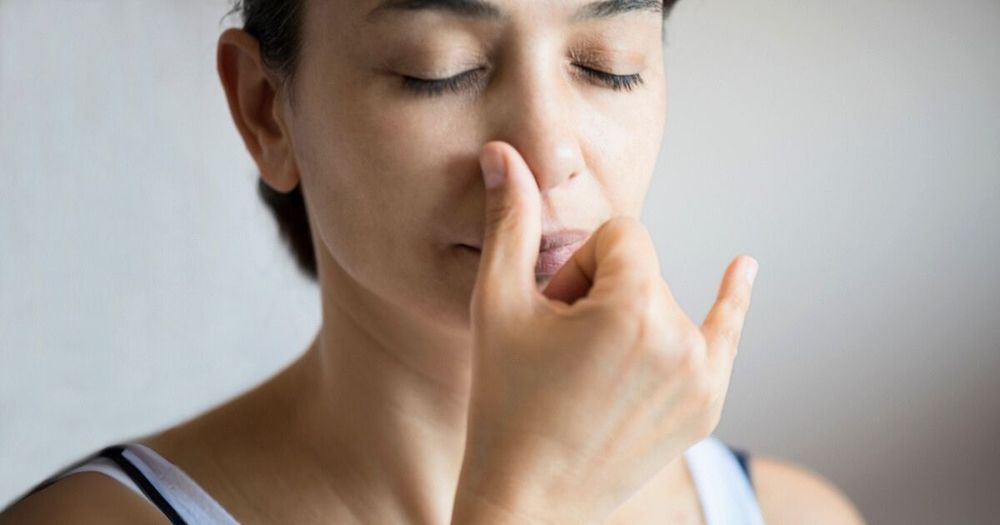
How it goes. Close your right nostril with your thumb and breathe in through the left. Close the left with your finger, open the right, and breathe out. Breathe in through the right, swap, and breathe out through the left. That's one round. Do this when your nose is clear, because it's no fun otherwise, and a can help with that.
What's been measured. You'll read that it balances the two halves of your brain. When 13 healthy people were tested with brain recordings, there was no change in how the two sides compared, though the readings did look calmer than sitting quietly with no instructions. In a separate test of 132 adults, blood pressure was lower straight after a session. So it's a pleasant and calming practice, with small studies behind it and no balancing act. Your brain was fine as it was.
Your nose does take turns by itself, as it happens. How Breathing Affects Your Emotional State has that too.
4. Progressive relaxation
When to use it. In bed, or at the end of a long day, when your body is still clenched and you hadn't noticed.
How it goes. Breathe in and tense one part of your body, starting with your forehead. Breathe out and let it go. Move down slowly through your jaw, shoulders, hands, stomach, legs and feet. The letting go is what you're practising. Herbert Benson's is the classic on calming the body on purpose.
What's been measured. When 60 students followed 20 minutes of recorded progressive muscle relaxation, deep breathing or guided imagery, and were compared with a group given none of them, all three raised their feeling of relaxation. 5 Relaxation Techniques, and the One That Revs You Up First, linked below, has the man who invented it, and the full routine.
5. Guided visualization
When to use it. When your thoughts are the problem. It helps when your mind keeps returning to the same worry.
How it goes. Close your eyes and breathe slowly. Picture somewhere you feel safe, a beach or a forest or your grandmother's kitchen, and fill in the details: what you can hear, what the air feels like. The kettle is already on. When your mind wanders off, which it will, just walk it back. A recording can help if you'd rather be led.
What's been measured. It was one of the three in that same test with the 60 students, and it raised relaxation like the other two. Treat it as a good place to go for ten minutes.
If pictures don't come easily, count instead. Count each breath out from one to nine, and start again whenever you lose your place. In one online test, four weeks of breath counting training improved mindfulness and reduced mind wandering compared with other training or none. You will lose count. Noticing that you have is the exercise.
6. Pursed-lip breathing
When to use it. When you're short of breath after climbing the stairs or carrying the shopping, and above all if you have a lung condition and have been shown it.
How it goes. Breathe in slowly through your nose. Then purse your lips as if you were blowing out a candle, and breathe out gently for about twice as long. Don't force it. You're not actually trying to blow the candle out.
What's been measured. This has the most serious history of the seven, because it's taught to people with chronic lung disease. A review of 16 studies with 1,233 people found that breathing exercises helped them walk further, and in one study of 60 people, pursed-lip breathing added about 50 metres to a six-minute walk. Effects on breathlessness and quality of life weren't consistent, though. It isn't a treatment by itself, and nothing here shows it grows your lungs. It may help you make the most of what you have.
Singing is a gentler relative of this one. Three small trials with 112 people with chronic lung disease put them in singing groups. Their breathlessness didn't improve significantly, but their score for physical health did, and no side effects were reported. The evidence is thin, and it may still be the most enjoyable breathing exercise on this page.
If you have a lung or heart condition, stick to the advice you've been given, and talk to a qualified health professional before you add anything new.
7. Belly breathing
When to use it. Any time you want to practise, and especially lying down, because it's easiest to feel there.
How it goes. Put one hand on your chest and the other on your belly. Breathe in through your nose so that the lower hand rises more than the upper one. Breathe out slowly. That's all of it.
Give it some room, too. Let your shoulders drop and loosen a tight waistband. It's hard to breathe into a belly you're holding in. This is the same breath as number one, so learning this will help that one as well.
What's been measured. You may hear that it strengthens your core and improves your posture. No good test of that turned up. On stress there's more, though not a lot. A review went looking and found only three studies that met its standards, all small, and all three came out positive, on cortisol, blood pressure or stress scores. The Invisible War Inside Your Body (And How to Win It) has the longer version: eight weeks of training, and lower cortisol at the end of it.
Which one, then?
If you want a shortcut, here it is. For right now, in the middle of a bad moment, use the long out-breath. To get ready for something hard, try the box. At bedtime, go for progressive relaxation. For a racing mind, take the walk to the beach. If you get out of breath, use the candle.
One tip whichever you choose. Practise it when you're calm, on an ordinary day, so it's already there when you need it. A breath you've rehearsed is much easier to find in the middle of a bad moment.
The easiest way to remember is to hang it on something you already do. Take three slow breaths while the kettle boils, at a red light, or before you open your inbox. The habit is already there, and the breath just comes along for the ride.
For sleep, How Breathing Affects Your Emotional State has the 14 people with insomnia who practised slow breathing before bed and fell asleep faster. A small test, and easy to copy.
If you'd like more to try, Richie Bostock's has forty.
You may also have heard of the 4-7-8. 5 Relaxation Techniques, and the One That Revs You Up First has how it goes, and the 43 young adults whose heart rate and blood pressure fell right after a few short rounds.
Add them all up and the honest summary is this: they help, modestly, and they cost nothing. Small and regular is easier to keep up than big and rare.
If all of this sounds too serious, hum. How to Boost Energy Levels Naturally: Little-Known Remedies That Actually Work has the ten volunteers whose noses made fifteen times the nitric oxide while they hummed. Yoga has its own version, named after the sound of a bee. Your neighbours may have views.
Your breath is always with you
You don't need an hour, a mat or an app. Your breath goes where you go, and it's there in the traffic and the inbox as much as anywhere.
So the next time you open your email today, stop and notice. Are you still breathing? If not, let it out slowly, and read on.
Wondering why any of this works? How Breathing Affects Your Emotional State — the wiring between breath and mood, six breaths a minute, the nose, what a sigh is for, and what happens with too much air.
Need more than a breath? 5 Relaxation Techniques, and the One That Revs You Up First — the 4-7-8, progressive relaxation with the man who invented it, guided imagery, forest walks, and which one to choose.
Know someone who stops breathing every time their phone buzzes? Send them this, and tell them to breathe out first.
Disclaimer: This article is general information. For advice about your own health, talk to a qualified health professional.
Affiliate Disclosure: This article contains affiliate links. As an Amazon Associate, All For Life earns from qualifying purchases, at no extra cost to you. We only link to products we would recommend without the commission.
Sources
The New York Times, in Rethinking65. Reading Email Can Disrupt Breathing, Study Says. rethinking65.com
Wikipedia. Email apnea. en.wikipedia.org
Wikipedia. Oxygen saturation (medicine). en.wikipedia.org
Balban MY, Neri E, Kogon MM, et al. (2023). Brief structured respiration practices enhance mood and reduce physiological arousal. Cell Reports Medicine 4(1):100895. doi.org/10.1016/j.xcrm.2022.100895
Divine M (2016). The Breathing Technique a Navy SEAL Uses to Stay Calm and Focused. Time. time.com
InsideHook. Here, Have a Secret Breathing Technique From a Navy SEAL. insidehook.com
Telles S, Gupta RK, Yadav A, et al. (2017). Hemisphere specific EEG related to alternate nostril yoga breathing. BMC Research Notes 10(1):306. doi.org/10.1186/s13104-017-2625-6
Pai V, Borkar N, Nirvan M, Verma M (2024). Immediate Hemodynamic Changes during Slow Uninostril and Alternate Nostril Breathing Patterns in Normotensive Adults. International Journal of Yoga 17(3):175–181. doi.org/10.4103/ijoy.ijoy_115_24
Toussaint L, Nguyen QA, Roettger C, et al. (2021). Effectiveness of Progressive Muscle Relaxation, Deep Breathing, and Guided Imagery in Promoting Psychological and Physiological States of Relaxation. Evidence-Based Complementary and Alternative Medicine 2021:5924040. doi.org/10.1155/2021/5924040
Levinson DB, Stoll EL, Kindy SD, Merry HL, Davidson RJ (2014). A mind you can count on: validating breath counting as a behavioral measure of mindfulness. Frontiers in Psychology 5:1202. doi.org/10.3389/fpsyg.2014.01202
Holland AE, Hill CJ, Jones AY, McDonald CF (2012). Breathing exercises for chronic obstructive pulmonary disease. Cochrane Database of Systematic Reviews 2012(10):CD008250. doi.org/10.1002/14651858.CD008250.pub2
McNamara RJ, Epsley C, Coren E, McKeough ZJ (2017). Singing for adults with chronic obstructive pulmonary disease. Cochrane Database of Systematic Reviews 2017(12):CD012296. doi.org/10.1002/14651858.CD012296.pub2
Hopper SI, Murray SL, Ferrara LR, Singleton JK (2019). Effectiveness of diaphragmatic breathing for reducing physiological and psychological stress in adults: a quantitative systematic review. JBI Database of Systematic Reviews and Implementation Reports 17(9):1855–1876. doi.org/10.11124/JBISRIR-2017-003848
Ma X, Yue ZQ, Gong ZQ, et al. (2017). The effect of diaphragmatic breathing on attention, negative affect and stress in healthy adults. Frontiers in Psychology 8:874. doi.org/10.3389/fpsyg.2017.00874
Vierra J, Boonla O, Prasertsri P (2022). Effects of sleep deprivation and 4-7-8 breathing control on heart rate variability, blood pressure, blood glucose, and endothelial function in healthy young adults. Physiological Reports 10(13):e15389. doi.org/10.14814/phy2.15389
Weitzberg E, Lundberg JON (2002). Humming Greatly Increases Nasal Nitric Oxide. American Journal of Respiratory and Critical Care Medicine 166(2):144–145. doi.org/10.1164/rccm.200202-138BC