
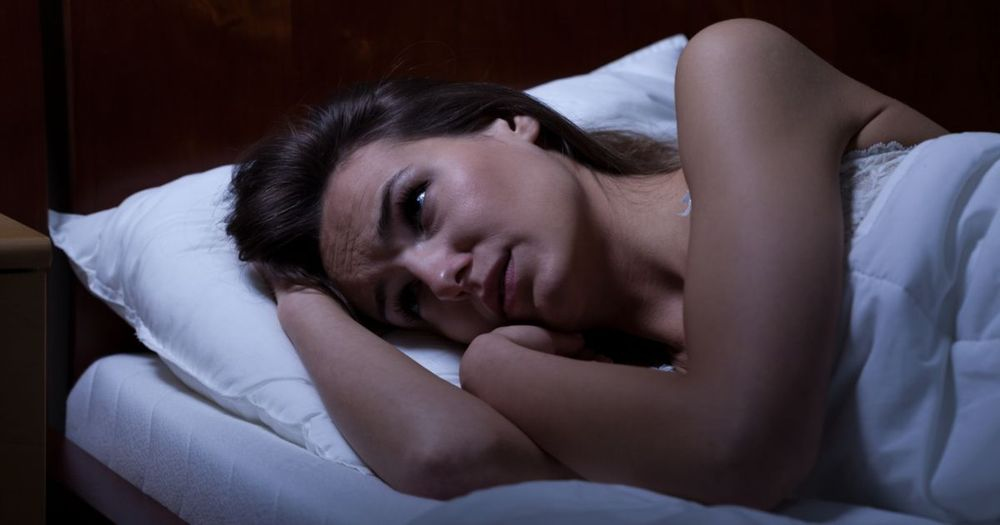
Have you ever tossed and turned, hoping sleep would come, only to wake up the next morning feeling even more tired than when you went to bed? You make the coffee, you go to work, and by the afternoon you tell yourself you're coping fine.
That last part is the trouble. Chronic sleep deprivation does its damage to the brain in several ways at once, and one of those ways is to stop you noticing the others. A tired brain is a bad judge of itself.
So here is what short nights do, effect by effect, starting with the one that hides the rest.
A word on the evidence. Researchers can't keep volunteers short of sleep for years, so much of the lab work here comes from a single lost night. The two-week tests and the 25-year follow-up show where it leads.
You can't feel it
In one laboratory test, healthy adults spent two weeks on no more than six hours in bed a night. By the end, their thinking had sunk to the level of people deprived of sleep for up to two nights in a row. They reported feeling sleepier in the first days, and after that hardly any change.
5 Ways to Harness Your Energy and Beat the Afternoon Slump, linked below, has that test. It is the most useful thing to know about sleep debt. You adapt to feeling tired long before your brain adapts to being tired, so "I'm fine on six hours" is exactly what someone on six hours would say.
It doesn't clear quickly, either. In another test, 66 volunteers spent a week on 3, 5, 7 or 9 hours in bed, and then had three nights of 8 hours. On 5 and 7 hours their speed fell and settled at a lower level, and the three good nights didn't bring it back. On 3 hours, recovery was only partial. On 9 hours, nothing changed.
The boy and the DJ
We know what the far end looks like, because two people went there in public.
In 1959 a New York radio DJ, Peter Tripp, stayed awake for 201 hours for charity, broadcasting from a glass booth in Times Square. After a few days he began to hallucinate. For the last 66 hours he was given drugs to keep him going. Afterwards he suffered psychologically, and for a time he believed he was an impostor of himself. Another DJ soon claimed his record, which tells you something about DJs.
In the winter of 1963 to 1964, a 17-year-old from San Diego, Randy Gardner, did it for the record: 264.4 hours, just over 11 days. A sleep researcher watching him, William Dement, later the author of , reported that on the tenth day Gardner beat him at pinball, and the story spread that going without sleep does little harm.
The man monitoring his health wrote something different. He recorded moodiness, trouble concentrating, poor short-term memory, paranoia and hallucinations. On the eleventh day, Gardner was asked to keep subtracting seven from 100. He stopped at 65. Asked why, he said he had forgotten what he was doing. He had, however, beaten a sleep researcher at pinball.
He then slept for 14 hours and 46 minutes, slept about ten and a half hours the next night, and appeared to recover fully. That is one teenager, and it is no guide to a decade of short nights.
Guinness stopped accepting new attempts in 1997, for safety reasons. Don't try it. If you live on short nights, you're running a much smaller version of the same experiment, a night at a time.
Attention and problem-solving
Lack of sleep leads to weaker problem-solving, poorer memory and a shorter attention span. Imagine trying to follow a meeting or study for an exam while fighting off brain fog. The meeting isn't harder. You have less to meet it with.
Researchers have watched this happen inside the brain. Surgical patients with electrodes already in place did a simple task after a sleepless night. Just before each lapse of attention, single brain cells fired more weakly and later than usual, and slow, sleep-like waves appeared in that part of the brain while the person was wide awake. Parts of your brain can nod off while the rest of you sits through the meeting.
Ideas
Lost sleep goes for the thinking that doesn't follow a track.
German researchers gave people a number task with a hidden rule that would make it far quicker, if you spotted it. They trained them, and then let them either sleep for eight hours or stay awake for the same length of time. When they came back to the task, more than twice as many of those who had slept had found the rule. Sleep did nothing for people who hadn't first been trained, so it doesn't hand you answers. It works on what you already put in.
The loss runs the other way as well. Ten trained, motivated people played a realistic marketing game, once rested and once after a lost night. Their ability to reason from written information held up. Their game fell apart once they had been awake for 32 to 36 hours: they thought more rigidly, kept repeating mistakes and failed to change plans when the facts changed.
Thinking outside the box can go while the reasoning still holds, and it doesn't send a warning. The plan just never changes.
Memory
Sleep is when the brain consolidates memories, the process by which new information gets stored. It matters on both sides of learning. 7 Natural Remedies to Boost Your Memory—and the Three That Pass the Test has the volunteers who took in new memories less well after one night awake, with the brain's memory hub running quieter.
So the night before the exam is the worst one to give up. Cramming borrows from the very thing that stores it. Whether you're learning a new skill or trying to remember the details of a conversation, sleep is part of the learning.
Mood
Lack of sleep brings mood swings and irritability, and you react more intensely to things that normally wouldn't touch you. In one scan, 26 healthy young adults looked at unpleasant pictures, some of them after about 35 hours awake. In the sleepless group, the brain's threat detector, the amygdala, reacted 60% more strongly. How to Silence Your Inner Critic When It Won't Shut Up has what that does to the voice in your head.
You may not notice, but other people do. Eighteen adults were filmed talking, once rested and once after a lost night. Then 1,033 strangers, who weren't told about the sleep, watched the clips. They rated the sleepless versions as lonelier and less appealing to deal with, and felt lonelier themselves after watching.
That strains relationships with family, friends and coworkers. Before you decide your marriage is the problem, check how much you slept.
Judgment and reactions
Impaired judgment leads to risky choices, whether a poor financial decision or driving when you're not fully alert, and slower reactions make the mistakes harder to catch.
The Sleep-Immune Connection: What One Sleepless Night Does to Your Defences has the measurement: after 17 to 19 hours without sleep, 39 people from the transport industry and the army scored on some tests no better than they had with 0.05% alcohol in their blood. We would not plan an important decision for after a few drinks. We plan them after a short night all the time.
In a test of 88 students, each was warned repeatedly that pressing the Escape key would lose the study's data. After a night either asleep or awake, they were asked to sign a statement saying, falsely, that they had pressed it. Of the rested, 18% signed. Of the sleepless, 50% did. Asked a second time, the figures rose to 39% and 68%. A tired brain will put its name to things it didn't do.
In 1988 a committee of sleep scientists, Dement among them, went through the record of major accidents. The presidential commission on the Challenger disaster had already pointed at sleep: certain key managers had slept under two hours the night before the decision to launch, and the commission wrote that irregular hours and lost sleep "may have contributed significantly" to the atmosphere of that call. That is a possible contribution, not the cause, but it was the wrong night to be short. On Chernobyl, the committee said too little was known to draw firm conclusions.
A microsleep is a lapse of a few seconds in which the brain simply drops out. People who have them often believe they were awake the whole time, which on a motorway is a bad thing to be wrong about.
If you are that tired, don't drive.
The long game
Does it add up over the years? It seems so, though this part rests on links rather than proof.
When 7,959 British civil servants were followed for 25 years, those who slept six hours or less at age 50 or 60 went on to have more dementia than those who slept seven. People who kept to short sleep at 50, 60 and 70 had about 30% more, after other health and lifestyle factors were allowed for. Early dementia can disturb sleep, which is why the age matters: these were people decades away from any diagnosis.
There is a likely reason. Dementia Risk: What It's Linked To, and What You Can Change has how deep sleep clears away waste from the brain, including beta-amyloid, the protein that builds the plaques of Alzheimer's, and how a single night without sleep left healthy adults with more of it. A bad night is forgivable. Decades of short ones are what the study measured.
Stress
Sleep deprivation raises cortisol, the stress hormone. The Stress-Sleep Vicious Cycle: How to Break It has the young men allowed only four hours in bed, whose cortisol was 37% up the following evening, and why that makes the next night's sleep harder to get. Stress keeps you awake, and being awake raises the stress.
Fixing it
This site has plenty on the fixes, so here are only the ones that matter most for a tired brain.
Keep the same hours. Go to bed and get up at the same time every day, even at weekends. A lie-in feels like repayment, and it drags your clock later. Regular hours are the habit the others lean on, and How to Fix Your Sleep and Wake Up Rested, linked below, has why.
Get morning light. Spend time outdoors early in the day. Reset Your Body Clock: Sleep Hacks, Tested has what it does for the clock.
Take a short nap if the night was short. Why You're Always Tired: The Rest You're Missing has the test: ten minutes beat both five and thirty.
Fix the room. Keep the bedroom cool, dark and quiet, with if a street light gets in. Why You Haven't Slept Your Best Night Yet has what is worth buying and what isn't.
Drop the caffeine. It doesn't repay the debt. It hides it, which is the last thing a brain that can't feel its own tiredness needs. Water is the better drink, and if you can't give caffeine up at once, stop early in the day.
Calm the evening. Reading, a warm bath, slow breathing or journaling will all do. Leave the phone outside the bedroom, and let an do the waking.
If you get the hours and still feel like this, look at your breathing. Loud snoring with gasping, or pauses someone else has noticed, can break up your sleep without fully waking you, and those signs are worth getting checked. Ways to Stop Snoring Naturally—Which One Will Work for You? has a four-question check to try on yourself.
If you've tried all this and you still can't sleep, the answer may not be more effort. Chronic Insomnia: Why Trying Harder Keeps You Awake has what works, and Natural Remedies for Insomnia: Match the Remedy to the Reason has which remedy fits which problem.
Progress, not perfection
Each night of tossing and turning may feel overwhelming, but you don't need a perfect record. It's about progress, not perfection. And since you can't trust how you feel on short sleep, don't.
Tonight, pick the time you will get up tomorrow, and count back eight hours.
Waking up tired even after a full night? How to Fix Your Sleep and Wake Up Rested: Complete Guide to Better Sleep — the grogginess, how much you need, the alarm, the wake-up time, the bedroom, and what steals your sleep.
Flagging by mid-afternoon? 5 Ways to Harness Your Energy and Beat the Afternoon Slump — guarding your sleep, walking it off, steady meals, water, and the people and places that recharge you.
Know someone who swears they're fine on six hours? Send them this. They would say that.
Disclaimer: This article is general information. For advice about your own health, talk to a qualified health professional.
Affiliate Disclosure: This article contains affiliate links. As an Amazon Associate, All For Life earns from qualifying purchases, at no extra cost to you. We only link to products we would recommend without the commission.
Sources
Van Dongen HPA, Maislin G, Mullington JM, Dinges DF (2003). The cumulative cost of additional wakefulness: dose-response effects on neurobehavioral functions and sleep physiology from chronic sleep restriction and total sleep deprivation. Sleep 26(2):117–126. doi.org/10.1093/sleep/26.2.117
Belenky G, Wesensten NJ, Thorne DR, et al. (2003). Patterns of performance degradation and restoration during sleep restriction and subsequent recovery: a sleep dose-response study. Journal of Sleep Research 12(1):1–12. doi.org/10.1046/j.1365-2869.2003.00337.x
Wikipedia. Peter Tripp. en.wikipedia.org
Wikipedia. Randy Gardner (record holder). en.wikipedia.org
Wikipedia. William C. Dement. en.wikipedia.org
Nir Y, Andrillon T, Marmelshtein A, et al. (2017). Selective neuronal lapses precede human cognitive lapses following sleep deprivation. Nature Medicine 23(12):1474–1480. doi.org/10.1038/nm.4433
Wagner U, Gais S, Haider H, et al. (2004). Sleep inspires insight. Nature 427(6972):352–355. doi.org/10.1038/nature02223
Harrison Y, Horne JA (1999). One Night of Sleep Loss Impairs Innovative Thinking and Flexible Decision Making. Organizational Behavior and Human Decision Processes 78(2):128–145. doi.org/10.1006/obhd.1999.2827
Yoo SS, Hu PT, Gujar N, et al. (2007). A deficit in the ability to form new human memories without sleep. Nature Neuroscience 10(3):385–392. doi.org/10.1038/nn1851
Yoo SS, Gujar N, Hu P, et al. (2007). The human emotional brain without sleep — a prefrontal amygdala disconnect. Current Biology 17(20):R877–R878. doi.org/10.1016/j.cub.2007.08.007
Ben Simon E, Walker MP (2018). Sleep loss causes social withdrawal and loneliness. Nature Communications 9(1):3146. doi.org/10.1038/s41467-018-05377-0
Williamson AM, Feyer AM (2000). Moderate sleep deprivation produces impairments in cognitive and motor performance equivalent to legally prescribed levels of alcohol intoxication. Occupational and Environmental Medicine 57(10):649–655. doi.org/10.1136/oem.57.10.649
Frenda SJ, Berkowitz SR, Loftus EF, Fenn KM (2016). Sleep deprivation and false confessions. Proceedings of the National Academy of Sciences 113(8):2047–2050. doi.org/10.1073/pnas.1521518113
Mitler MM, Carskadon MA, Czeisler CA, et al. (1988). Catastrophes, sleep, and public policy: consensus report. Sleep 11(1):100–109. doi.org/10.1093/sleep/11.1.100
Wikipedia. Microsleep. en.wikipedia.org
Sabia S, Fayosse A, Dumurgier J, et al. (2021). Association of sleep duration in middle and old age with incidence of dementia. Nature Communications 12(1):2289. doi.org/10.1038/s41467-021-22354-2
Shokri-Kojori E, Wang GJ, Wiers CE, et al. (2018). β-Amyloid accumulation in the human brain after one night of sleep deprivation. Proceedings of the National Academy of Sciences 115(17):4483–4488. doi.org/10.1073/pnas.1721694115
Leproult R, Copinschi G, Buxton O, Van Cauter E (1997). Sleep Loss Results in an Elevation of Cortisol Levels the Next Evening. Sleep 20(10):865–870. doi.org/10.1093/sleep/20.10.865
Taylor A, Wright HR, Lack LC (2008). Sleeping-in on the weekend delays circadian phase and increases sleepiness the following week. Sleep and Biological Rhythms 6(3):172–179. doi.org/10.1111/j.1479-8425.2008.00356.x
Brooks A, Lack L (2006). A brief afternoon nap following nocturnal sleep restriction: which nap duration is most recuperative? Sleep 29(6):831–840. doi.org/10.1093/sleep/29.6.831