
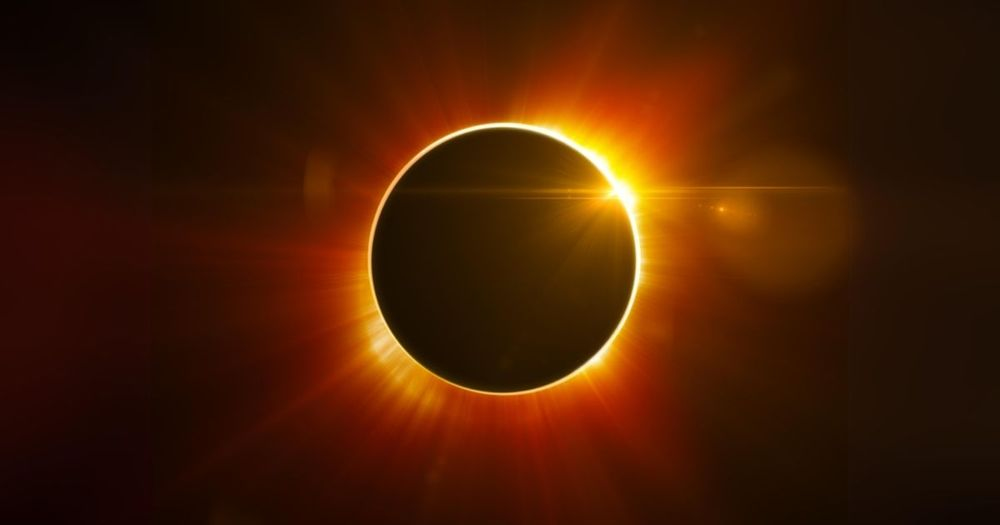
Imagine standing outside as the sky darkens, the sun slipping behind the moon, and for a moment everything goes still. Birds go quiet. The air cools on your arms. It's the middle of the day, and something very old in you wants to know what's going on.
You'll read that this is a cosmic reset, that old energies are being cleared and that you should use the darkness to manifest your goals. There's no evidence for any of that. The moon's shadow does not reach inside you and rearrange anything.
But something does happen to the people who stand and watch, and it has been measured. It's more interesting than the energy talk, and it won't cost you a retreat. There's also one real risk, which the cosmic lists tend to forget. So here is what a solar eclipse can do to your mind, body and spirit, for better and for worse.
Eclipses depend on a remarkable coincidence. The sun's diameter is about 400 times the moon's, and the sun is also about 400 times further away. So the two look almost exactly the same size in the sky, and that's why the moon can fit over the sun so neatly. It's the best-timed accident in the solar system.
People have always stopped what they were doing
Nearly every culture has had to explain the day going dark, and the explanations are wonderful. In Norse myth, a wolf chases the sun for ever, and the day it catches it, the world ends. In Hindu myth, it was swallowed. The Jukun people explained it as the sun catching the moon, and beat drums until it let go. It worked every time.
In Greek history, an eclipse stopped a war, or so Herodotus tells it. The Medes and the Lydians were mid-battle in what is now Turkey when day turned into night. They took it as an omen, and the fighting stopped. It's usually dated to 28 May 585 BC. Herodotus adds that Thales of Miletus predicted it, which would make it the first eclipse known in advance, though how he would have done it is still unclear.
In 1919 people stopped for a different reason. Two British expeditions went to Príncipe, off West Africa, and to Sobral in Brazil, to photograph the stars around the darkened sun during an eclipse. Einstein's theory said the sun's gravity would bend their light. The observations helped to confirm it, and the newspapers made him world-famous. So an eclipse did change a mind or two, by showing the evidence.
Eclipse science had form by then. In 1868, astronomers watching an eclipse recorded an unknown yellow line in the sun's light. Norman Lockyer proposed that it was a new element and named it after the sun: helium. It wasn't found on Earth until 1895, so the gas in a birthday balloon was discovered in the sky first.
Tyler Nordgren's tells the whole story, from omens of doom to Einstein.
So when the old writers call an eclipse a time for pausing and thinking, they have a point. People did stop. Today, rabbis who accept the astronomy may still treat it as a time for prayer and introspection. You don't need to believe the sky is sending you a message in order to take that part seriously.
1. Your mind: the real effect is awe
Awe has a measurable footprint. On 21 August 2017, a total eclipse crossed the United States from coast to coast, and researchers later looked at what nearly 2.9 million people had written on Twitter. People inside the eclipse's path showed more awe than people outside it. They also wrote in a less self-focused, more humble way, with more language about other people and about "us". Those who showed the most awe changed the most, compared with how they'd written before.
It's only language, and Twitter isn't the whole of anybody. But think about what's being described. For one afternoon, a few million people talked a little less about themselves. On Twitter, that counts as a miracle.
You can get this without the moon. 8 Practical Tips to Break Free from the Daily Rut, linked below, has the awe walk: 15 minutes a week spent looking for something vast or beautiful, which left older adults more joyful on their walks and less distressed in daily life.
A co-author of that Twitter study had tried something odder. On the Berkeley campus, people spent one minute looking up at towering eucalyptus trees, while others stood in the same spot and looked at the side of a large building. Then a researcher "accidentally" dropped a box of pens. Those who had looked up at the trees picked up more of them. A student replication elsewhere didn't find the effect, so hold it lightly, but it only costs you a minute. Dacher Keltner's gathers what is known about the emotion.
2. Your eyes: the one real danger
This is the only physical effect on this list that's proven, and it isn't the one the lists mention.
Looking directly at the sun, even for a few seconds, can permanently damage your retina. What makes it nasty is that the retina has no sense of pain, and the damage may not show for hours, so nothing warns you while it's happening. An eclipse makes this more likely, not less, because the dimmed sky lets you stare, and the dimmer light opens your pupils wider, as Most Eye Fixes Sell Hope. A Few Actually Work., linked below, explains. After the 2017 eclipse, a young woman came to a New York eye hospital with symptoms, and her scans showed damage to the light-sensing cells of the retina, far worse in the eye she favoured.
So take this one seriously. Sunglasses are not safe, however dark. Use proper eclipse glasses, with ISO 12312-2 printed on them, and with no scratches. Counterfeits have been sold, so buy from a seller you can trust.
Or do what's safest of all and don't look at the sun. Make a small hole, about a millimetre across, in a piece of card, and let the sun's image fall through it onto a sheet of paper. Keep an eye on the children, because they'll look.
Never look at the sun through binoculars, a telescope or a camera, even with eclipse glasses on. The concentrated light can damage the filter in your glasses, and it can damage your eyes within a fraction of a second.
The only moment it's safe to look without protection is during totality itself, when the sun is completely covered. The moment any of it reappears, the glasses go back on.
A partial eclipse never gets to that safe moment. Even with most of the sun covered, what's left can still damage your eyes, so the same rules apply from start to finish. The same goes for an annular eclipse, when the moon looks too small to cover the sun and leaves a bright ring around it. The name comes from the Latin for ring, not year, and totality never comes.
If you notice a spot in your vision afterwards that won't go away, or blurring, get your eyes examined promptly and say you watched the eclipse. The loss often clears, sometimes after a month and sometimes after more than a year, but it can be permanent.
3. Your body: not much, whatever you've read
You'll read of people feeling drained during an eclipse, and of others feeling a surge of energy. The honest reading is that the eclipse hasn't been shown to do it. Expect something strange and you'll probably notice something strange.
The usual argument goes through the moon. It moves the tides, you're mostly water, so it must move you. A meta-analysis of 37 studies on the moon and human behaviour found no significant link. One lab study did get attention, when researchers went back through old sleep recordings and found that around the full moon, people slept 20 minutes less and had 30% less deep sleep. It was an intriguing finding. A larger check with better controls then found no effect at all.
Light is the one that matters. Your body clock runs on it, but a couple of minutes of midday darkness is nothing that a normal night's sleep won't handle.
4. Your spirit: light and dark
The old Chinese idea of yin and yang treats light and dark as forces that need each other, and it's hard to stand in a sudden noon-time dusk without thinking of it. The joy and the sorrow, the highs and the lows. You may find it gives you something to think about.
That's what an eclipse can do for you on this front, and it's enough. It won't clear anything or release anything. It's a reason to stop for a few minutes, look up and ask yourself what you've been avoiding, and you're the one doing that work. Write it down afterwards if you like. The sky has gone back to normal by then, and you may not have.
5. Nature: what the bees know
Animals don't know about omens, so their reaction is a clean test of what's really going on. During the 2017 eclipse, sunlight fell by a factor of about a thousand and the temperature dropped by 10 to 15°C. Researchers and hundreds of school pupils put small microphones in flower patches across North America to listen for bees.
The bees flew on through the dim light of the partial phases, staying in the air for longer. At totality, they stopped. It was the light that did it and not the cold, and as soon as the sun returned, so did they. There's no ritual in that, and no energy. Just a small animal reading the light, as bees always have. No bee was asked about its energy.
A zoo in South Carolina shows what the bigger animals do. Researchers and keepers watched 17 kinds of animal at Riverbanks Zoo through the 2017 eclipse, and 13 of them did something not seen at any other time of observation. Most of those went into their evening routines. Three giraffes galloped for several minutes as totality passed. A pair of Galápagos tortoises began mating just before it. The Komodo dragon hurried to its evening den, found the door closed, and ran around its enclosure until the sun came back.
Be fair about this one, because the zoo also had a large, cheering crowd that day, and the authors say that may have added to the animals' anxiety.
Your body clock reads the same signal as those bees, as it happens. It's the reason you feel it when your bedroom is lit all night or your mornings are spent indoors.
How to watch one
Find the next one. A total eclipse happens somewhere on Earth about every 18 months, but it returns to any one place only once every 360 to 410 years. If you wait for it to come to you, you'll probably wait for ever. A total eclipse on 2 August 2027 will cross the Strait of Gibraltar and southern Spain, then North Africa and into the Middle East. It will last 6 minutes and 22 seconds at its longest, just south-east of Luxor in Egypt, which is unusually long.
Get inside the path of totality. Close doesn't count. It takes well over 90% coverage to notice any darkening at all, and even at 99% it's no darker than twilight.
Sort out your eyes first. Buy proper eclipse glasses well before the day, and make your pinhole card with the children.
Drive as if the other cars are watching the sky. In the three days around the 2017 eclipse, people were involved in fatal crashes at 10.3 an hour, against 7.9 an hour on comparison days, up 31%. That came to an estimated 46 extra deaths. The authors can't say exactly why, but they point to traffic, unfamiliar roads, rushing, distraction and people stopping in unsafe places. Leave early, and don't pull over on the hard shoulder to look up.
Plan for the wait. Totality lasts minutes, but you'll be outdoors for hours, and in 2027 that means August in Spain, North Africa or Egypt. Find shade, wear a hat and bring water.
Put your phone away for totality. You'll only get a few minutes. Your photo won't be as good as the ones in the papers the next day, and you won't get those minutes back.
Look around you, too. Watch the light change on the ground. Listen for the birds going quiet and the crickets starting up. During the partial phases, look under the nearest tree. The gaps between the leaves act as natural pinholes and throw small images of the eclipse onto the ground. Just before and after totality, watch for shadow bands, faint moving lines like the ones on the bottom of a swimming pool.
Then tell someone. Those researchers found that awe turned people outward. See if it does the same for you.
What stays afterwards
An eclipse won't clear your energy or reset your life. Nothing in the sky will. What it can do is stop you for a few minutes, make you feel small in a good way, and turn your attention to something other than yourself. That's a lot to get from a shadow.
And you don't need to book a flight to Luxor. Tonight, go outside for fifteen minutes and look at the biggest thing you can see.
Want the awe without the flight? 8 Practical Tips to Break Free from the Daily Rut — micro-adventures, something to look forward to, the awe walk, and being where you are.
Looking after your eyes in general? Most Eye Fixes Sell Hope. A Few Actually Work. — what training can change, Bates and the sun, your eyes after 40, children's short sight, and the bottles.
Know someone already booking flights to Luxor? Send them this, and check their glasses.
Disclaimer: This article is general information. For advice about your own health, talk to a qualified health professional. Never look directly at the sun without certified eye protection.
Affiliate Disclosure: This article contains affiliate links. As an Amazon Associate, All For Life earns from qualifying purchases, at no extra cost to you. We only link to products we would recommend without the commission.
Sources
Wikipedia. Solar eclipse. en.wikipedia.org
Wikipedia. Eclipses in mythology. en.wikipedia.org
Wikipedia. Eclipse of Thales. en.wikipedia.org
Wikipedia. Eddington experiment. en.wikipedia.org
Wikipedia. Helium. en.wikipedia.org
Goldy SP, Jones NM, Piff PK (2022). The Social Effects of an Awesome Solar Eclipse. Psychological Science 33(9):1452–1462. doi.org/10.1177/09567976221085501
Sturm VE, Datta S, Roy ARK, et al. (2022). Big smile, small self: Awe walks promote prosocial positive emotions in older adults. Emotion 22(5):1044–1058. doi.org/10.1037/emo0000876
Piff PK, Dietze P, Feinberg M, et al. (2015). Awe, the small self, and prosocial behavior. Journal of Personality and Social Psychology 108(6):883–899. doi.org/10.1037/pspi0000018
Greater Good Magazine. How Awe Makes Us Generous. greatergood.berkeley.edu
Nguyen C (2019). Awe, the Small Self, and Prosocial Behavior: Replication and Extension. DePaul University. via.library.depaul.edu
Wu CY, Jansen ME, Andrade J, et al. (2018). Acute Solar Retinopathy Imaged With Adaptive Optics, Optical Coherence Tomography Angiography, and En Face Optical Coherence Tomography. JAMA Ophthalmology 136(1):82–85. doi.org/10.1001/jamaophthalmol.2017.5517
Popular Science. How to make sure your eclipse glasses actually work. popsci.com
American Academy of Ophthalmology. Solar Eclipse Eye Safety. aao.org
Wikipedia. Photic retinopathy. en.wikipedia.org
Wikipedia. Lunar effect. en.wikipedia.org
Cajochen C, Altanay-Ekici S, Münch M, et al. (2013). Evidence that the Lunar Cycle Influences Human Sleep. Current Biology 23(15):1485–1488. doi.org/10.1016/j.cub.2013.06.029
Cordi M, Ackermann S, Bes FW, et al. (2014). Lunar cycle effects on sleep and the file drawer problem. Current Biology 24(12):R549–R550. doi.org/10.1016/j.cub.2014.05.017
Galen C, Miller Z, Lynn A, et al. (2019). Pollination on the Dark Side: Acoustic Monitoring Reveals Impacts of a Total Solar Eclipse on Flight Behavior and Activity Schedule of Foraging Bees. Annals of the Entomological Society of America 112(1):20–26. doi.org/10.1093/aesa/say035
Hartstone-Rose A, Dickinson E, Paciulli LM, et al. (2020). Total Eclipse of the Zoo: Animal Behavior during a Total Solar Eclipse. Animals 10(4):587. doi.org/10.3390/ani10040587
Wikipedia. Solar eclipse of August 2, 2027. en.wikipedia.org
Redelmeier DA, Staples JA (2024). Fatal Traffic Risks With a Total Solar Eclipse in the US. JAMA Internal Medicine 184(5):575. doi.org/10.1001/jamainternmed.2023.5234
University of British Columbia. Solar eclipses associated with increased traffic fatalities. news.ubc.ca