
The second cup arrives before you've decided whether you want it. Coffee has become furniture: the kettle, the mug, the first sip that tells your body the day has started. Then one day you want out, because the sleep has gone thin, the heart flutters, the headache arrives on Sundays, or a pregnancy test has just come back positive.
So you look for something else to drink, and the shelf is full of promises. Several of the popular coffee alternatives still contain caffeine. The swap that keeps your ritual most intact is the one that gets mocked, and even that one has a catch. And one of the trendiest replacements carries a cancer warning that comes from the heat it's drunk at.
Why switch at all
Caffeine is the most widely used mind-altering drug in the world, and the body treats it like one. It builds tolerance, it asks for more, and it punishes you for stopping. Its costs show up in different places for different people.
Sleep. In a test where texts told adults, day by day and at random, whether to have coffee or go without, coffee nights came with 36 fewer minutes of sleep. They also walked about a thousand more steps on coffee days, which says a lot about why coffee feels useful. Timing matters too. Even six hours before bed, a big hit of caffeine still cost over an hour of sleep, so a mid-afternoon cup reaches your sleep.
The heart flutter. Those coffee days also brought roughly 50 percent more premature beats from the heart's ventricles. These are usually harmless, and they're the flutter that has you looking for a way out.
Your genes and your pill. How fast you clear caffeine is partly inherited. In one large comparison, coffee was linked to more heart attacks only in people carrying the slow-clearing version of the gene that breaks caffeine down. The contraceptive pill slows clearance by roughly 40 per cent, so each cup lasts longer. That's how one espresso keeps one person awake all night while another sleeps straight after it.
Anxiety and panic. Caffeine can tip an anxious brain over the edge. Given a large amount of caffeine in tests, around half of the people with panic disorder had a panic attack, and none did after a dummy drink, while among people without the disorder it almost never happened. If you get panic attacks, caffeine is the first thing to cut.
Dependence. Caffeine withdrawal is real and measurable. Quit abruptly and a headache arrives for roughly every second regular drinker. It tends to begin half a day to a day after the final cup, is worst a day or two later, and can drag on for as long as nine days. A single cup's worth a day is enough to set it up, which is why a weekend lie-in can come with a pounding head.
Heartburn. Coffee is a common heartburn trigger. If the burn follows the morning mug, two weeks on tea or a caffeine-free cup is a fair test, and if decaf still burns, the coffee itself is the problem.
Pregnancy. Caffeine passes through the placenta freely, so the baby carries about as much in its blood as you do. Pooled across 53 cohorts, more caffeine in pregnancy went with more miscarriage, stillbirth and small babies, and no safe threshold could be found below which the risk stopped. Expecting, or hoping to be? Then leave caffeine out entirely, whether it comes in a mug of coffee or tea, a cup of cocoa, a cola or an energy drink.
One popular reason, "adrenal fatigue", falls apart. When the evidence was gathered, no endocrinology society recognised it and nothing showed it exists. Coffee raises stress hormones for a while, and the glands that make them carry on working fine.
The old line that coffee dehydrates you mostly falls apart too. Fifty daily coffee drinkers spent three days on four mugs a day and three on an equal volume of water, and every check of how well hydrated they were barely differed. A big hit of caffeine after days without it does make you pass more water for a while, and regular drinkers lose that effect. For an everyday coffee drinker, coffee counts as fluid.
Know what's in the cup
Many of the alternatives keep the caffeine, which is the first surprise. A standard mug of brewed coffee carries around 96 milligrams. A shot of espresso has about 63. Black tea comes in at about half a coffee, around 48, and green tea at about a third, around 29. Matcha and yerba mate are caffeinated too. Decaf coffee carries around one or two.
Energy drinks are a bad swap, since a 60-millilitre energy shot carries around 200 milligrams, roughly two mugs of coffee in two gulps. Several countries now keep them from children. Lithuania became the first in the EU to ban their sale to under-18s, in 2014, Norway has banned sales to under-16s since January 2026, and UK supermarkets stopped selling them to under-16s of their own accord in 2018, with a law planned to follow.
Caffeine also hides in cola, dark chocolate, pre-workout powders and some headache tablets, which list it as an ingredient. While you're stepping down, check the labels, because hidden caffeine keeps the habit going.
That gives you a ladder. Step down from coffee to tea, from tea to green tea or decaf, and then off caffeine entirely, and your body adjusts on the way without the crash of stopping dead.
The step-down drinks
Black and green tea. Tea brings caffeine with a calming partner, L-theanine, which takes the edge off, and green tea carries less of both than black. It's the gentlest first step down, a place to pause on the way, and it still keeps the caffeine habit going. Tea Bags vs Loose Leaf, linked below, has the plastic in the bag and the fluoride in the leaf.
Chai and café lattes. A chai latte is black tea with milk and, in a café, often a lot of sugar. Swapping a caramel latte for one keeps both the caffeine and the sugar, and café "alternatives" often sit closer to dessert than to a drink.
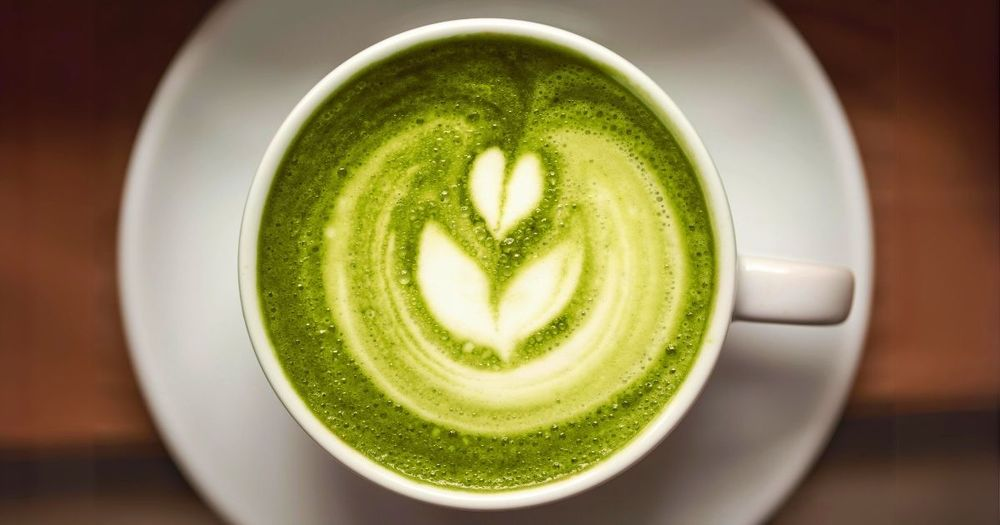
Matcha. Matcha is the whole green tea leaf ground to powder and whisked in, so you drink everything the leaf holds, caffeine included. It makes a rich, grassy cup, caffeine and all, and it comes with a catch. Because you swallow the leaf itself, you take in everything it holds, and the shading matcha growers use may push its oxalate, the compound behind the commonest kind of kidney stone, above that of unshaded green teas. Black tea is rich in oxalate too, and a man who drank large amounts of iced tea every day ended up with kidney failure from it. If you've ever had kidney stones, go easy on both.
Yerba mate. This South American tea is drunk from a gourd through a metal straw, and it delivers a coffee-like lift. The cancer warning attached to it comes from the temperature. Drinking scalding drinks, above about 65 °C, is classed as probably causing cancer of the food pipe, and much of the evidence came from places where drinks like mate are sipped scalding hot all day. Mate itself, let cool to a drinkable warmth, carries no such label. The same goes for scalding tea or coffee.
Mushroom coffees and half-caf blends. Popular mushroom coffees often contain real coffee or tea, often with around half the caffeine of a normal cup, plus extracts of lion's mane, cordyceps or reishi. The mushroom claims run on thin evidence in people. What they offer is a halfway house: a coffee-like cup with less caffeine.
A whole country once tried the halfway house. After a poor harvest in 1977, East Germany ran short of coffee, and the state sold "Kaffee-Mix", about half real coffee and half substitute, which people nicknamed "Erichs Krönung" after the leader, Erich Honecker. To get the real thing, the government traded weapons and trucks for it.
Decaf, the underrated swap
Decaf gets laughed at, and it may be the best swap if you love coffee and want your sleep back. It keeps the taste, the smell, the warm mug and the ritual, and drops the caffeine to a trace.
It began with an accident at sea. In 1903, a German coffee merchant, Ludwig Roselius, found that coffee beans drenched by seawater on the voyage had kept their flavour and lost most of their caffeine. His first process used benzene to pull the caffeine out, a solvent now known to cause cancer. His decaf went on sale in Germany as Kaffee HAG, and in France under a name built from "sans caféine": Sanka.
Methods have changed since, and solvents are still widely used. Methylene chloride or ethyl acetate strip the caffeine out and are then steamed and roasted off, though traces can remain. US rules allow up to 10 parts per million of methylene chloride in the finished coffee, and in 2024 campaigners petitioned the US food regulator to ban it, because it's linked to cancer.
If you'd rather keep solvents out of your cup, look for the Swiss Water process or the carbon dioxide method on the label. The first uses only water and charcoal filters, the second pressurised gas, and neither uses a chemical solvent. The water method is cleverer than it sounds. The beans soak in a "green coffee extract", water that already holds everything in coffee except the caffeine, so the flavour has no reason to leave and only the caffeine moves out, to be caught by the charcoal. It was developed in Switzerland in 1933 and made commercial in 1980. is a dark-roast decaf made the Swiss Water way.
The caffeine-free cups
Chicory. Roasted chicory root brews into a dark, bitter, coffee-like drink with no caffeine at all, and it has been the stand-in whenever coffee ran short. When Frederick the Great banned coffee imports into Prussia in 1766, chicory filled the gap, and Napoleon's France and Confederate soldiers in the American Civil War leaned on it too. New Orleans still drinks its coffee cut with chicory. It's rich in inulin, a fibre that feeds gut bacteria and can cause wind and bloating, so start small. brews like ground coffee in a cafetière or a filter.
Grain drinks had their turn too, and their marketing shows how long fear has sold the alternatives. In 1895 the cereal maker C. W. Post launched Postum, a caffeine-free brew of roasted wheat bran and molasses, with adverts such as "Lost Eyesight through Coffee Drinking" and the slogan "There's a Reason". When copies appeared, he brought out a cheaper one himself, Monk's Brew.
Rooibos. The South African red bush makes a naturally caffeine-free tea with a smooth, slightly sweet taste. It takes milk well and stands up to a long brew without turning bitter. is organic and sold loose, so you can brew it as strong as you like.
Golden milk. Warm milk with turmeric, ginger, cinnamon and black pepper makes a soothing cup for later in the day. The pepper matters, because it helps the body absorb turmeric's main compound. Turmeric in food is fine. Concentrated turmeric supplements are another matter: they have been linked to a growing number of cases of liver injury.
Cacao. Hot drinking chocolate made with real cacao and little or no sugar carries theobromine, a gentle cousin of caffeine, and a small amount of caffeine itself. It's a warm, rich cup, and because it still carries a little caffeine, it belongs on the last rung of the ladder.
Broth. For a savoury start, a mug of hot bone broth with a little good-quality unrefined salt gives warmth, protein and salt with no caffeine at all, and fits a meat-based or low-carb morning.
Ginger and peppermint teas. Both bring a sharp, waking flavour with no caffeine. Mint loosens the muscle that keeps stomach acid down, so leave peppermint out if heartburn troubles you.
Switching without the headache
Stepping down beats stopping dead. Replace one coffee a day with hot water, a tea or a decaf, hold there for several days, then swap the next. Withdrawal is driven by the drop in caffeine, so a gradual slope keeps the headache small or away entirely. Drink water through the day, keep your usual meals, and plan the last step for a quieter week. How to Quit Coffee, linked below, has the full way through withdrawal.
The energy coffee was covering
Coffee often covers a gap that something else opened. If you feel flat without it, the drink is usually covering for short sleep, a breakfast that drops your blood sugar by mid-morning, too little daylight in the first hours of the day, or too little movement. Those are the real fixes. If the tiredness runs deep and lasts beyond the withdrawal week, an iron or B12 check is worth having, since both can run low without obvious signs and feel like needing coffee.
Iron is part of that story, because coffee blocks iron from the food it's drunk with. Drunk with a burger, a cup of coffee cut the iron taken up from the meal by 39 percent, and a cup of tea by 64. Coffee an hour ahead of the meal changed nothing, while coffee an hour after it still blocked the iron, so with low iron, keep every cup well clear of meals.
Keep the ritual, change the cup
The mug was never the problem. Whatever you drink instead should keep the parts of coffee you love, the warmth, the pause, the first sip, and leave out the part that keeps you up at night.
Plain water is the cleanest cup of all, and it can keep the ritual too. Every other drink on this list brings something along with it, whether caffeine, sugar, oxalate, fluoride or a trace of solvent, and water brings only water. A mug of hot water in the morning gives you the warmth and the pause with nothing added. Make water your drink, and if you keep any other cup, keep it as an occasional pleasure.
So tomorrow morning, swap your second cup for a mug of hot water, and change nothing else. Next week, swap another.
Ready to cut caffeine for good? How to Quit Coffee: Getting Through Caffeine Withdrawal — how withdrawal unfolds, and the step-by-step way through it.
Switching to tea? Tea Bags vs Loose Leaf: What's Really Steeping in Your Cup — the plastic in the bag, the fluoride in the leaf, and how to brew without either.
Know someone on their fourth coffee by lunchtime who still can't sleep? Pass this on. Their next cup could be a different one.
Tried something here, or got a question it didn't answer? Write to us at contact@allforlife.club. Your questions shape the next articles.
Disclaimer: This article is general information. For advice about your own health, talk to a qualified health professional. If you're pregnant or trying to conceive, keep caffeine out altogether.
Affiliate Disclosure: This article contains affiliate links. As an Amazon Associate, All For Life earns from qualifying purchases, at no extra cost to you. We only link to products we would recommend without the commission.
Sources
Wikipedia. Caffeine. en.wikipedia.org
Marcus GM, Rosenthal DG, Nah G, et al. (2023). Acute Effects of Coffee Consumption on Health among Ambulatory Adults. New England Journal of Medicine 388(12):1092–1100. doi.org/10.1056/NEJMoa2204737
Drake C, Roehrs T, Shambroom J, Roth T (2013). Caffeine Effects on Sleep Taken 0, 3, or 6 Hours before Going to Bed. Journal of Clinical Sleep Medicine 9(11):1195–1200. doi.org/10.5664/jcsm.3170
Cornelis MC, El-Sohemy A, Kabagambe EK, Campos H (2006). Coffee, CYP1A2 Genotype, and Risk of Myocardial Infarction. JAMA 295(10):1135–1141. doi.org/10.1001/jama.295.10.1135
Patwardhan RV, Desmond PV, Johnson RF, Schenker S (1980). Impaired elimination of caffeine by oral contraceptive steroids. Journal of Laboratory and Clinical Medicine 95(4):603–608. pubmed.ncbi.nlm.nih.gov/7359014
Klevebrant L, Frick A (2022). Effects of caffeine on anxiety and panic attacks in patients with panic disorder: A systematic review and meta-analysis. General Hospital Psychiatry 74:22–31. doi.org/10.1016/j.genhosppsych.2021.11.005
Juliano LM, Griffiths RR (2004). A critical review of caffeine withdrawal: empirical validation of symptoms and signs, incidence, severity, and associated features. Psychopharmacology 176(1):1–29. doi.org/10.1007/s00213-004-2000-x
Greenwood DC, Thatcher NJ, Ye J, et al. (2014). Caffeine intake during pregnancy and adverse birth outcomes: a systematic review and dose–response meta-analysis. European Journal of Epidemiology 29(10):725–734. doi.org/10.1007/s10654-014-9944-x
Cadegiani FA, Kater CE (2016). Adrenal fatigue does not exist: a systematic review. BMC Endocrine Disorders 16(1):48. doi.org/10.1186/s12902-016-0128-4
Killer SC, Blannin AK, Jeukendrup AE (2014). No Evidence of Dehydration with Moderate Daily Coffee Intake: A Counterbalanced Cross-Over Study in a Free-Living Population. PLoS ONE 9(1):e84154. doi.org/10.1371/journal.pone.0084154
Mayo Clinic. Caffeine content for coffee, tea, soda and more. mayoclinic.org
Wikipedia. Energy drink. en.wikipedia.org
Wikipedia. Matcha. en.wikipedia.org
Charrier MJ, Savage GP, Vanhanen L (2002). Oxalate content and calcium binding capacity of tea and herbal teas. Asia Pacific Journal of Clinical Nutrition 11(4):298–301. doi.org/10.1046/j.1440-6047.2002.00294.x
Syed F, Mena-Gutierrez A, Ghaffar U (2015). A Case of Iced-Tea Nephropathy. New England Journal of Medicine 372(14):1377–1378. doi.org/10.1056/NEJMc1414481
Loomis D, Guyton KZ, Grosse Y, et al. (2016). Carcinogenicity of drinking coffee, mate, and very hot beverages. The Lancet Oncology 17(7):877–878. doi.org/10.1016/S1470-2045(16)30239-X
Wikipedia. East German coffee crisis. en.wikipedia.org
Wikipedia. Decaffeination. en.wikipedia.org
Wikipedia. Sanka. en.wikipedia.org
Ataman D (2024). Activists petition to remove methylene chloride from common decaf coffee production method amid carcinogen concerns. FoodNavigator. foodnavigator.com
Wikipedia. Chicory. en.wikipedia.org
Wikipedia. Postum. en.wikipedia.org
Shoba G, Joy D, Joseph T, et al. (1998). Influence of Piperine on the Pharmacokinetics of Curcumin in Animals and Human Volunteers. Planta Medica 64(04):353–356. doi.org/10.1055/s-2006-957450
Halegoua-DeMarzio D, Navarro V, Ahmad J, et al. (2023). Liver Injury Associated with Turmeric—A Growing Problem: Ten Cases from the Drug-Induced Liver Injury Network [DILIN]. The American Journal of Medicine 136(2):200–206. doi.org/10.1016/j.amjmed.2022.09.026
Wikipedia. Theobromine. en.wikipedia.org
Wikipedia. Gastroesophageal reflux disease. en.wikipedia.org
Morck T, Lynch S, Cook J (1983). Inhibition of food iron absorption by coffee. The American Journal of Clinical Nutrition 37(3):416–420. doi.org/10.1093/ajcn/37.3.416