The TSH result came back normal. The doctor said the thyroid looks fine. The fatigue, weight gain, brain fog, cold hands, and hair loss continue. This is one of the most common patterns in thyroid health — a patient whose numbers sit within range but whose body keeps producing exactly the symptoms a struggling thyroid produces. The explanation most often offered is that something else must be causing it. The explanation most often missed is that the TSH test measures the signal sent to the thyroid, not the hormone the thyroid produces in response.
The gap between those two things — the signal and the output — is where halogen chemistry sits. The thyroid depends on iodine to produce the hormones that regulate metabolism, temperature, energy, weight, and cognitive function. Fluoride, chlorine, and bromine are structurally similar enough to iodine that the thyroid accepts them at the same receptor sites. Once in position, they produce nothing. The gland receives the signal, attempts the work, and delivers less than the body needs — while TSH, measuring only whether the signal was sent, reports everything as normal.

Fluoride, Chlorine, Bromine, and Iodine: Four Elements Your Thyroid Can't Tell Apart
The sodium/iodide symporter is the protein that moves iodide from the bloodstream into thyroid cells — the entry point for all thyroid hormone production. Fluoride, chlorine, and bromine are chemically similar enough to iodine that they interact with this same transport system, interfering with iodide uptake and in some cases substituting for iodine at points further along the hormone synthesis pathway.
Iodine, fluoride, chlorine, and bromine belong to the same chemical family — the halogens. They share a similar atomic structure, which is why all four interact with the sodium/iodide symporter. The symporter accepts what fits the iodide binding site — and competing halogens fit. Fluoride and bromide interfere with how the symporter handles iodide — competing for uptake, disrupting transport efficiency, and in the case of bromide, substituting for iodide at points further along the synthesis pathway.
Iodine's role in the thyroid is specific and irreplaceable. The two primary thyroid hormones — T4 (thyroxine) and T3 (triiodothyronine) — are named for the number of iodine atoms they contain. T4 carries four iodine atoms; T3 carries three. Remove iodine from the synthesis process and hormone production falls proportionally. There is no substitute element. A symporter occupied by competing halogens is a symporter delivering less iodine to a gland that needs it.
The halogen displacement problem compounds over time. Fluoride, bromine, and chlorine accumulate in thyroid tissue with chronic low-level exposure — the kind delivered daily by tap water, bromated flour, and treated swimming pools. The accumulation is gradual enough that no single exposure produces a detectable change, but the total burden across years of daily contact represents a meaningful reduction in the thyroid's functional iodine availability.
The evidence for each halogen differs meaningfully. Fluoride has the strongest human data: a 2023 systematic review and meta-analysis found TSH levels begin rising at fluoride concentrations around 2.5mg per litre in drinking water, and a 2024 systematic review found five of seven eligible studies linked high fluoride exposure to thyroid changes — though both reviews noted that study quality was generally low to moderate and that most evidence came from high-fluoride regions rather than standard municipal fluoridation levels. Bromine carries credible mechanistic concern and older pharmacological evidence, but high-quality modern human studies are sparse. Chlorine is the weakest case of the three — one controlled human study found no significant impact on thyroid metabolism at normal drinking water exposure levels, though small trends toward lower T4 and T3 were observed. The practical implication is this: fluoride warrants the most attention, bromine warrants dietary source reduction, and chlorine warrants reasonable exposure limits without alarm.
Most thyroid content skips this mechanism entirely. The conversation about thyroid health tends to focus on autoimmune triggers, stress, nutrient deficiencies in general, and the adequacy of TSH as a diagnostic marker. The specific chemistry of halogen interference with iodine transport — why the sodium/iodide symporter accepts competing halogens — rarely appears outside specialist endocrinology literature, and almost never with the evidence calibrated across the three halogens at the level of practical daily exposure.
The iodine side of the equation is more precarious than most people in developed countries assume. Iodine deficiency is widely associated with remote mountain regions and developing countries — the classic goitre picture. The reality is that iodine intake across Western populations has been declining since the 1970s. The US National Health and Nutrition Examination Survey found median urinary iodine levels dropped by more than 50% between the early 1970s and the 1990s. The causes align directly with the series this article is part of: processed food displaced iodine-fortified home-cooked food, low-sodium dietary advice reduced iodised salt consumption, and the baking industry switched from potassium iodate to potassium bromate — removing iodine from bread while adding its competitor. The reader with thyroid symptoms in a developed country who assumes iodine deficiency is someone else's problem may be describing their own situation precisely.
For a detailed account of the iodine deficiency epidemic in developed countries — covering the historical iodate-to-bromate transition, the collapse of dietary iodine sources, and the case for replenishment — by Lynne Farrow documents how the modern food supply removed the population's primary iodine shield and what the clinical consequences have been.
Where Fluoride, Chlorine, and Bromine Enter the Picture
Fluoride arrives primarily through drinking water. Water fluoridation — the addition of fluoride compounds to municipal water supplies at concentrations between 0.7 and 1.0 parts per million — has been standard practice in many countries since the 1940s, promoted for its effect on dental caries. The thyroid connection has been documented in epidemiological research, and fluoride's mechanisms of disruption are more specific than simple competition with iodine. Research has shown that fluoride inhibits the Na+/K+ ATPase pump — the enzyme that maintains the sodium gradient the sodium/iodide symporter depends on. When this pump is disrupted, the entire iodine transport mechanism loses its driving force, regardless of how much iodine is available in the bloodstream. Separately, fluoride exposure induces downregulation of NIS mRNA expression — the cell produces fewer iodine pumps. These are two distinct mechanisms operating in parallel: one collapses the energy source for iodine transport, the other reduces the number of transporters available.
Populations with higher fluoride exposure show associations with elevated TSH in observational studies, particularly above 2.5mg per litre. A large observational study in England found that GP practice areas with fluoride levels above 0.7mg per litre had a 60% greater risk of high hypothyroidism prevalence compared to areas with levels below 0.3mg per litre — a threshold closer to standard municipal fluoridation levels than the high-fluoride regions most earlier studies focused on. The honest qualifier across the literature is that study quality has generally been rated low to moderate and most evidence comes from cross-sectional designs rather than controlled trials. The evidence supports attention and caution, particularly for people with existing thyroid vulnerability, while falling short of treating standard municipal water fluoridation as a direct cause of hypothyroidism in otherwise healthy adults. Toothpaste delivers a secondary fluoride load, particularly relevant for children who swallow it. Fluoride also concentrates in processed foods and beverages made with fluoridated water — including tea, which naturally accumulates fluoride from soil throughout the plant's life and concentrates it further during brewing. A cup of black tea can deliver 1–3mg of fluoride — comparable to several glasses of fluoridated water — which means someone drinking three cups daily may be consuming more fluoride from tea than from their tap. It is one of the more reliable health foods that carries a hidden halogen burden.
Chlorine enters through drinking water and through skin and respiratory absorption during showering and swimming. Municipal water treatment uses chlorine and chloramine compounds to kill pathogens — effective for that purpose, and chlorine is chemically a halogen. The thyroid concern with chlorine itself is weaker than with fluoride: one controlled human study of short-term chlorinated water exposure found no significant impact on thyroid metabolism, though small trends toward lower T4 and T3 were observed. The more significant chlorine-related thyroid concern comes from a compound chlorine produces in water: perchlorate. When chlorine reacts with organic matter in water and certain fertilisers, it forms perchlorate — a chlorine-based anion with approximately 30 times greater affinity for the sodium/iodide symporter than iodide itself. Even trace concentrations of perchlorate can functionally block iodine uptake. Perchlorate travels through groundwater and irrigation systems into produce, which means chlorine-related thyroid interference operates substantially through what gets into the food supply rather than through drinking water or shower exposure alone. Reducing total chlorine exposure remains reasonable — a twenty-minute hot shower delivers chlorine through skin absorption and steam inhalation — but the perchlorate pathway is the more clinically significant concern within the chlorine family. Competitive swimmers have among the highest rates of thyroid dysfunction of any athletic population — documented in sports medicine literature and almost entirely absent from general thyroid content. Daily hours in heavily chlorinated water deliver chronic halogen loading through skin, lungs, and mucous membranes simultaneously, at concentrations well above what tap water exposure alone produces. For any reader who trains in a pool regularly and has unexplained thyroid symptoms, the exposure history is worth naming to their practitioner.
Bromine arrives through several distinct routes, and the dietary history behind it is one of the most significant — and least discussed — shifts in thyroid health over the past century. Until the 1960s, the US baking industry used potassium iodate as a dough conditioner. A single slice of bread during that era could deliver approximately 150 micrograms of iodine — the entire adult recommended daily allowance. Around 1980, the industry transitioned to potassium bromate, citing cost and a perceived risk of iodine excess. The shift represented a double hit: it removed bread as a primary iodine source while simultaneously introducing a bromine compound that actively competes with iodine at the sodium/iodide symporter. Most commercial bread, rolls, pizza dough, and baked goods made with bromated flour carry residual bromide in the finished product, particularly when baking temperatures or times fall short of fully converting bromate.
A second significant dietary bromine source — brominated vegetable oil (BVO) — was used for decades in citrus-flavoured soft drinks to keep flavour oils in suspension. Because BVO is fat-soluble, it bioaccumulates in adipose tissue and lipid-rich organs including the thyroid rather than being readily excreted. Toxicological studies found thyroid damage including hypertrophy and altered hormone signalling at consumption levels approximating real-world human exposure. The FDA revoked BVO's authorisation in 2024 — aligning the United States with over 100 countries that had already banned it. Its removal from the US food supply is recent enough that many products formulated before 2024 may still carry it. On ingredient labels it appears as "brominated vegetable oil" — a straightforward label check that most thyroid-focused content never mentions.
Bromine compounds also appear in some medications — certain sedatives, antihistamines, and historically some psychiatric medications contain bromide. Hot tub sanitisers frequently use bromine rather than chlorine. Fire retardants in furniture, mattresses, and electronics — polybrominated diphenyl ethers (PBDEs) — release bromide compounds into household dust and air over time. The thyroid concern with bromine is mechanistically credible — bromide can interfere with iodine handling and there is older pharmacological evidence for thyroid effects — but high-quality modern human studies are sparse. The combined bromine load from diet, medication, and environment is typically higher than people estimate, and reducing the dietary contribution from processed baked goods is the most practical and evidence-supported action available.
The keto and carnivore dietary approach removes the single largest dietary bromine source immediately — the full case for that dietary shift is made in a later section.
For people with Hashimoto's thyroiditis or other autoimmune thyroid conditions, the bromine and chlorine picture carries an additional layer of concern. Brominated and chlorinated compounds may bind to thyroglobulin — the protein scaffold on which thyroid hormones are assembled — and alter its structure in ways that trigger or amplify immune recognition. The immune system, encountering a modified version of a protein it normally tolerates, may begin producing antibodies against it. This is a plausible pathway through which chronic halogen exposure worsens autoimmune thyroid disease rather than reducing hormone output alone — and it is one reason why reducing halogen exposure matters more acutely for someone with a confirmed autoimmune thyroid condition.
PFAS — the fluorinated connection to Article 4 — per- and polyfluoroalkyl substances, covered as environmental contaminants in the previous article, carry specific thyroid disruption mechanisms that extend well beyond simple halogen competition. PFAS interfere with thyroid function through four distinct pathways: direct NIS inhibition blocking iodide transport; binding to albumin and transthyretin — the proteins that carry thyroid hormone through the bloodstream — displacing T4 from circulation before it reaches target cells; accelerating liver clearance of thyroid hormones so they are broken down and excreted faster than normal; and binding directly to the thyroid hormone receptor, preventing active T3 from initiating gene expression even when it is present. The implication is that PFAS exposure produces functional thyroid hormone insufficiency without the thyroid gland itself being impaired — the hormone is produced but obstructed from reaching and activating cells. This is a different failure mode from halogen displacement at the NIS, and it is why thyroid symptoms in someone with significant PFAS exposure may persist even with adequate iodine intake. The practical response to all of these mechanisms — halogen displacement, autoimmune amplification, PFAS obstruction — shows up in the same place: the symptoms of a thyroid that is working but underdelivering.
What Happens When Iodine Loses the Competition
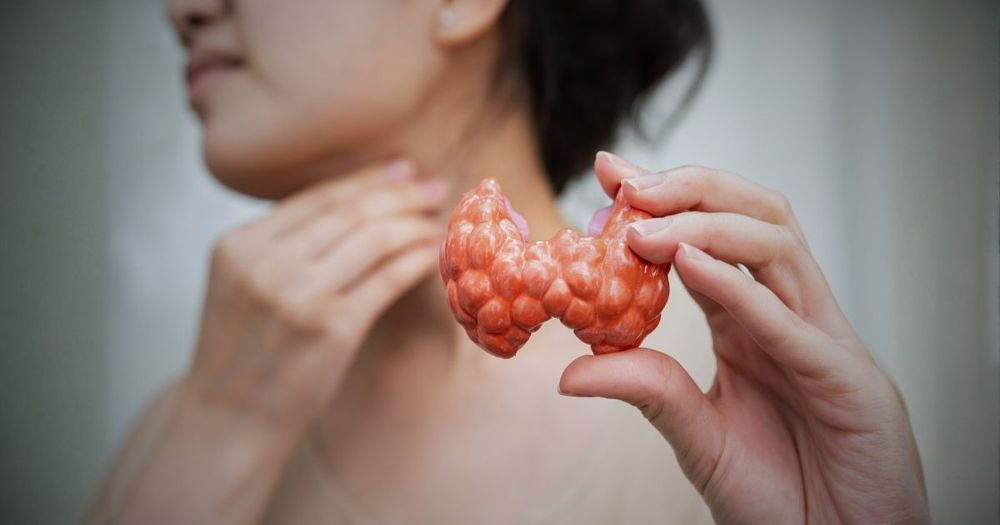
The thyroid gland sits at the base of the throat and functions as the body's metabolic regulator. Every cell in the body has receptors for thyroid hormone — T3 and T4 govern the rate at which cells convert nutrients to energy, regulate body temperature, control heart rate, influence mood and cognitive function, and drive hair follicle activity. When thyroid hormone output drops, every system that depends on it slows proportionally.
The symptoms of functional thyroid insufficiency are diffuse precisely because the gland's influence is so broad. Fatigue that sleep does not resolve. Weight gain that persists despite controlled food intake. Persistent cold — cold hands and feet, difficulty warming up, preference for warmer environments. Hair thinning and loss, particularly from the outer third of the eyebrow. Brain fog — the specific quality of slow, effortful thinking that thyroid patients describe consistently. Constipation. Low mood. Dry skin. All of these reflect cells receiving inadequate hormonal signal to maintain their normal metabolic rate.
The complication is that TSH — thyroid stimulating hormone, the standard diagnostic marker — measures the pituitary gland's signal to the thyroid, not the thyroid's actual hormone output. The pituitary senses low T3/T4, increases TSH to stimulate more production, and the thyroid attempts to comply. In the early stages of halogen displacement, the thyroid may produce enough hormone to keep TSH within the reference range while still delivering less than the body needs for full function. TSH normalcy and functional thyroid insufficiency coexist — they appear together in exactly the pattern the frustrated patient with normal results describes.
A more informative assessment includes free T3 and free T4 — the actual circulating hormone levels — alongside TSH. Free T3, the active form of thyroid hormone, frequently reveals insufficiency that TSH alone misses. Many practitioners who work specifically with thyroid patients now consider free T3 the more clinically relevant marker.

Iodine Replenishment — Why the Dietary Route Is More Complicated Than It Looks
The instinctive response to iodine displacement is to eat more iodine-rich foods. The two primary dietary sources are seafood and seaweed — both legitimately high in iodine. Both also carry contamination risks that complicate the straightforward recommendation.
The contamination picture from Article 4 applies directly here. Large predatory fish — tuna, swordfish, shark, king mackerel — accumulate mercury, PCBs, and microplastics through the food chain at concentrations that make them a poor choice as a daily iodine source. The contamination trade-off is real: eating more large fish to address iodine deficiency introduces a heavy metal burden alongside it.
Seaweed carries its own complications. It bioaccumulates arsenic, heavy metals, and iodine in quantities that are inconsistent and often excessive. Hijiki seaweed carries enough inorganic arsenic that several European countries and Canada have issued advisories against consuming it. Kelp supplements — widely sold as an iodine source — have wildly inconsistent iodine content between products and batches, with some delivering doses high enough to overstimulate or suppress thyroid function rather than support it.
The practical dietary solution is narrower than most thyroid content suggests: small fatty fish and shellfish from clean sources. Sardines, anchovies, and mackerel carry meaningful iodine alongside omega-3 fatty acids and substantially lower mercury loads than larger fish — because they sit lower in the food chain and accumulate less. Oysters and clams are among the highest iodine-content foods available and carry lower mercury risk than large fish, though water source quality matters for shellfish. These foods fit naturally within a keto or carnivore dietary framework and deliver iodine without the contamination trade-offs of large predator fish or seaweed.
The limitation of even this approach is dose consistency. Fish and shellfish iodine content varies by species, season, and water source. For someone with a meaningful halogen burden accumulated over years of fluoridated water and bromated flour consumption, dietary iodine alone — even from clean sources — may not deliver enough to displace what has accumulated in thyroid tissue.
Lugol's Solution: A Controlled Dose Without the Contamination Variable
Lugol's solution is a mixture of molecular iodine and potassium iodide in water, named after the French physician Jean Lugol who developed it in 1829. It has been used clinically for thyroid conditions for nearly two centuries. In the context of halogen displacement, its relevance is specific: it delivers a known, controlled quantity of iodine directly, bypassing both the contamination variable of seafood and the inconsistency of seaweed supplements.
The mechanism of action in halogen displacement goes further than adding more iodine. Iodine in sufficient quantity competitively displaces bromine, fluoride, and chlorine from tissue binding sites — including thyroid tissue — and the displaced halogens are then excreted through the kidneys. This is why some practitioners who use high-dose iodine protocols monitor urinary bromide as a marker of displacement — bromide in the urine increases significantly during the initial period of iodine loading as accumulated bromine is released from tissue.
For liquid Lugol's solution, is the most established preparation — widely referenced in clinical iodine literature and available in the 2% concentration appropriate for starting a low-dose protocol. For those who prefer a tablet form with precise, pre-measured dosing, by Optimox delivers the same iodine and potassium iodide combination as Lugol's solution in a format that removes the guesswork of liquid drops.
Lugol's solution is available in different concentrations — the standard preparations are 2% and 5%. The 5% preparation (Lugol's 5%) delivers approximately 6.5mg of iodine per drop, which is relevant because typical daily iodine intake from diet in Western countries sits far below the levels used in displacement protocols. The Japanese population — whose diet is built around seafood and seaweed — consumes an estimated 1,000–3,000 micrograms of iodine daily through diet alone, compared to the 150–200 micrograms typically consumed in Western countries. The gap between current intake and the intake required to address accumulated halogen burden is significant.
One population where this gap becomes acutely relevant: pregnancy. The iodine requirement doubles during pregnancy — the thyroid must produce 50% more hormone to support both maternal metabolism and foetal brain development, and the foetus depends entirely on maternal iodine supply until its own thyroid becomes functional around weeks 18–20. A woman who enters pregnancy with already-marginal iodine status and an existing halogen burden may experience the onset of thyroid symptoms during or after pregnancy. This pattern is consistently attributed to postpartum thyroiditis or hormonal fluctuation — both real phenomena — but the iodine and halogen picture that was developing before conception rarely gets examined. It is one of the more specific failure modes of standard thyroid assessment in reproductive-age women.
The critical qualification: iodine supplementation at therapeutic doses requires practitioner oversight, and the U-shaped relationship between iodine and thyroid function is essential context here. Iodine deficiency causes thyroid dysfunction — that is well established. But iodine excess also disturbs thyroid function in some people, particularly those with autoimmune thyroid conditions. The thyroid dislikes extremes in both directions, which means the goal is adequate iodine, not maximum iodine. When the thyroid is suddenly flooded with high-dose iodine, it temporarily shuts down hormone synthesis as a protective mechanism — the Wolff-Chaikoff effect. In most people this suppression is transient and the thyroid resumes normal function within days. In people with underlying thyroid vulnerability, the escape mechanism fails and the suppression persists, producing hypothyroid symptoms from iodine excess rather than deficiency. This is why some people feel worse when they start iodine supplementation, and why starting at the lowest possible dose matters mechanistically rather than as general caution alone. Individuals with autoimmune thyroid conditions — Hashimoto's thyroiditis in particular — can experience symptom flares with high-dose iodine introduction if the protocol is not managed carefully. The correct approach is to confirm iodine status first, start low and increase gradually under supervision if supplementation is warranted, and monitor thyroid hormone levels throughout. Lugol's solution at low doses — one to two drops of 2% in water daily — is sometimes used as a starting point, but anyone with a diagnosed thyroid condition should involve their practitioner before beginning, and high-dose iodine protocols require practitioner supervision throughout.
For a clinical guide specifically addressing why thyroid symptoms persist despite normal TSH results — covering functional thyroid insufficiency, the role of nutrition in hormone conversion, and the dietary approach to thyroid recovery — by Datis Kharrazian is the most direct resource available for the reader the halogen displacement mechanism most affects.
The Dietary Angle: Where Food Choices Reduce Halogen Load on the Thyroid
The halogen problem has both an exposure reduction side and a replenishment side. Diet addresses the exposure side more directly than most thyroid-specific content acknowledges.
Bromated flour is the single largest dietary bromine source for most people. Every slice of commercial bread, every pizza base, every commercially produced baked good made with bromated flour delivers a bromine load that competes directly with thyroid iodine uptake. A keto or carnivore dietary approach eliminates this entirely — the elimination is mechanistically relevant, a direct reduction in the compound most directly competing with thyroid function, rather than a carbohydrate side effect.
Iodised salt deserves a specific note here. It contains approximately 45 micrograms of iodine per gram — enough to theoretically cover the RDA across three to five grams of daily salt use. Two problems undermine this in practice. First, iodine degrades in salt over time: a salt shaker open for six months may have lost 50% of its iodine content through evaporation, particularly in humid environments. Second, most sodium in the modern diet arrives through processed and restaurant food, which uses non-iodised salt for cost reasons. The reader who uses iodised salt at home but eats significant processed food is receiving far less iodine from salt than the label implies — and may be operating with marginal iodine status while assuming the problem is covered.
Processed foods made with fluoridated tap water concentrate fluoride beyond what drinking water alone delivers. The cleaner and more whole-food the diet, the lower the incidental fluoride load from food preparation. Cooking with filtered water — particularly water filtered through a system that removes fluoride — reduces this exposure further.
The animal-food dietary pattern delivers iodine through sardines, anchovies, oysters, clams, and eggs while simultaneously removing bromated flour and the plant-based contamination concerns from Articles 2 and 4. The combination of reduced halogen exposure and improved iodine intake from clean animal sources addresses both sides of the displacement equation through the same dietary shift.
Iodine sufficiency is the foundation, but three additional nutrients govern what happens to the hormone once the thyroid produces it. Selenium is required at the active site of the deiodinase enzymes — the proteins that convert inactive T4 into the active T3 that cells use. Without adequate selenium, the thyroid can produce T4 efficiently and still leave the body functionally hypothyroid because the conversion step fails. The most concentrated single food source is two Brazil nuts daily, which consistently delivers the selenium equivalent of supplementation. For those following a stricter carnivore framework, beef kidney and liver are also high in selenium and fit the dietary pattern more naturally than Brazil nuts. Zinc is required for the thyroid hormone receptor to bind to DNA and initiate gene expression — even when T3 reaches a cell, it produces no effect if the receptor machinery lacks zinc. Oysters, beef, and lamb are the highest dietary sources and fit naturally within a carnivore framework. Iron is required for thyroid peroxidase, the enzyme that performs the organification step — incorporating iodine into the thyroglobulin scaffold where hormone synthesis occurs. Iron deficiency is a commonly overlooked cause of impaired iodine utilisation that produces hypothyroid symptoms despite adequate iodine intake. These three nutrients are the difference between a thyroid that has enough iodine and a body that successfully uses the hormones the thyroid produces.
For a practical clinical guide covering selenium, zinc, and iron alongside dietary and lifestyle interventions for thyroid health — with specific focus on autoimmune thyroid conditions — by Izabella Wentz, PharmD addresses the nutritional cofactors that govern thyroid hormone conversion and the dietary approach that supports recovery from autoimmune thyroid disease.
Practical Halogen Exposure Reduction
Water filtration is the highest-leverage environmental intervention for fluoride specifically, and the most defensible practical action the evidence supports. Standard carbon block filters — the most common type in household pitcher and under-sink systems — remove chlorine effectively but leave fluoride largely intact. Fluoride removal requires a different technology entirely. Three options work: reverse osmosis removes 90–97% of fluoride through mechanical rejection by a semi-permeable membrane; activated alumina removes 70–90% through chemical adsorption via porous aluminium oxide; and bone char carbon — made from hydroxyapatite, the same mineral structure as bone — removes approximately 90% of fluoride through adsorption and fits inline in many filter systems. The distinction between these and standard carbon filters matters practically: most people who filter their water believe they are removing fluoride when they may only be removing chlorine and improving taste.
Reverse osmosis is the most comprehensive option and also removes chlorine, disinfection byproducts, perchlorate, heavy metals, and microplastics in a single system — the filtration comparison from Article 4 applies directly here. Among specific options, the has reported 100% fluoride reduction in independent testing and fits a kitchen counter without installation. Under-sink RO systems offer more capacity for households with higher daily water use. Bone char carbon is a lower-cost alternative specifically for fluoride and suits households where a full RO system is impractical. The specific product matters less than confirming independent lab certification for fluoride removal — only third-party testing provides reliable confirmation.
Shower filters reduce chlorine and chloramine absorption through the skin and lungs. A vitamin C shower filter neutralises chlorine and chloramines at the point of contact — the only filtration method that handles chloramines effectively, since KDF and carbon filters cannot. The installs between the shower arm and existing showerhead in minutes, removes up to 99.9% of chlorine and chloramines, and requires no replacement of the showerhead itself. For swimmers, limiting time in heavily chlorinated pools and rinsing immediately after reduces the absorption window.
Bromated flour avoidance requires reading bread labels specifically for "potassium bromate" or "bromated flour" in the ingredients. In some countries — the EU, Canada, Brazil, China — potassium bromate has been banned in food production. In the United States it remains legal and in use. Non-bromated flour alternatives exist and are labelled as such. For anyone on a keto or carnivore approach, the issue resolves automatically with grain elimination.
Medication review for bromide-containing compounds is worth raising as relevant context with a prescribing practitioner, with the treatment protocol unchanged — the purpose is awareness rather than discontinuation.
What a Normal TSH Result Tells You — and What It Leaves Out
A normal TSH result confirms the pituitary gland sent the appropriate signal to the thyroid. The questions it leaves open are how much usable iodine the thyroid had available to act on that signal, how much receptor capacity was occupied by competing halogens, and whether the hormone produced is reaching cells in sufficient quantity.
The halogen displacement mechanism sits entirely outside what TSH measures. A thyroid competing with years of accumulated fluoride, bromine, and chlorine at its receptor sites may respond to the pituitary's signal with everything it has — and still produce less hormone than the body needs, because a meaningful portion of its receptor capacity is occupied by elements that produce nothing.
TSH remains a useful signal for detecting significant thyroid failure — the implication is that normal TSH alongside thyroid symptoms warrants a more complete picture: free T3, free T4, and an honest accounting of daily halogen exposure from water, food, and environment. The most defensible practical framework is: fluoride is primarily a water problem, chlorine is primarily a repeated-exposure problem, and bromine is primarily a processed-food problem. Each has a specific, proportionate intervention that requires no aggressive supplement protocols or detox claims. The evidence base for bentonite clay, activated charcoal, salt flushes, and commercial detox products reliably removing fluoride, bromide, or chlorine from the body remains weak. The evidence-supported approach is simpler and more effective: reduce the source, maintain adequate iodine, and verify thyroid status with the right labs.
The reader who has been told their thyroid is fine but continues to experience exactly the symptoms of a thyroid that is struggling received an accurate result. They received an incomplete one. The chemistry behind that gap has been documented for decades. It simply rarely makes it into the conversation between patient and doctor.
Why does the organic label cover what went into growing the food but say nothing about what gets in after — and what does that mean for the chemicals already in your body? Hidden Food Contamination: BPA, Microplastics, and Heavy Metals in Your Clean Diet — the PFAS, microplastics, and heavy metals that arrive through packaging, cookware, and water rather than through the food itself.
Why does the body keep reacting to food that every test says should be fine? Food Allergies, Sensitivities, and Intolerances: Why Your Body Keeps Reacting to Food That's Supposed to Be Good for You — the compound-load framework that explains what standard allergy testing was never designed to find.
Do you know someone who keeps being told their thyroid is fine but still feels like it isn't? This covers the chemistry behind why that gap exists — and what their daily water, bread, and morning tea may have to do with it.
Disclaimer: This article is for informational purposes only and does not constitute medical, psychological, or nutritional advice. The research cited covers documented mechanisms and compounds — individual responses vary, and any significant dietary or supplementation changes should be discussed with a qualified healthcare practitioner, particularly for anyone with a diagnosed thyroid condition.
Affiliate Disclosure: This article contains affiliate links. If you purchase through these links, we may earn a small commission at no additional cost to you. We only recommend books and products we consider genuinely valuable for the specific topics discussed.