
Sixteen volunteers were overfed by 1,000 calories a day for eight weeks. Some of them stored ten times more fat than others. Why People Fail at Weight Loss (And How to Succeed), linked below, has what made the difference, and it was not the gym. It was fidgeting, standing and moving about through the day: the small, unplanned, lazy movement that rarely gets counted.
That is encouraging if you have no intention of becoming a gym person. Health advice usually arrives as an overhaul: a new diet, a training plan, a morning routine that starts before it is light. Much of what works is smaller than that, and some of it can be done lying down. Which is, to be fair, the best position for health advice.
Here are ten easy ways to get healthier without breaking a sweat, things you can do sitting, talking or asleep. Two of the popular lazy favourites turn out not to work, and those are in here too.
1. Keep water within reach
You drink what is in front of you. Keep a bottle you like next to you, on the desk, by the sofa, in the car, such as the , and you will drink from it without deciding to.
Plain water is the drink. A slice of lemon or cucumber is fine if it helps. A splash of juice is sugar in disguise, so leave it out.
2. Sleep longer
Sleep is the laziest powerful habit there is, because you are lying down for all of it. The Sleep-Immune Connection: What One Sleepless Night Does to Your Defences has the 164 healthy adults whose sleep was tracked for a week before they were given a cold virus on purpose. Those sleeping under five hours a night were 4.5 times as likely to catch the cold as those sleeping more than seven. Between six and seven hours, the risk was no higher at all.
So protect the night. Screens off a while before bed, the lights low, the bedroom cool and dark. Then do nothing, for hours. It counts.
The daytime version counts too. NASA's work on pilots and astronauts found that a 26-minute nap raised alertness by 54% and performance by 34%. Twenty-six minutes on the sofa, filed under work.
One kind of tired is worth telling apart. How to Start Taking Care of Yourself Today: Why Your Body Can't Wait has the difference: muscles worn out from work need rest, but the tiredness that comes from doing too little gets worse with it. If you are too tired to walk but can scroll your phone for half an hour, it is the second kind. The sofa is a poor charger.
3. Fidget, stand, and walk while you talk
The overfed volunteers make the point. The ones who stayed leanest were not exercising. They were the people who could not sit still. That suits the restless, and it is a hint for everyone else: stand up when you take a call, pace while you think, take the long way to the kettle.
A second test put a number on it. Ten lean and ten mildly obese people who did no exercise had their posture and movement recorded every half-second for ten days. The obese group spent about two hours a day longer sitting. The habit held when they lost weight, and when the lean ones gained it, which suggests it is partly built in. Moving like the lean ones would have burned about 350 calories a day.
A desk that lets you stand takes some of that back. Across 34 sets of findings with 3,397 people, sit-stand desks reduced sitting at work by about 100 minutes a day in the first three months, and by 57 minutes after three to twelve months. The evidence is weak, but the direction is plain.
Lazy at home and lazy on the sofa are two different things. When women in a large American study were followed for six years, every extra two hours a day of television went with a 23% higher risk of obesity and a 14% higher risk of diabetes. Two hours a day of standing or walking around at home went the other way: a 9% lower risk of obesity and a 12% lower risk of diabetes. Pottering counts.
The phone call is the easiest place to start. Next time a friend or a relative rings, get up and walk, round the room, round the garden, round the block. It does not feel like exercise because it is not, and it still adds up.
Walking helps the head as well. When people were asked to think up new uses for everyday objects, walking raised the scores of 81% of them, and the boost lingered after they sat down again. Walking outdoors gave the most original ideas of all. A walk on the phone may make for a better conversation too.
A dog takes the deciding out of it. Win the Morning, Win the Day: Simple Rituals That Separate High Achievers from the Rest has why: owning one goes with more physical activity, and the strongest predictor of actually walking it was the bond with the dog. A dog waiting by the door is hard to argue with.
4. Do heel raises in your chair
This is the laziest exercise ever tested, and one of the most surprising. The soleus is a calf muscle that makes up about 1% of your body weight. Sitting down, with your feet flat, you raise your heels as far as they go, let them drop, and repeat, the way a restless knee bounces under a table.
Done like this, the soleus kept working for hours without tiring, even in unfit volunteers. And it did more than burn a little energy. After a meal, their rise in blood sugar was 52% lower than when they sat still, and their insulin 60% lower. A laboratory finding, but a striking one for something you can do under a desk during a meeting. The meeting will not notice. Your blood sugar will.
5. Walk for ten minutes after dinner
Your muscles are the biggest sugar sponge you own. How to Fix Blood Sugar Spikes Naturally has the adults with type 2 diabetes who walked for ten minutes after each meal and had lower blood sugar after eating than when they walked the same total in one go each day. After dinner, the biggest and laziest meal, the difference was largest.
Ten minutes is a lap of the block. It is also the best excuse to leave the washing-up.
6. Laugh, for the mood and not the calories
The old version of this list said laughing burns calories. Someone measured it. Forty-five pairs of friends watched funny and not-so-funny film clips in a sealed room that measured exactly how much energy they used. Genuine laughter raised their energy use and heart rate by 10 to 20% above rest. Ten to fifteen minutes of laughing a day would burn between 2 and 10 calories.
That is a crumb of a biscuit. There is a better reason. 10 Ways Laughter Is Good for Your Health and Happiness has the six tests, with comedy on video and on stage, in which people could bear more pain after laughing, and the effect came from the laughing itself.
So laugh for the right reasons. It feels good, and it is better company than the news. Put on something funny, or ring the friend who always makes you laugh, and walk while you do it.
7. Sigh on purpose
Mindfulness does not have to be an hour on a cushion. Stress Management 101: Simple Techniques Anyone Can Master in Minutes has the quickest one there is, the sigh. Breathe in through the nose, top it up with a second short sniff, then let it all out slowly through the mouth, longer than the breath in.
It takes seconds, needs no app, and can be done in a queue, in traffic or while the kettle boils.
8. Stretch, for what it does
Stretching in front of the television is pleasant, and it is honest work for your joints. Just know what it buys. Defy Aging with Movement: How Exercise Keeps You Strong, Sharp, and Independent for Life has it: stretching improves how far a joint can move, and whether that changes daily life for older adults is "conflicting" across 22 reports.
So stretch because it feels good and keeps you moving freely, and do the heel raises and the walk for the rest.
One stretch doubles as a test. The Harsh Truth About Aging: Decline or Longevity? has the 2,002 adults aged 51 to 80 who were scored out of ten on getting down to the floor and back up, losing a point for every hand or knee they used for support. The lowest scorers were more than five times as likely to die over the next six years as the highest. Sit on the floor in front of the television now and then, and get up again.
9. Let meat, eggs and tins do the cooking
Lazy eating is mostly about what is already in the fridge. A batch of boiled eggs, made on a quiet evening, is breakfast and a snack for days, and a does them with no pan to watch. A roast chicken does three meals. A tin of sardines or mackerel, such as , is a meal with a fork and no cooking at all. None of them asks you to hide spinach in a muffin. Spinach has suffered enough.
The same goes for a delivery night. Take a few seconds over the menu: grilled or roasted meat over fried, the kebab meat without the bread, the burger without the bun, and water to drink with it. It still arrives at the door. You still do not cook.
10. Skip the stability ball
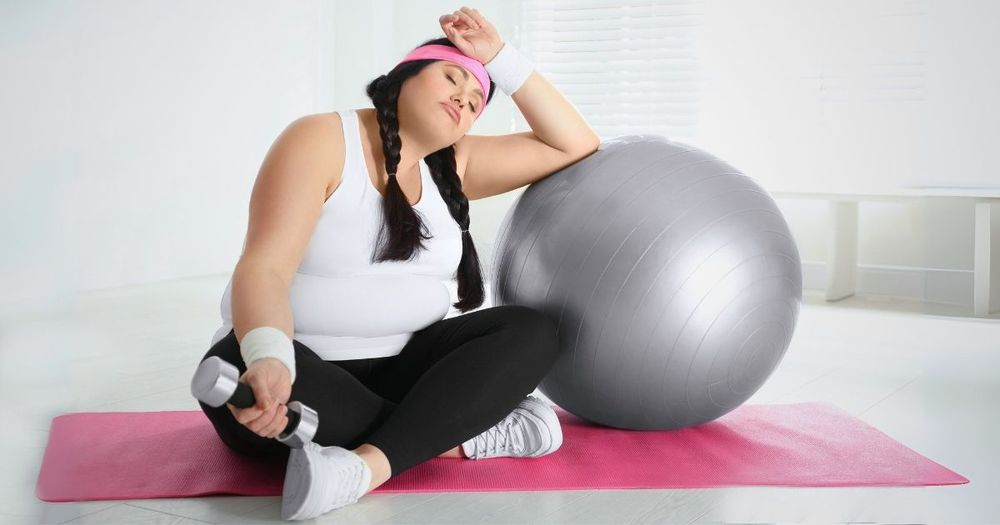
The stability ball was sold as the chair that makes you healthier while you sit: core switched on, posture fixed, back pain gone. It has been tested. Fourteen people sat at a computer for an hour on a ball and an hour on an ordinary office chair, with their muscles and spine measured. The differences were small, and the ball was more uncomfortable. Discomfort, it turns out, is not the same as exercise.
So keep the chair. If you want to work while sitting, the heel raises from number 4 do more.
Back to the fidgeters
The volunteers who stayed leanest on all that extra food were the ones who never stopped moving, in small ways that would never be called exercise. Health is like that more often than the overhaul suggests. Water within reach, a long night, a walk on the phone, ten minutes after dinner, a laugh and a sigh. None of it needs a gym, and most of it can be done in slippers. Some of it is better in slippers.
Today, at your desk or on the sofa, do the heel raises for a few minutes after your next meal.
Want the simplest changes with the biggest payback? 7 Simple Changes to Improve Your Health, Starting Today — water, short bursts of movement, meat at the centre of the plate, and sleep.
Wondering why the weight never shifts? Why People Fail at Weight Loss (And How to Succeed) — the fidgeters, the body that defends its weight, and what works instead.
Know someone with a stability ball they never sit on? Send them this, and tell them to keep the chair.
Disclaimer: This article is general information. For advice about your own health, talk to a qualified health professional, especially if you have diabetes, take medicines that lower blood sugar, or have a heart or joint condition.
Affiliate Disclosure: This article contains affiliate links. As an Amazon Associate, All For Life earns from qualifying purchases, at no extra cost to you. We only link to products we would recommend without the commission.
Sources
Levine JA, Eberhardt NL, Jensen MD (1999). Role of nonexercise activity thermogenesis in resistance to fat gain in humans. Science 283(5399):212–214. doi.org/10.1126/science.283.5399.212
Prather AA, Janicki-Deverts D, Hall MH, Cohen S (2015). Behaviorally Assessed Sleep and Susceptibility to the Common Cold. Sleep 38(9):1353–1359. doi.org/10.5665/sleep.4968
Wikipedia. Nap. en.wikipedia.org
Levine JA, Lanningham-Foster LM, McCrady SK, et al. (2005). Interindividual variation in posture allocation: possible role in human obesity. Science 307(5709):584–586. doi.org/10.1126/science.1106561
Shrestha N, Kukkonen-Harjula KT, Verbeek JH, Ijaz S, Hermans V, Pedisic Z (2018). Workplace interventions for reducing sitting at work. Cochrane Database of Systematic Reviews (12):CD010912. doi.org/10.1002/14651858.CD010912.pub5
Hu FB, Li TY, Colditz GA, Willett WC, Manson JE (2003). Television watching and other sedentary behaviors in relation to risk of obesity and type 2 diabetes mellitus in women. JAMA 289(14):1785–1791. doi.org/10.1001/jama.289.14.1785
Oppezzo M, Schwartz DL (2014). Give your ideas some legs: the positive effect of walking on creative thinking. Journal of Experimental Psychology: Learning, Memory, and Cognition 40(4):1142–1152. doi.org/10.1037/a0036577
Westgarth C, Christley RM, Christian HE (2014). How might we increase physical activity through dog walking?: A comprehensive review of dog walking correlates. International Journal of Behavioral Nutrition and Physical Activity 11:83. doi.org/10.1186/1479-5868-11-83
Hamilton MT, Hamilton DG, Zderic TW (2022). A potent physiological method to magnify and sustain soleus oxidative metabolism improves glucose and lipid regulation. iScience 25(9):104869. doi.org/10.1016/j.isci.2022.104869
Reynolds AN, Mann JI, Williams S, Venn BJ (2016). Advice to walk after meals is more effective for lowering postprandial glycaemia in type 2 diabetes mellitus than advice that does not specify timing: a randomised crossover study. Diabetologia 59(12):2572–2578. doi.org/10.1007/s00125-016-4085-2
Buchowski MS, Majchrzak KM, Blomquist K, et al. (2007). Energy expenditure of genuine laughter. International Journal of Obesity 31(1):131–137. doi.org/10.1038/sj.ijo.0803353
Dunbar RIM, Baron R, Frangou A, et al. (2012). Social laughter is correlated with an elevated pain threshold. Proceedings of the Royal Society B: Biological Sciences 279(1731):1161–1167. doi.org/10.1098/rspb.2011.1373
Stathokostas L, Little RMD, Vandervoort AA, Paterson DH (2012). Flexibility Training and Functional Ability in Older Adults: A Systematic Review. Journal of Aging Research 2012:306818. doi.org/10.1155/2012/306818
Brito LBB, Ricardo DR, Araújo DSMS, et al. (2014). Ability to sit and rise from the floor as a predictor of all-cause mortality. European Journal of Preventive Cardiology 21(7):892–898. doi.org/10.1177/2047487312471759
Gregory DE, Dunk NM, Callaghan JP (2006). Stability ball versus office chair: comparison of muscle activation and lumbar spine posture during prolonged sitting. Human Factors 48(1):142–153. doi.org/10.1518/001872006776412243