
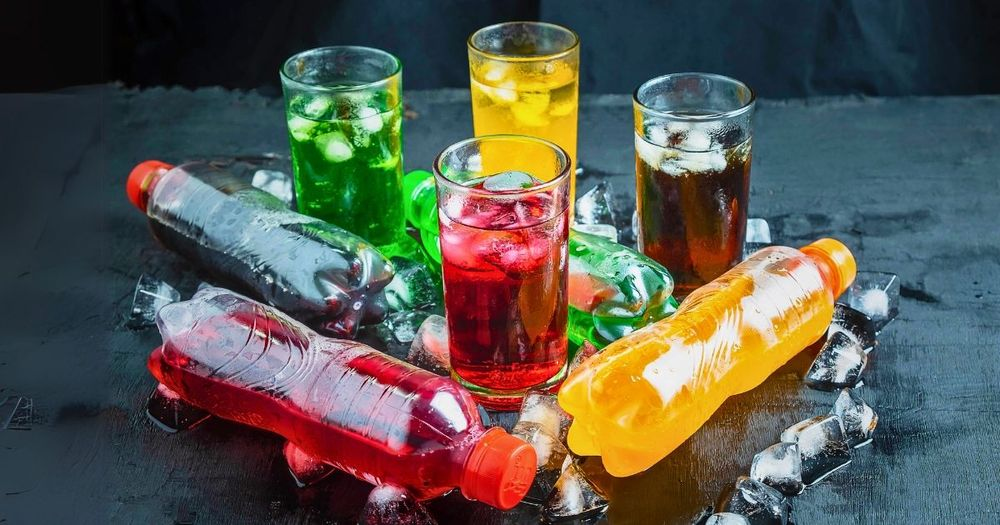
A daily bottle of soda has been tied to 4.6 extra years of ageing in your cells. The team who measured it put that on a par with smoking.
They examined the white blood cells of 5,309 healthy American adults. The ones who drank sugary soda had shorter telomeres, the caps on the ends of your DNA that wear down as you age (the word means "end part"). The 4.6 years is what a daily 20-ounce bottle, about 600 ml, came to.
That's a link, measured at one moment, and one link proves little. The trouble for sugary drinks is how much else points the same way. Ahead: what a litre of cola a day did to the liver in six months, the fizzy drink that shows up in women's hip bones, the "healthy" glass that carries nearly as much sugar as cola, and the cola "flavouring" that 23 out of 25 drinkers failed to taste.
1. Your appetite never notices it
Sugar you drink slips past the part of you that keeps count. Fifteen people had the same 450 calories a day as jelly beans or as soda, four weeks each. On jelly beans they ate less of everything else to match. On soda they ate as before, and gained weight.
A can of cola holds about 39 grams of sugar, close to ten teaspoons. Eat ten teaspoons of sugar from the bowl and you'd feel it. Drink them and you're ready for lunch. The World Health Organization (WHO) suggests keeping added sugar to about 25 grams a day, so one can clears it with room to spare.
For one week, write down every drink other than water, and read the list on the last day.
2. Your teeth meet it first
In 939 Finnish adults followed for four years, those who had one or two sugary drinks a day got 31% more new decay than those who had none. The link held whether or not they brushed with fluoride toothpaste.
Acid does its own damage, with no help from sugar. Of 379 drinks bought off American shelves, 93% were acidic enough to dissolve enamel, and 39% fell in the most erosive class, cola among them. Diet cola and sports drinks were close behind, sugar-free or not. Plain sparkling water landed in the mildest class.
Britain put a levy on sugary drinks in 2018. Within two years, hospital admissions to have decayed teeth pulled were 12% lower than the earlier trend predicted among children, and 29% lower among the under-fives.
Make water the only thing you sip between meals.
3. It lands in your liver
Forty-seven overweight adults drank a litre a day of one of four drinks for six months: regular cola, milk with the same calories, diet cola or water. In the cola group, liver fat rose 132 to 143% more than in the other three, and the fat packed around the organs 24 to 31% more. Total body fat ended up about the same in all four groups, so the bathroom scale would have missed it.
The reason is fructose. The word comes from the Latin fructus, fruit. In an apple it arrives slowly, wrapped in fibre. In a bottle it arrives all at once.
Table sugar is half fructose, and the corn syrup used in soft drinks is 55%. When overweight adults drank fructose-sweetened or glucose-sweetened drinks for ten weeks, both groups gained the same weight. Only the fructose group gained fat around the organs and lost sensitivity to insulin, and their livers turned more of the sugar into fat.
Swap one sugary drink a day for water, starting with the one you drink out of habit.
4. It wears down your blood sugar control
Across 17 long-running groups of people, each daily sugary drink was tied to an 18% higher risk of type 2 diabetes. With body weight taken out of the picture it was still 13%, so the link goes beyond the weight the drink adds.
Of 20.9 million new cases of type 2 diabetes expected in the US over ten years, about 1.8 million were put down to sugary drinks, by the same team's estimate.
If you've had a daily habit for years, ask for an HbA1c, a three-month average of your blood sugar, the next time you have blood taken.
5. It shows on your face
Sugar in your blood sticks to proteins, including the collagen and elastin that hold your skin up. The process is called glycation. Two collagen fibres get welded together by a sugar, and neither can be easily repaired afterwards. The higher the sugar, the faster it happens.
When 602 people had their age guessed from photographs, those with higher blood sugar were judged older, by about five months for each extra unit of glucose in their blood, and that held among people without diabetes.
Before you buy another anti-ageing cream, drop the sweet drinks.
6. It reaches your joints and your kidneys
"Gout" comes from the Latin gutta, a drop, from the old idea of bad humours dripping into the joint. It was once called the disease of kings, because it took a rich table to get it. A fridge of soda will now do.
It strikes when uric acid forms crystals in a joint. In 46,393 men followed for twelve years, those who had two or more sugary soft drinks a day were 85% more likely to develop it than those who had less than one a month. Diet drinks showed no link.
Kidney stones follow the same drinks. In 194,095 people followed for over eight years, those who drank the most sugary cola were 23% more likely to form a stone, and for other sugary sodas the figure was 33%.
If you've had a gout attack or a kidney stone, make sweet drinks the first thing to go.
7. Cola shows up in your hips
In 1,413 women, those who drank cola every day had hip bones 3.7% less dense than those who drank it less than once a month. Diet cola showed the same pattern. Other fizzy drinks showed none, so the bubbles are in the clear. Cola carries phosphoric acid and caffeine, the two likeliest suspects.
Bubbles are older than the sugar anyway. Joseph Priestley made the first carbonated water in 1767 by hanging a bowl of water over a beer vat in Leeds.
If it's the fizz you like, switch to sparkling water with a few mint leaves.
8. It may reach your brain
In about 4,000 people, those who had one or two sugary drinks a day had slightly smaller brains on a scan and did worse on memory tests than those who had less than one. Daily fruit juice went the same way. It's a snapshot, which leaves open which came first.
Notice how clear your head is an hour after a sweet drink, and an hour after water.
9. It shortens the odds
About 118,000 American health professionals were followed for around thirty years. Compared with those who had less than one sugary drink a month, those who had two or more a day were 21% more likely to die during those years, 31% more likely to die of heart disease, and 16% more likely to die of cancer. The risk rose with each step up.
That's a link too. Stack it beside the liver scans and the telomeres, and the direction is hard to miss.
If you're at two a day, drop to one this week. Each step down counts, the same way each step up did.
The drinks with a halo
Orange juice has 8.3 grams of sugar in every 100, apple juice 9.6, and cola 9.9. The orange came with fibre and took a few minutes to eat. The juice has neither brake.
Juice's record is milder than soda's, and it still shows up: each daily glass came with a 7% higher risk of type 2 diabetes, a weaker and less certain link.
A smoothie is no exception. Blending frees the sugar from the fruit the same way juicing does, and the NHS counts both the same.
The rest of the shelf, per 100 grams: energy drinks 10.2, chocolate milk 9.5, sweetened iced tea 9.5, and bottled sweetened coffee 10.7, more than cola. Plain milk has 4.8 as lactose, and plain coconut water 2.6.
Sports drinks earn no halo either. When 72 men drank a litre each of 13 drinks, the sports drink kept them no better hydrated than water. Sparkling water did as well as still.
Labels help less than they seem to. The WHO's count of sugar includes honey, syrups, fruit juice and juice concentrate, so a drink "sweetened only with fruit juice" still counts.
Eat the fruit and leave the juice.
Why it's hard to put down
Soda began as medicine. Coca-Cola went on sale in 1886 at a pharmacy in Atlanta, five cents a glass, as a cure for headaches, nerve disorders, morphine addiction and impotence.
Sugar is half the hook. Caffeine is the other half. Cola makers call caffeine a flavouring. When 25 regular cola drinkers were tested blind, only two could taste the difference at the level used in most colas. A flavouring that 23 out of 25 fail to taste is doing another job.
The argument is over a century old. In 1911 the US government seized forty barrels and twenty kegs of Coca-Cola syrup, calling its caffeine injurious to health. The company won twice in the lower courts. In 1916 the Supreme Court sent the case back, and Coca-Cola settled by cutting the caffeine in its recipe. By then the law listed caffeine among the "habit-forming" substances that had to be named on a label. Michael Moss's follows the same playbook through the rest of the supermarket.
Sugar content is a choice too. After the British levy, the share of soft drinks above 5 grams of sugar per 100 ml fell by 34 percentage points as makers changed their recipes.
What stopping does
In a six-month test with 318 overweight adults, those who swapped the drinks that carried calories for water or diet drinks lost 2 to 2.5% of their weight, and were twice as likely to lose 5% as a comparison group. The water group's fasting blood sugar improved too.
The liver answers fast. Forty teenage boys with fatty liver either cut added sugar and juice to almost nothing for eight weeks or ate as usual. Liver fat fell from 25% to 17% in the first group and from 21% to 20% in the second.
Children show the effect on weight most cleanly. For 18 months, 641 children got one drink a day at school, sugary or sugar-free, without knowing which. The sugar-free group gained about a kilo less.
Teenagers show how much the house matters. When 224 overweight teenagers had water and diet drinks delivered at home for a year, their sugary drinks fell to almost none and they gained 1.9 kg less than a comparison group. A year after the deliveries stopped, the gap had closed.
Is diet the answer?
In the short run, partly. In the six-month liver test, diet cola behaved like water, and in the gout data it showed no link.
Over decades the picture is murkier. In 451,743 Europeans followed for about 16 years, those who had two or more glasses of diet soft drinks a day were 26% more likely to die during that time than those who had less than one a month. For sugary soft drinks the figure was 8%. Switching to diet because you're already unwell would produce the same pattern, so treat it as a warning, short of a verdict.
The brain data cut the same way. In 2,888 adults followed for ten years, a daily diet soft drink went with nearly three times the risk of the commonest kind of stroke, and with nearly three times the risk of Alzheimer's among the over-60s. The numbers were small and the margins wide.
Diet cola also showed the same hip-bone pattern as regular. And the WHO advises against sugar-free sweeteners for weight control, having found no long-term benefit for body fat.
Use diet drinks as a bridge off sugar if you need one, and keep walking.
How to stop
Stop bringing it home. What's in the fridge gets drunk, as the teenagers showed in both directions.
Count it as carbs. On a low-carb, keto or carnivore plate, sweet drinks are the first thing to go. In the US they lead the list of sources of added sugar.
Keep the fizz and the cold. Water does the job. Sparkling water does it with bubbles, plain or with mint or cucumber, and a on the counter makes it as easy as opening a can. Herbal teas, hot or iced, add flavour without sugar. Iced is a good place to start, unless you get heartburn. For something hot and savoury, a mug of bone broth has no sugar and no caffeine.
Expect a headache if your drink was cola. When caffeine stops, about half of people get one. It starts within a day and lasts two to nine days, and then it's over.
Keep your rescue drink. If you take insulin or another medicine that can drop your blood sugar too low, keep whatever you've been told to use for a low.
One less a day
Sugary drinks bill you in places you'll see only later: the liver, the hip bones, the ends of your DNA. The fix is the cheapest one in nutrition. Stop buying them.
Start with the next one you reach for. Pour a glass of water first, and see if you still want it.
Tired an hour after something sweet? How to Fix Blood Sugar Spikes Naturally — the carbs to cut first, and the ten-minute walk that flattens the rest.
Lost weight before and watched it come back? Why People Fail at Weight Loss (And How to Succeed) — why your body fights back, and what the people who keep it off do.
Know someone with a can-a-day habit? Send them this, and bring sparkling water the next time you visit.
Disclaimer: This article is general information. For advice about your own health, talk to a qualified health professional.
Affiliate Disclosure: This article contains affiliate links. As an Amazon Associate, All For Life earns from qualifying purchases, at no extra cost to you. We only link to products we would recommend without the commission.
Sources
Leung CW, Laraia BA, Needham BL, et al. (2014). Soda and cell aging: associations between sugar-sweetened beverage consumption and leukocyte telomere length in healthy adults from the National Health and Nutrition Examination Surveys. American Journal of Public Health 104(12):2425–2431. doi.org/10.2105/AJPH.2014.302151
Wiktionary. Telomere. en.wiktionary.org
DiMeglio DP, Mattes RD (2000). Liquid versus solid carbohydrate: effects on food intake and body weight. International Journal of Obesity 24(6):794–800. doi.org/10.1038/sj.ijo.0801229
Wikipedia. Coca-Cola. en.wikipedia.org
World Health Organization (2015). Guideline: sugars intake for adults and children. who.int
Bernabé E, Vehkalahti MM, Sheiham A, Aromaa A, Suominen AL (2014). Sugar-sweetened beverages and dental caries in adults: a 4-year prospective study. Journal of Dentistry 42(8):952–958. doi.org/10.1016/j.jdent.2014.04.011
Reddy A, Norris DF, Momeni SS, Waldo B, Ruby JD (2016). The pH of beverages in the United States. Journal of the American Dental Association 147(4):255–263. doi.org/10.1016/j.adaj.2015.10.019
Rogers NT, Conway DI, Mytton O, et al. (2023). Estimated impact of the UK soft drinks industry levy on childhood hospital admissions for carious tooth extractions: interrupted time series analysis. BMJ Nutrition, Prevention & Health 6(2):243–252. doi.org/10.1136/bmjnph-2023-000714
Maersk M, Belza A, Stødkilde-Jørgensen H, et al. (2012). Sucrose-sweetened beverages increase fat storage in the liver, muscle, and visceral fat depot: a 6-mo randomized intervention study. American Journal of Clinical Nutrition 95(2):283–289. doi.org/10.3945/ajcn.111.022533
Wiktionary. Fructose. en.wiktionary.org
Wikipedia. High-fructose corn syrup. en.wikipedia.org
Stanhope KL, Schwarz JM, Keim NL, et al. (2009). Consuming fructose-sweetened, not glucose-sweetened, beverages increases visceral adiposity and lipids and decreases insulin sensitivity in overweight/obese humans. Journal of Clinical Investigation 119(5):1322–1334. doi.org/10.1172/JCI37385
Imamura F, O'Connor L, Ye Z, et al. (2015). Consumption of sugar sweetened beverages, artificially sweetened beverages, and fruit juice and incidence of type 2 diabetes: systematic review, meta-analysis, and estimation of population attributable fraction. BMJ 351:h3576. doi.org/10.1136/bmj.h3576
Danby FW (2010). Nutrition and aging skin: sugar and glycation. Clinics in Dermatology 28(4):409–411. doi.org/10.1016/j.clindermatol.2010.03.018
Noordam R, Gunn DA, Tomlin CC, et al. (2013). High serum glucose levels are associated with a higher perceived age. Age 35(1):189–195. doi.org/10.1007/s11357-011-9339-9
Wiktionary. Gout. en.wiktionary.org
Wikipedia. Gout. en.wikipedia.org
Choi HK, Curhan G (2008). Soft drinks, fructose consumption, and the risk of gout in men: prospective cohort study. BMJ 336(7639):309–312. doi.org/10.1136/bmj.39449.819271.BE
Ferraro PM, Taylor EN, Gambaro G, Curhan GC (2013). Soda and other beverages and the risk of kidney stones. Clinical Journal of the American Society of Nephrology 8(8):1389–1395. doi.org/10.2215/CJN.11661112
Tucker KL, Morita K, Qiao N, et al. (2006). Colas, but not other carbonated beverages, are associated with low bone mineral density in older women: the Framingham Osteoporosis Study. American Journal of Clinical Nutrition 84(4):936–942. doi.org/10.1093/ajcn/84.4.936
Wikipedia. Soft drink. en.wikipedia.org
Pase MP, Himali JJ, Jacques PF, et al. (2017). Sugary beverage intake and preclinical Alzheimer's disease in the community. Alzheimer's & Dementia 13(9):955–964. doi.org/10.1016/j.jalz.2017.01.024
Malik VS, Li Y, Pan A, et al. (2019). Long-term consumption of sugar-sweetened and artificially sweetened beverages and risk of mortality in US adults. Circulation 139(18):2113–2125. doi.org/10.1161/CIRCULATIONAHA.118.037401
U.S. Department of Agriculture. FoodData Central: sugars per 100 g in orange juice (FDC ID 169100), apple juice (167771), cola (174852), energy drink (173210), chocolate milk (170879), sweetened iced tea (171888), sweetened milk-based coffee (171880), whole milk (746782) and coconut water (170174). fdc.nal.usda.gov
NHS. Sugar: the facts. nhs.uk
Maughan RJ, Watson P, Cordery PA, et al. (2016). A randomized trial to assess the potential of different beverages to affect hydration status: development of a beverage hydration index. American Journal of Clinical Nutrition 103(3):717–723. doi.org/10.3945/ajcn.115.114769
Griffiths RR, Vernotica EM (2000). Is caffeine a flavoring agent in cola soft drinks? Archives of Family Medicine 9(8):727–734. doi.org/10.1001/archfami.9.8.727
Wikipedia. United States v. Forty Barrels and Twenty Kegs of Coca-Cola. en.wikipedia.org
Scarborough P, Adhikari V, Harrington RA, et al. (2020). Impact of the announcement and implementation of the UK Soft Drinks Industry Levy on sugar content, price, product size and number of available soft drinks in the UK, 2015-19: a controlled interrupted time series analysis. PLoS Medicine 17(2):e1003025. doi.org/10.1371/journal.pmed.1003025
Tate DF, Turner-McGrievy G, Lyons E, et al. (2012). Replacing caloric beverages with water or diet beverages for weight loss in adults: main results of the Choose Healthy Options Consciously Everyday (CHOICE) randomized clinical trial. American Journal of Clinical Nutrition 95(3):555–563. doi.org/10.3945/ajcn.111.026278
Schwimmer JB, Ugalde-Nicalo P, Welsh JA, et al. (2019). Effect of a low free sugar diet vs usual diet on nonalcoholic fatty liver disease in adolescent boys: a randomized clinical trial. JAMA 321(3):256–265. doi.org/10.1001/jama.2018.20579
de Ruyter JC, Olthof MR, Seidell JC, Katan MB (2012). A trial of sugar-free or sugar-sweetened beverages and body weight in children. New England Journal of Medicine 367(15):1397–1406. doi.org/10.1056/NEJMoa1203034
Ebbeling CB, Feldman HA, Chomitz VR, et al. (2012). A randomized trial of sugar-sweetened beverages and adolescent body weight. New England Journal of Medicine 367(15):1407–1416. doi.org/10.1056/NEJMoa1203388
Mullee A, Romaguera D, Pearson-Stuttard J, et al. (2019). Association between soft drink consumption and mortality in 10 European countries. JAMA Internal Medicine 179(11):1479–1490. doi.org/10.1001/jamainternmed.2019.2478
Pase MP, Himali JJ, Beiser AS, et al. (2017). Sugar- and artificially sweetened beverages and the risks of incident stroke and dementia: a prospective cohort study. Stroke 48(5):1139–1146. doi.org/10.1161/STROKEAHA.116.016027
World Health Organization (2023). Use of non-sugar sweeteners: WHO guideline. who.int
Centers for Disease Control and Prevention. Get the Facts: Added Sugars. cdc.gov
Juliano LM, Griffiths RR (2004). A critical review of caffeine withdrawal: empirical validation of symptoms and signs, incidence, severity, and associated features. Psychopharmacology 176(1):1–29. doi.org/10.1007/s00213-004-2000-x
NHS. Low blood sugar (hypoglycaemia). nhs.uk