
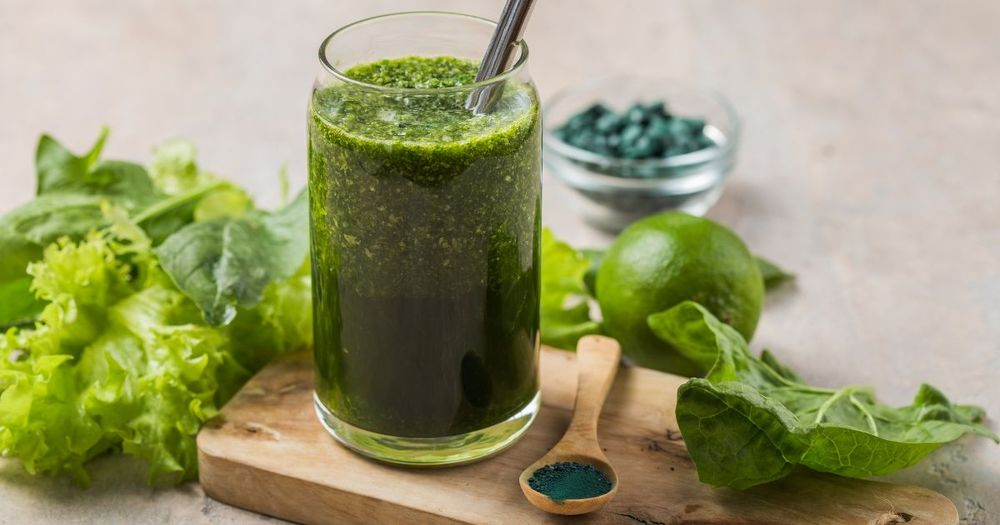
In 1520, one of Cortés' soldiers described the Aztecs harvesting something green from Lake Texcoco and selling it in cakes. They called it tecuitlatl. In 1940, a cake called dihé, eaten by the Kanembu people around Lake Chad, was described in print, and in the 1960s it was confirmed to be the same thing. Both were spirulina. Pond scum, sold by the cake.
After the Second World War, its cousin chlorella was going to feed the world. The Carnegie Institution, the Rockefeller Foundation and Stanford studied it as the protein of the future, cheap, green and endless. Early tests at Stanford suggested it could turn 20% of the sunlight falling on it into a plant that was half protein when dried, and one magazine headline promised "Algae to Feed the Starving". Its real efficiency can reach about 8%, which still beats sugar cane, but only in artificial light or shade. It turned out to be far harder to grow than anyone had hoped, and it ended up where spirulina is now: in tubs and tablets on the health-food shelf, sold for detox, energy and glowing skin. It has even been studied as food for long space flights and missions to Mars.
So here are the eight claims made for spirulina and chlorella, one at a time, and what each is worth.
Two different things in one tub
Spirulina and chlorella sit side by side on the shelf, but they are not even the same kind of life. Spirulina is a cyanobacterium, a bacterium that lives on sunlight, and its family were the first living things known to make oxygen. Chlorella is a genus of single-celled green algae, first described in 1890 by Martinus Beijerinck. What they share is a green colour, a powdery finish and a long list of promises.
1. It is a protein powerhouse
By weight, it is. Dried spirulina is about 57% protein. The catch is the weight. A tablespoon of the powder is about 7 grams, which brings about 4 grams of protein. One egg brings more than 6, and an egg needs no smoothie to hide in.
The claim works on a label. It works less well on a spoon.
2. It is rich in vitamin B12
This is the claim that matters most, because people who eat no meat rely on it. And it is wrong. Why Eating Well Isn't Enough Anymore has the test: when spirulina tablets were analysed, most of what looked like B12 turned out to be a look-alike, pseudovitamin B12, which the human body cannot use. One standard lab test counted the look-alikes as B12 and read six to nine times higher than a second test did.
The food tables agree. Dried spirulina carries no vitamin B12 at all. Cooked beef liver carries about 70 micrograms in every 100 grams. A vegan counting on spirulina can look fine on the label and still run empty. The label says B12. The body disagrees.
3. It gives you energy and iron
Spirulina does carry iron, 28.5 milligrams in every 100 grams of the dried powder, about 2 milligrams in a tablespoon. It is the plant kind. 7 Essential Nutrients Your Brain Craves, linked below, has why that matters: how much iron the body absorbs ranges from about 5% to as much as 35%, depending on the source, and the best-absorbed iron comes from animal foods.
As for energy, a tablespoon of spirulina carries about 20 calories. Whatever lift people feel is not coming from the fuel. It may be coming from the price.
4. It detoxes your body
The original claim was that chlorella binds heavy metals "in the bloodstream" and carries them out. What there is behind it comes from animals. Rats poisoned with an insecticide called chlordecone cleared it faster on chlorella: the time it took for half of it to leave their bodies fell from 40 days to 19. The algae passed through their guts and interrupted the toxin's loop back into the body.
That is a real finding, in rats.
There is one in people too, of a kind. In Bangladesh, 41 people with chronic arsenic poisoning from their well water were all given a filter for clean water, and then either a spirulina extract with zinc or a dummy pill for 16 weeks. On the extract, the arsenic coming out in their urine rose sharply after four weeks, nearly half the arsenic in their hair was gone by the end, and their skin lesions improved. A concentrated extract, with zinc, in people being poisoned. A spoonful in a smoothie is a long way from that. For everyone else, the detoxing is already being done. What a Liver Detox Cannot Do That Your Liver Already Does, linked below, has how the liver and kidneys handle it every day, and why no tub improves on them.
5. It strengthens your immune system
For the immune system, as for everything else, the U.S. National Institutes of Health's verdict covers spirulina as a whole: the evidence is insufficient to recommend it for any human condition. For chlorella, the American Cancer Society says the available evidence does not support its effectiveness for preventing or treating cancer or any other disease in humans.
6. It is good for your heart
This is the one claim with a measurable result. Pooled across seven randomised tests, spirulina lowered total cholesterol, LDL cholesterol and triglycerides, and raised HDL. The tests were few and varied, and blood fats are a sign; a heart attack prevented would be the real test. But the effect was there.
If your triglycerides are high, the faster lever is on your plate. How to Start Taking Care of Yourself Today: Why Your Body Can't Wait has the 43 children with obesity whose sugar was cut from 28% of their calories to 10%: in nine days, their triglycerides fell by 46%.
7. It helps you lose weight
The argument was that spirulina is "low in calories but high in nutrients" and its protein keeps you full. A tablespoon has about 20 calories and 4 grams of protein. That is not enough of anything to fill anyone up. A boiled egg does more. The food that keeps you full for hours is the one with real protein and fat in it, in amounts you can see on a plate.
8. It fixes your gut and gives you glowing skin
The chlorophyll that makes both algae green is said to calm the gut and feed the good bacteria, and the antioxidants to protect the skin and build collagen. Here, too, the National Institutes of Health's verdict holds. And when the European Food Safety Authority looked at one of spirulina's health claims, on blood sugar, it rejected it in 2013.
What else is in the tub
Spirulina is a cyanobacterium, one of the so-called blue-green algae, and some of its relatives make toxins called microcystins. Spirulina does not make them itself, but batches can be contaminated by algae that do, and some supplements have been found to contain them, in one American check at levels below the state's limit. Chronic exposure can damage the liver. In 2016, Health Canada reviewed spirulina products and found varying levels of microcystins in them. That part is not on the front of the tub. A batch that is free of them counts only as "possibly safe"; a contaminated one as "likely unsafe", especially for children.
Like all protein-rich foods, spirulina also carries phenylalanine, so it is not for anyone with phenylketonuria.
The plate that does the job
Everything the tub promises, a plate delivers in amounts you can feel. Cooked beef liver brings 29 grams of protein, 6.5 milligrams of iron, much of it the kind the body absorbs best, and about 70 micrograms of B12 in every 100 grams. Eggs bring protein and real B12. Sardines, such as , bring protein, omega-3 fats and calcium in their soft bones, and a tin of brings iron and B12 together. None of them needs a blender.
The Aztecs ate their spirulina as a food, from their own lake. They were not counting on it for B12.
This week, put liver or sardines on the plate once, and leave the green powder on the shelf.
Tempted by a detox? What a Liver Detox Cannot Do That Your Liver Already Does — what the liver and kidneys already do every day, and what slows them down.
Want the nutrients the tub promises? 7 Essential Nutrients Your Brain Craves (and Where to Find Them) — DHA, choline, B12, iron and iodine, and the foods that carry them.
Know someone with a green smoothie and a tub of spirulina on the counter? Send them this, and a tin of sardines.
Disclaimer: This article is general information. For advice about your own health, talk to a qualified health professional, especially if you are pregnant, have a liver condition or phenylketonuria, or take any medicines.
Affiliate Disclosure: This article contains affiliate links. As an Amazon Associate, All For Life earns from qualifying purchases, at no extra cost to you. We only link to products we would recommend without the commission.
Sources
Wikipedia. Spirulina (dietary supplement). en.wikipedia.org
Wikipedia. Chlorella. en.wikipedia.org
Wikipedia. Cyanobacteria. en.wikipedia.org
U.S. Department of Agriculture. FoodData Central: protein, iron and vitamin B12 per 100 g in dried spirulina (FDC ID 170495), whole egg (171287) and cooked beef liver (168626). fdc.nal.usda.gov
Watanabe F, Katsura H, Takenaka S, et al. (1999). Pseudovitamin B12 Is the Predominant Cobamide of an Algal Health Food, Spirulina Tablets. Journal of Agricultural and Food Chemistry 47(11):4736–4741. doi.org/10.1021/jf990541b
Wikipedia. Human iron metabolism. en.wikipedia.org
Misbahuddin M, Islam AZ, Khandker S, et al. (2006). Efficacy of spirulina extract plus zinc in patients of chronic arsenic poisoning: a randomized placebo-controlled study. Clinical Toxicology 44(2):135–141. doi.org/10.1080/15563650500514400
Serban MC, Sahebkar A, Dragan S, et al. (2016). A systematic review and meta-analysis of the impact of Spirulina supplementation on plasma lipid concentrations. Clinical Nutrition 35(4):842–851. doi.org/10.1016/j.clnu.2015.09.007
Lustig RH, Mulligan K, Noworolski SM, et al. (2016). Isocaloric fructose restriction and metabolic improvement in children with obesity and metabolic syndrome. Obesity 24(2):453–460. doi.org/10.1002/oby.21371